Language Arts Leveled Daily Curriculum LEVEL 3 Product Preview
Sasha shows the Level 3 Language Arts Daily Curriculum for students with autism and special needs. It has nine units covering parts of speech through paragraph writing, with twenty daily activities per unit, pre and post tests, and data sheets to track progress against IEP goals.
Chapters
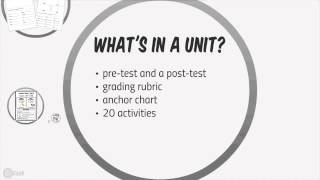
Hi, this is Sasha from theautismhelper.com, and I'm really excited to share with you our Language Arts Level Daily Curriculum Level 3. So the Level Daily Curriculum is an individualized curriculum created specifically for students with autism and special needs. This curriculum really can be utilized with anyone. It's just a great structured and routine way to teach basic academics to more complex academics. There's 3 levels so all types of learners can utilize this curriculum. Level 1 focuses on those basic foundational skills. Level 2 starts to introduce some academics, and what we're going to talk about right now, Level 3, takes everything to the next level and works on those higher cognitive skills and more advanced academic topics. You can buy the levels separately, or you can buy the bundle and save a little money, and for many of us who have multi-level classrooms, have something for everyone in your room. Today we're gonna talk about Level 3, which is the highest and most complex level of the curriculum. So the Daily Levels curriculum is structured, so even with our higher-level learners, they still need that routine and they still need to break these skills into manageable parts. We're looking at harder concepts here, things like synonyms and antonyms and idioms and paragraph writing, so we want to really break down these complex skills into manageable parts. These learners, although are higher functioning, might still need some visuals, and those visuals might be in the forms of textual cues and different types of prompts that are included in this curriculum and in the activities. Like with the other levels, there are embedded assessments, and that— and this curriculum utilizes data-based decision-making. This is huge. There's an awesome grading rubric which I'm going to show you in a few minutes, which will break everything down for you and make taking data and using your data Very easy. So let's check out this Level 3 curriculum. So there's 8 units plus a review unit. The unit curriculum map you can print and hand right to your administrator, and they'll know exactly what you and your students are working on all year. So this level is the highest level, so there's some really complex topics included in here. So we start out with some basic review of parts of speech, noun, verbs, and adjectives, review of sentence rules and edits, and identifying synonyms and antonyms. This quickly picks up to add more complex parts of speech like adverbs, contractions, homonyms and homophones, looking at regular plurals versus irregular plurals. Some kind of complex language topics included are idioms and similes, which are things many of our learners have a really hard time with. Units 4, 5, 6, and 7 focus on the skills related to writing a complete paragraph. So it starts with this introduction into structure, One whole unit focuses on the topic sentence, another unit focuses on the concluding sentence, and another paragraph focuses on those supporting details. So this is going to be a great way to break down the skills of writing a complete paragraph into easy-to-understand parts for your kids. This curriculum also teaches singular and plural possessives and rules related to using a comma, so it identifies some of those more complex academic skills in a functional and meaningful way. Within one unit, remember there's 8 units, there's a lot of stuff included in each unit. There's a pretest and posttest which will give us that great baseline assessment of what the student knows before you do any teaching. And then the posttest is the exciting part. We're gonna see how much growth your student has had after you've done all the hard work of teaching the skills. Next is a grading rubric which I talked about earlier. This is a great way to identify the errors your student has and use that to plan future instruction. Each unit has a visual colored anchor chart which is going to highlight those focus topics for the unit and 20 activities. So the idea is that you can do one activity every day of the month and this unit will take one month. There's 8 units plus a review unit, so your language arts curriculum is planned for the entire year, which is amazing. I am beyond out of my mind excited about that. So let's check out a little more into these activities. So the pretest and the posttest, like I said, will give you that baseline assessment and then also give you that— the data of what they've learned throughout the unit. So you'll know exactly what you've taught and what your hard work has paid off on. So this is the exciting part. So the grading rubric has a few important components. First, it's going to teach you how to exactly grade the pretest and posttest. There's pretty specific directions on how you're going to score each one to get a number score. For both the pre-test and the post-test. You'll get a total incorrect and a total correct, and you can even figure out the percentage. As many of us has— have IEP goals related to percentage, this will be perfect for tracking IEP goals. Next, you're gonna— this part is going to help you analyze your errors. So this is where we talked about that data-based decision making. We so often take all this data and then don't use it. Well, this is going to show you exactly how to use the data from the post-test to show what your student still needs to work on. So this guide will guide your different error— the different errors student has will tell you exactly what concepts they're weak on and give you suggested activities for future instruction. So you're going to be using your data to plan future curriculum decisions. Administrators and principals will be wowed by this, and this will make your instructions so much more meaningful. You won't waste any time with your kids. They'll only be working on what they need to work on. So like I said, each unit contains an anchor chart. These are the only things that are in color in the unit, so your printers can thank me. The rest of the activities are black and white. I highly suggest posting this in the front of your room, giving this for student binders. You can project it on a Smartboard or an iPad. This will highlight the key focus topics for the unit and is a great way for your students to problem solve and figure out their own answers instead of always asking you for help. They can reference these anchor charts. So here's an example of a few of the different anchor charts. They still have visuals to highlight these more complex topics for our students. The paragraph one is great to show the different color coding cues. Even those type of visuals can be really helpful to our learners. So the 20 activities, like I said, are all black and white. Each unit has 20 activities. You can do one each day of the week and have enough for the entire year. The units— each unit focuses on those focus skills from the curriculum math, but they also tie in some activities from previous units. So maybe in Unit 5 you might see an activity from Unit 2 or 3. This will be great to ensure that your students still have those previously mastered skills in their repertoire. They haven't forgotten about anything. So it's kind of always looping back to the things we've taught about— taught before and building, building, building. So your students will never forget. So this unit is for students that have mastered basic academics. This is great for students who struggle with complex language. The English language is tricky. Homonyms, homophones, similes, idioms— our very concrete kiddos cannot understand this without direct instruction. So this will target those skills perfectly, and this is great for early and middle childhood. So you might be thinking, this— a lot of these concepts look great, but these might still be a little too advanced for your kids. So if these are the topics you want to work on, you can still adapt this by adding in some different prompts. You can add in some writing prompts or response options. You can really rely on those anchor charts for matching tasks. Instead of students creating their own list of homonyms, you can prompt them to reference the anchor chart on a regular basis and problem solve, and soon they'll be able to do that on their own. And although this— the units are designed to use one month at a time, you can for sure work on them more slowly and lengthen them out to take 2 or 3 months and to ensure that the skill is mastered. So let's check out what else is included in this unit. You have a grading data sheet that will guide those pre-test and post-test scorings. This is gonna be the place where you're gonna be so proud of you and your student to see all the growth they've had on the pre- and post-test scores. You also have a data sheet that you'll use on a daily basis for each activity. So you can track the exact activity page you're working on, number correct and incorrect, and how many prompts to see exactly how your student is doing throughout the length of the unit. There's also 2 different lesson plan templates included. Many schools are required to submit lesson plans, so this curriculum can align perfectly with your school's requirements. So thank you so much for checking out our Level 3 Language Arts Daily Curriculum. I encourage you to check out Level 1 and 2, and if you're considering having— buying more than one, get the bundle and save the money. This will be a great way to target all of the learners in your class in a way that is focused and structured. Again, this curriculum is— will have your language arts planned for the entire year. I can't say how excited and how much that eases my anxiety as a teacher. Been working on this for months, and I am so excited to share with you. Math is on the way, so be on the lookout for the math curriculum coming as well.










