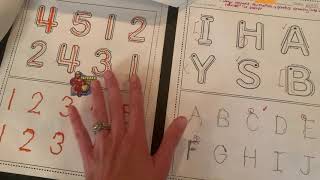
Gina from The Autism Helper walks through Level 0.5 math and language arts curricula, showing how built-in rubrics reveal skill gaps like shape identification and letter tracing. Data showed students made far more errors when dotted guides were removed, proving the value of scaffolded practice before independent work.
Chapters
Hi everyone, this is Gina from The Autism Helper. I wanted to show you some of my favorite parts of the Level 0.5 curriculums that Sasha's made for both math and language arts. She has them in other levels, but this is, like I said, 0.5. They all come with this grading and rubric sheet no matter what level you get, and it's one of my favorite, favorite parts because not only do you get to collect your data, but she has a part on here about analyzing your data. So after you actually grade it and collect it, you look to see if there's an area that has maybe more errors. So obviously, um, the Section 3 has the most errors. So I went down here and I was able to find out exactly what I need to work on with this student. So we're going to work on reinforcing shapes, and it makes sense because he was only able to expressively identify one. Um, on the language arts, um, prompt sheet, I found out that the student needs work on tracing uppercase letters. I also thought it was kind of interesting that that in the math section, the numbers on this specific pretest has the dots inside of it, and he did pretty well on this. But when those dots are taken away and it's just a line, an empty space, there were a lot more errors. And of course, these are letters versus number, but we're, again, we're into the tracing realm, so it does, you know, allow you to go even farther into analyzing the data. So this student can do a great job with, you know, the whole physical prompt tracing, and then it gets a little bit hairier the bigger they are. And then when you take away that dotted line in the middle, it's really difficult for the student at this time. So that's something that we can continue working on. And of course, the whole curriculum builds and scaffolds up to these skills. So by the time that we're done this unit, we should see probably some really amazing progress. So that's one of my favorite parts. And also, this is a great way if you're working with your admin or supervisors— of course they want you doing grade level. These are all connected to grade curriculums or scaffolding, and then you can really go dive deep with your admin and show them how you know, you know, about your data and where to go next and differentiating instruction. So check out these curriculums if you haven't already.