Leveling Up Matching Activities - Back to School Tips
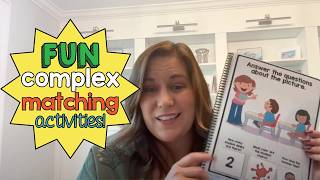
Jen, an autism teacher, introduces Complex Matching Weekly Workbooks for students ready to move beyond basic matching. The books add multi-step tasks like sorting by size, CVC word onsets, and simple addition, with removable pieces so teachers can adjust difficulty for each student.
Chapters
Let's talk about moving students beyond simple, errorless, and matching tasks. I'm Jen, and I am a former K-12 self-contained autism teacher. Your job, if it was anything like mine, is hard, and oftentimes we have students who come to us who don't know how to learn or function in the school setting yet. I saw this all the time as a kindergarten teacher. My students would come to me and they had some great skill, but they didn't know how to complete a task or do it independently. Enter Easy Matching Weekly Workbooks. Now, if you have followed my classroom for a long time on this channel, you know that I love these things. I use them all of the time. And in fact, when students can complete this and do these tasks, I move it, and they're mastered, I move it into independent work because this is just one of those tools that you can use in so many different ways. And these really became a, like a foundation, a cornerstone in my classroom for building independence and task initiation. Now, I have students who have moved past Errorless Matching, and I need something a little bit harder for them. So last time I got to show you our brand new Intermediate Matching Weekly Workbooks, and today I get to show you for the very first time our Complex Matching Weekly Workbooks. These are done in a familiar format. They still work on things like task initiation, but what we are doing is we're building the complexity of the skill all the way from easy matching and errorless tasks to building basic skills to expanding on basic skills. Let me show you the inside. This is the very first Complex Matching Weekly Workbook out, and it is themed, and it matches the Intermediate and the Easy Matching Weekly Workbooks. Today we are just going to focus on the Complex, and I'm going to give you a good view of everything on the inside and some of the skills that the Complex Matching Weekly Workbooks covered. You can see that the tasks here are a little bit more complex. Here, what we're doing is we're following multiple-step directions. So we have a blue tray, a red tray, and a green tray, and we are giving the students directions to follow on each tray. Here we're sorting not just by big and little, but large, medium, and small. Here we are finding the beginning of a CVC word. You'll notice they're all school-themed. I have these all done so you can see what they look like, but I just put Velcro on the left so students can and move it to the right and complete the answer. Here we are sorting, classifying. We've got books about animals and books about vehicles. The students will use the picture to be able to identify where they go. And I really love this task. We are looking at the picture and then we are answering questions. And you can see the answers are not written. So there's not a lot of language that needs to be done here. We don't have to have a lot of reading skill, but what are the kids eating? How do the kids feel? And how many lunchboxes are there? So once they are given this, if they're not readers, we can ask them the question, they can independently answer based off of the picture. Then we are going to sort some more things, things that we read, things that we draw with, and things that we carry. And then we're gonna pair the items. You can see now we're pairing, we are not necessarily matching. You know, matching in the intermediate books, we matched non-identical items. So if this was the intermediate book, this would be a pencil and this would also be a pencil, but in a different color or size. Here, we're looking for the items that go together. We are just stepping up and building on that skill. So for instance, we've got a book for the backpack, we've got paint for the paint splash, headphones, with the iPad. These are great ways to expand on those basic skills of matching. Let's take a look at Tuesday's book because honestly they are all so good. Um, I'm just going to show you a little bit of this one so you can see some of the different skills. Um, every book has 7 activity pages, um, and what I love is that you can make it really what your students need. So I talked about this a little bit with the intermediate books, but one of the things that the intermediate and the complex books offer are extra pieces. You can see here I've made the number sentence. I counted the bears, I put the number, and then I answered the number sentence. But I have extra pieces. If I had a student who was just moving into this level, I wouldn't offer the extra pieces. I would take those off, I would put them in a baggie, I'd put them in my desk drawer. And I'd leave them be until the student was ready for more of a challenge. So what we've really done in these books is we've tried to make them more adaptable for exactly where your students are, because we know there isn't— not a one-size-fits-all when it comes to a product. So we wanted to make this as adaptable and differentiated as possible for your students. Um, here we are matching the written number to the number Look at our complex patterns. We're looking at all kinds of patterning here, and again, we have extra pieces. Matching the markers. Here we are answering questions about a picture, and again, there's very little text down here. And then counting up to 20. We will do simple addition up to 20 as well, and counting up to 20. And then we're sorting playground and classroom. Here's another one of my favorite tasks. This one is in the— I think it is the Wednesday book. I love that we're matching chairs. These are so realistic to what students actually do. We've got a name tag there, we're going to push the chair in that matches. And here we're going to be able to match the name to the name. Um, this one, I love this one. We are reading the name on the door and then matching the correct teacher to the classroom. Um, oh, I got Monday in here. Let's take a look at the schedule, reading a schedule. So there's picture prompts to be able to help students read the schedule, and then they're going to answer what's first, what's before lunch, what's after math. You could really use this and expand on this. If your student has mastered this, you can come up with your own questions here, and you've got all of the prompts to be able to have them answer. This is so adaptable for those students who are working their way towards mastering and expanding those basic skills, but they need to be able to do it and have adaptable pieces to be able to support them, visuals to be able to support them. Also, this is done in a really familiar way. If you are somebody who has used our Easy Matching Weekly Workbooks, you know this is a very similar setup. This is what an Easy Matching Weekly Workbook looks like. This is so similar in setup. So when you give them something that looks similar, it's going to be received a little bit better than if it was a brand new task. They're going to have an idea of what to do, which is going to help with that task initiation. And honestly, your students are going to love these because they're so engaging, they're so bright, they're so fun. I really love it. This one, you put the backpacks in the lockers that match They are just a blast to complete. You know, these are not just for classroom teachers. These would be perfect for homeschooling families, clinicians. My SLP would regularly grab these off the shelf and have instant language prompts at her fingertips. In fact, like, let's just open a page and let's take a look at what we think. Okay, so here is the picture. We could ask a million pictures and get so much language and build so much language and model so much language just from this page. So I want you to think beyond just the task. I want you to think of different ways that you can use this. In fact, we have blog post upon blog post about the different ways you can use this. One thing I really wished I had in the classroom was a way to differentiate the Easy Matching Weekly Workbook and make it more complex for my learners who needed a challenge, but keep that consistency and routine going that they have in this weekly workbook. They knew every Monday to go get their red book, and they knew every Tuesday to go get their yellow book. And so that's just something that I wanted to remain with, but I didn't have the tools to do it. And now we do with the Complex and the Intermediate, and I am so excited for you guys to dig into these. If you have any questions, definitely let me know in the comments, and I will get back to you on those. But I think that this is going to be a product that honestly is a showstopper in your classroom. If you are looking for independent work, if you are looking for ways to build that task if you are looking for ways to build upon basic skills in a familiar way, this is the product for you.










