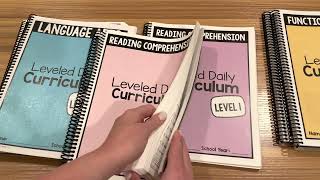
The Autism Helper curriculum has three literacy strands: Language Arts covers grammar and phonics across six levels, Reading Comprehension adds Lexile-graded passages in levels 2-4, and Functional Literacy uses real-world texts like menus and weather forecasts. They work together or separately, with matching levels across strands.
Chapters
Let's go over the difference between Language Arts, Reading Comprehension, and Functional Literacy in the Autism Helper curriculum. None of the content in any 3 of these subjects is redundant. It all streamlines nicely, so if you're working on Level 3 in Language Arts, you'll work on Level 3 in Functional Literacy. It will really expand and extend on the skills, so you can definitely use all 3 or just 1 or 2. So let's talk about the difference. So first up, we have Language Arts. This is our core language arts curriculum. It's going to include grammar, writing, phonics, sight words, all that great stuff. Um, so it's going to increase in level from difficulty. We have the most levels in language arts. We have 0.5, which requires no writing, 1, level 1, which requires no writing, level 1.5, which requires no writing, and then level 2, 3, and 4. So here's 4, our most difficult level, and then here is 1.5, which expands on the skills in level 1 but with minimal writing. So all tracing, circling, or simple fill-ins. So that's language arts. You're gonna include writing. There is some reading comprehension here because reading comprehension is tied into almost everything we do with language arts. I highly recommend if you are just using language arts to really consider adding in the reading comprehension. If you took my Roadmap to Reading course, you know how passionate I am about reading comprehension. That is the point of reading. The reading comprehension comes in level 1, 1.5, 2, 3, and 4. Everything in reading comprehension is professionally leveled by Lexile. This is gonna include phonics instruction, fluency fluency, vocabulary, sight words, all kinds of key skills related to reading comprehension. What to me is a game changer about this is that all of the passages— look at this— there's a passage on every single page in levels 2, 3, and 4. They are all professionally leveled by Lexile. On the curriculum map, it tells you exactly what level it is, so you can then extend and expand and do book groups, guided reading in your classroom. So this is what the most difficult level looks like. And then Level 1 is no writing, it's working on basic phonemic awareness and sight word identification. So we're not to passages yet, we're building up those precursor skills. So here is Level 1. And then we have our functional subject. So our functional subject is going to extend on language arts and reading comprehension skills using real-world-based texts. So things like the weather forecast, mail, signs that we see, All of the vocabulary is gonna be super functional, things that we need in the real world. All of these skills, whether it's something like sequencing, we're gonna be sequencing steps to an everyday routine or filling in a to-do list. So it's all gonna be things that are really relevant to things you and I do on a daily basis. Coupons, menus, all real-world text, real-world concepts. And here's what Functional Literacy Level 1 looks like. Again, those amazing real-world texts. We're building that phonemic awareness, we're building all of these essential skills. Minimal writing— we do have a non-writer version included if your student is not yet writing, so they will trace in these spots. And this will build these same skills in this really functional way with those real-world texts.