Sasha shows ten math centers that fit in single binders for early childhood and special education classrooms. Each covers one skill: money, patterns, measurement, fractions, clock reading, and more. Students pick centers from a visual schedule with clothespins, and each binder has differentiated activities for different levels.
Chapters
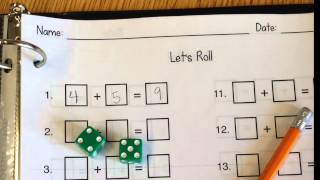
Hi, this is Sasha from TheAutismHelper.com, and today I want to share a video tutorial of my math centers for early childhood and special education. So the math centers go— fit into 10 binders, so as you can see, it really doesn't take up a lot of room. This is the entire chunk of the centers. They'll really just have to shelf. Each center goes in one binder, so I'll show you in a minute what's exactly included into each center. Here's the little mini schedule, so I like to use clothespins and students can find the one with their name. And pick which center they want to work on and grab it. So it's all color-coded and visual, so for your kids with special needs, it'll be really easy for them to select which center to work on to utilize this color coding. Um, so each binder works on a different type of math skill, and it really ranges from all types of math skills including time, money, operations, fractions. So I really wanted to include the gamut in here to get a little bit of everything. All of them can be differentiated for your lower-level learners and your higher-level learners in one center. So this first center, Money Mania, works on identifying if you have enough or not enough money, which is a really great skill for a lot of our kids to work on. So there's two sets of flashcards. Student pick one of each, a money card and a price card, and they have to answer the questions determining if they have enough money to buy it and if they need to make change. The next is a pattern center, so students are going to follow the visual directions and pick a pattern flashcard and and then draw the corresponding pattern on the worksheet. Next is Find and Measure, which is a really great center. So students are gonna have to find different objects around the classroom, write the object down, and write down the length in inches. So this will really get them involved in the room and up and moving, which is a really fun thing to do. The next center is Math Boggle, which I love. There's 2 levels included. There's a board with 9 and a board with 16. So you can differentiate this for your different learners. So students will copy the numbers onto the worksheet and identify number sentences. Next is Let's Roll. Students can roll 2 dice, write down the numbers, and add them up. You can use dice, traditional dice like shown here, or dice with numbers to make it a little bit easier. Next, the next centerpiece of pizza works on fractions. So students will write different fractions on the worksheet and then cut up their pizza and color it according to the fraction. The first one's done to give an example. Next is working on heavy and light and comparing objects, which I love this center. Students are going to pick a flashcard of a common object and they're going to have to write something lighter and something heavier than each object. You could store all flashcards in a pencil case like I have here. Next is true and false. This is great to work on our basic number operations. This includes both addition and subtraction. You could take one out if you want to make it easier for one specific learner. Students are going to sort fractions based on them being true or false. They'll pull different cards. The next center works on time. Students are going to pull 10 flashcards. There are both flashcards with the clocks and flashcards with the time, and they're gonna have to draw the time in. An anchor chart is included on that worksheet. The next is Math Path. This is a puzzle one, and I love this one. I was really excited to make it. Students are going to pick the corresponding puzzle and and put it in order from start to finish. So they'll follow the prompts in the puzzle to put the whole thing in order, and then they'll copy it down on the worksheet. So it's great for following directions. So here's the set of all the centers together. Again, it really doesn't take up a lot of room. Here's another picture of the mini schedule so students can select the schedule center. Each one comes with the Math Center rules and the So You Think You're Done, which I put in the front and back of each center. Center as prompts. So this was a video tutorial of math centers by theautismhelper.com.