Sasha from theautismhelper.com previews Math Level 0.5, a curriculum for learners needing very basic math. Each concept spreads across two units with daily pages pairing tracing and matching tasks. Five versions of each page vary colors and positions to prevent memorization while building one-to-one correspondence skills.
Chapters
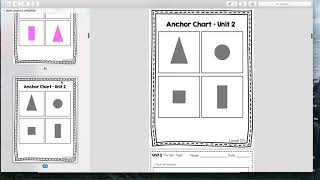
Hi, this is Sasha from theautismhelper.com, and this is a product preview of my math level daily curriculum level 0.5. So if you're familiar with the other levels of math or any of the other curriculum, this is set up in the same way, obviously with much more basic content and concepts included. This is not included in the bundle. Bundles are just levels 1, 2, and 3. Any easier levels like this level 0.5 or the harder levels, level 4, is separate. I had a lot of requests for content that was easier that was— had larger text, larger, less writing involved. So I was really excited to make this. I spent a lot of time conceptualizing what this looks like for this type of learner for both language arts and math. So here's the curriculum map. As a little bit different than the other levels, each concept is worked on for 2 units in Level 0.5. So we have 2 units to practice identifying shapes, tracing 1 through 5, tracing 6 through 9, just to give that extra repetition and extra practice. To kind of really solidify those skills. The data sheet also looks a little bit different. There's a spot for the page, and then each activity page has basically 2 activities: one type of tracing and then one type of matching. So there's an opportunity to put your data in there, and then there's a spot for the vocabulary and counting data. You can do receptive language or expressive language, so students who are nonverbal can still work on these skills. Here's where you'll collect all of this data right here. This data is also going to go on the student activity page, which I'll I'll show in a moment. There's pretty detailed instructions of how to set this up. There's some things that are included in here that might not make sense right away, like why I included 5 versions of different pages, but I really wanted to ensure that we are building in generalization, students aren't memorizing anything, and that everything's tied right in data collection, everything like that. Unit 1 looks at identifying shapes. There are 5 different versions of shape vocabulary pages. I recommend it as in these, in in these directions to put them all in one page protector and then switch them out each day. Because you don't want a student to memorize that one, a circle is only blue, a circle can be a different color, or that the circle is always the one in this upper corner, or that the triangle is always the one in the lower corner. So mixing up the locations and colors of the shapes will really help build in generalization. Here's the pre-test and the post-test and then the rubric. So for the vocabulary identification, every activity page will have a tracing and a matching activity. Plus here's this section for data at the bottom. So you can circle, like, let's say I'm gonna do expressive language, I'm gonna do 10 trials, then I can tally how many correct or incorrect based on using these vocabulary pages above. So each unit follows that structure. So Unit 2 works on a lot of these same, we're doing different types of shapes here, still matching shapes, tracing 1 through 5. Unit 3 starts into counting. So we're looking at counting 1 through 3, There's 5 different versions of this counting page. So again, we're not memorizing. And you can also use this with receptive language. That would be, show me the one that has— group that has 2. Show me where there's 1. Show me where there's 3. Or work on counting, like, okay, how many are in this group? And having students count 1, 2, or 1, 2, 3. So the pretest, posttest, rubric, grading sheet, we're looking at matching non-identical shapes and increasing the numbers that we are tracing. And as you go through the units, Some of the tracing gets a little bit smaller. It still stays pretty big because these are typically going to be students that struggle with those fine motor skills. So we want to give a lot of opportunity and practice. So the counting builds very slowly, which I love. So now we're counting groups 1 through 4. So same setup, same rubric, same opportunity for data right on the bottom here. All ready to go, tracing 1 through 9. And this is matching quantities. I love the matching quantities. This is such an important precursor to counting and kind of more complex matching. So it's matching the same quantity. So 1 and 1, 2 and 2, 3 and 3. Purposefully using the same sets of items so we're not just matching items, but you have to match the group that looks the same. And I'll show you how this gets a little bit harder in the next unit. So we're still match— counting quantities 1 through 4 and matching quantities 1 through 3. So here in Unit 6, it gets a little bit trickier because the positions of the items change. So as you may have noticed in that previous unit, the position was the same. So if it was 2 books on top of each other, we're matching to 2 books on top of each other. Now in this unit, we're getting a little bit harder, but doing it really gradually. Now the books are next to each other, or the 3 is all on top versus like this, or matching 2 like that. So the goal here here is identifying that one-to-one correspondence and finding groups of items that have the same quantity. So a really, really important skill. Now we're on to Counting 1-5 and Matching Numbers. So we are matching numbers 1 through 5 in this unit, um, going through all the activities here, um, tracing, um, 2 types of matching. Now we're on to Counting 1-5, our second unit. Again, matching numbers and matching quantities, 1 through 4, 1 through 5, but again with that different kind of position as well. So all through here, and then there is that final review unit just like the other ones that has mishmash of everything. I love this for summer school, I love this for review, homework, etc. So this was the long version of Math Level 0.5. If you are unfamiliar with the Level Daily curriculum, it's designed to last a whole year, one page a day. There are 8 units plus the 9th review unit, everything ready to go. I have lots of videos on how to set this up and suggestions, and hope this is helpful for your most basic level learners.