Math Leveled Daily Curriculum LEVEL 1 Product Preview
Sasha shows the Level 1 Math Leveled Daily Curriculum, a visual math program for students with autism and special needs. It has eight units covering number identification, counting, patterns, and coins, each with twenty activities, pre- and post-tests, and a grading rubric tied to IEP goals. Materials are mostly black-and-white worksheets with minimal writing, plus color anchor charts for visual matching.
Chapters
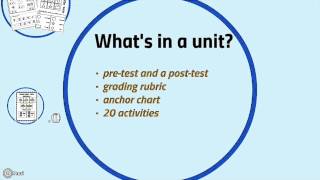
Hi, this is Sasha from theautismhelper.com, and this is a product preview of my math level daily curriculum, Level 1. So the level daily curriculum is an individualized curriculum created specifically for students with autism and special needs. This curriculum can be utilized by any kids, but the amount of structure and visuals make it— makes it especially effective for our learners who are— have the most challenges. So there's 3 different levels included. Level 1 is the lowest level that works on foundational math skills. Level 2 makes it a little more complicated and brings in some of our number operations. And Level 3 is our hardest level that's the most complex. So you can purchase these levels separately or you can buy them as a bundle. Many of us work in multi-level classrooms. I always joke when I go to the photocopy, I have preschool work and 6th grade work in the same pile because my kids are all different levels. So the bundle gives you the opportunity to have a leveled math curriculum for all of your learners, which can be super convenient. Today we're going to talk about Level 1, the foundational level. So this level daily curriculum is structured. There's going to be 9 different units. Each unit is set up the same way. The units break down each skill into manageable parts, so especially with our lowest level learners in Level 1, we're going to work on these skills very slowly and build to the higher level skill. A lot of the activities are visually based. Visuals can be really effective for our learners and help them understand the skill more quickly. This curriculum has embedded assessments and utilizes database decision-making. So you're gonna use all of that data you're taking to decide where to go next with your students. So this is gonna really wow your administrators. This has a great grading rubric and a really easy-to-use data system, which is really half the battle with a lot of curriculum options. So Level 1, there's 8 different units plus a review unit. The 8 units focus on different foundational skills. So we start with really basic concepts like number identification and counting 1 through 5, shapes. We move on to counting with numbers 6 through 10. Unit 2 works on identifying only items that are big. Unit 3 works on identifying only items that are little. And then in Unit 4, we make it more tricky by looking at big and little together. Which is when a lot of our kids can really struggle with that discrimination option. This unit works on basic patterns. This— then in Units 5, 6, 7, and 8, we kind of break down the process of the different coins. So Unit 5 works on just pennies. Unit 6 builds on that by adding in nickels. Unit 7 works on penny, nickel, and dime. Unit 8 works on penny, nickel, dime, and quarter. So this is identifying the names of the coins and the amounts. So there's a lot of different math skills included in this. More and less is also included, and identifying number words. So a lot of these activities can be done with both your learners who are verbal and nonverbal using receptive language tasks, and we'll talk about that in a minute. So there's 8 different units. In each unit, there's a pretest and a posttest, a grading rubric, an anchor chart, and 20 different activities. So the 8 different units plus the anchor chart, plus, plus the review unit has 20 activities in each. Ideally, you could do 1 unit a month and this curriculum would last the entire year, which is amazing. That means your math curriculum is done, your math planning is completely finished for the entire school year. This makes my stress level so much lower knowing that all of my math instruction is done and ready to go. You can also make this take longer. Many of us have students for several years. Especially in this Level 1 unit, a lot of our learners might need more time than just 1 month. So you can repeat the activities, you can do several activities every other day and make each unit take several months and make this curriculum span out the time over a few years. So there's a lot of options on how you can individualize this curriculum. So the pretest and the posttest that is going to be done before you've done any instruction and then after you've completed your instruction. So you're gonna get that great baseline score to see where your student's at and then you can compare and compare it with what they've done when they're finished. So you're gonna really see all the great growth that your students have and you're gonna feel like such a proud teacher. The grading rubric is where this curriculum really shines and this is going to make my life so much easier. So the grading rubric is going to align with the pretest and posttest. It's gonna show you exactly how to score this so you'll get a numerical grading value for each pretest or posttest. So it's gonna give very specific instructions for the grading. You'll get a total correct, a total incorrect, and even be able to determine a percentage. Many of us have IEP goals that are written as percentage, so this will really help with IEP goal tracking. This is where things get cool. So once you do the post-test, you're going to be able to analyze your students' errors to see where they still need work. Not all students will have everything mastered at that post-test. They might need additional practice, and instead of practicing all of the concepts from each unit, you can really focus on those the exact skills that they're missing based on this tool. So it's gonna tell you based on the student errors exactly what they need more practice on and also give some suggested activities for that. So there's 8 different anchor charts. The anchor charts are the only things in the unit that are color, so those will be great to print and put in your students' binders, post in the front of their room, put in their work area. So these are color-based, the rest is black and white, so your printers can thank me. So this is the only thing that's color. For each unit, I would recommend posting these in the front of the room. People have done really cool things putting them on Smart Boards or displaying it on your iPad. So there are a lot of different options. The anchor charts are going to be great as really a matching tool, especially in this level. Some of these skills might be a little too hard for your kids. It's going to be really pushing them and making things more complex. Well, they might not know that the word circle is spelled like the word circle, but you can utilize this anchor chart so they can match. They can identify the circle on their page, match it to the anchor chart, and match the corresponding word. So here's an example of a few of the different anchor charts included in our unit. So now each unit has 20 different activities. Like I said, all the activities are black and white. They're very visually based. There's not a ton of writing. We'll talk about in a minute how to adapt this for non-writers. But they're very visually based and kind of continue to reiterate those previously mastered skills. That's something that's really important to me. Once we work on something in October, I still want to make sure my students still getting exposure to that skill come January. So each unit focuses on those new topics but also pulls in some of those previously mastered topics. So in Unit 5, you'll see some Unit 1 or 2 activities pop in to make sure that your students still has those skills mastered. So as you can see, there's not a ton of writing. It's a lot of circling, a lot of coloring, a lot of tracing, and a lot of matching. So this will be great for your students who have emerging writing skills. So like I said, this unit is for— is great for students who need to work on foundational skills, students with limited verbal skills, or students who are nonverbal. This unit can definitely be completed with students who are nonverbal. This, this curriculum can also be completed by students with limited writing skills. There's a lot of matching and coloring and circling in this unit, so your students that really struggle to write will benefit from this type of approach. This unit is also great for early childhood since it focuses on those foundational skills. So you might think, okay, this unit's great, but it's a little bit too challenging for our kids. But even the idea of our Level 1 learners can be really, really wide. So how can you adapt this? One thing you can do is you can break this down and work on this much more slowly. Have each unit take several months. Repeat the activities. The activities are all very different within each unit, so photocopy it 3 times and have them do each worksheet 3 times. You can add in different prompts and so they can circle the right answer. For the spaces that there is writing, you can go ahead and highlight the words or the answers and have the students trace. And really rely on that anchor chart for matching tasks because that's gonna really help them aid in their learning. So what else is included in this unit? So we also have a unit grading data sheet. This is gonna really guide the progress of the curriculum. You'll put in your pretest and your posttest score and get to show all that great growth throughout the year. This will be the data sheet that guides your instruction each day. So for each unit, you'll use one of these data sheets, put down the date, to the activity page, and you can track how many correct, incorrect, or how many prompts they needed. Many schools require lesson plans, so this curriculum also aligns with those type of requirements. There's 2 lesson plan templates included, one for a whole class lesson plan and one for a whole class weekly lesson plan. So you can kind of plan ahead on what exactly each of your students is going to be working on in a really organized and easy-to-use way. So again, this was a product preview of our math level daily curriculum, Level 1. I encourage you to check out the language arts curriculum if you haven't done so, so yet, and also check out the Level 2 and 3. If you have a multi-level class, it really makes the most sense to get the bundle because you'll save a little bit of money and you'll be ready for any type of learner that shows up in your classroom. If you have any questions, please contact me at theautismhelper.com.










