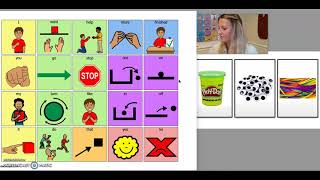
Gina from The Autism Helper pairs Sarah's adapted book "What's Scaring You?" with core language boards to teach the preposition "on." Students make Play-Doh monsters with pipe-cleaner legs and googly eyes while teachers model the word "on" on the board, targeting language, directions, and social skills.
Chapters
Hi everyone, this is Gina from The Autism Helper. I'm here to show you a really fun activity that you can pair with one of Sarah's adapted books, What's Scaring You? I love this book. There are so many amazing things that these adapted books work on. If you haven't seen them before or if you're new to The Autism Helper, Sarah has a whole bunch of these. Um, but what I love about it is that it works on following directions, prepositions in this, in this specific book, the word "on." It has labeling. You can do expressive, receptive language, print tracking, so many awesome things with these adaptive books. But I also wanted to show you how to use this book with our new core boards that we have finally developed together because I know you've all been asking about them. They come in— this is the Midcell board on my screen. It comes in different versions with male, female, adult, child, adult, child, and so on. And then it comes in the low-tech board, just meaning it has less symbols on it, the medium board, which you see on my screen, and then a high-cell board, which has 56 cells on it. So you can really go in any direction based on what your skills, um, your kids need in your classroom. You can also always just use one symbol, and you could just cut out the word "on" or just blow up the word "on" and make it bigger if you just want to focus on that core word. But using these core words is going to be really helpful because today we're going to make a fun little monster spider with the book. So after you finish reading the book and you're emphasizing the word "on" because you're going to put on these cute little ghosts in the back on to the specific item that it labels. So an example, this one, you're putting the ghost on the haunted house. So I like to follow up after I read a type of adaptive book with an activity that correlates with that. So using the core word "on" is how we are going to make our little Play-Doh monster balls. So what you need is some Play-Doh or any type of dough. You can even make your own. You can make a pumpkin flavor, whatever you want to do. Some pipe cleaners that you can either pre-cut into little strips or your students can cut them depending on where they are with their scissor skills. And then of course super fun googly eyes. You can get these at the Dollar Tree. You can get a whole bunch of them for just like a dollar. So, really easy, inexpensive activity that can go along. So, what you want to do is after you read your story and you're emphasizing the word "on" and you're modeling the word "on," I'm just going to show you up here on my screen. I would start with saying, "Okay, like, let's get out our materials. We have our Play-Doh, our googly eyes, and our pipe cleaners." I just took these images right off the internet. I will upload this. We call this the fringe board. Over here for you, but you can make it as easily as using pictures with what you have in the classroom or just go on the internet and just pop those up there on a PowerPoint. So you want to take your Play-Doh, and it depends on what words you're targeting. I'm definitely going to be working on the word "on," but I can also still model other words while I'm doing this activity. So maybe I hand them the Play-Doh with the lid on it and they need some help getting it out. "Oh, do you need some help?" And I would point to the word "help." "Take it out. Take the Play-Doh out. Out." And I would model. I wouldn't give the students all the materials in the very beginning. I would have control over everything but what they're currently working on. That way you can really have them use the core language board. Again, you're not going to force them to touch the word or say the word. You're just modeling in this activity. If they say it or point to it, that's wonderful. Again, just modeling the language. So, we're going to take the Play-Doh out, and then you can show them how— and they might want to play with it for a few minutes. I mean, you know, kids want to explore Play-Doh. And then show them how to roll it into a ball. If I was working on a table, I would be showing them how to roll it on the table. And then you can say, "Hmm, I want some eyes or legs. I want some pipe cleaners. I want some legs." And so maybe you're pointing to the word "want" and "legs," and then you hand them a little leg and you can show them, model it, how to stick it on. It doesn't matter where it goes, how it goes, if they want to bend it, if this is the top, if this is the bottom, it's whatever. It is their art, their scary little monster. And then you can hold up the pipe cleaners again, like up to your eyes so that they're looking at you, and maybe they reach for it. "Oh, you want some more?" "More pipe cleaners. Put it on." I'm putting it on, and I would be touching the word "on" as I'm putting it on and then hand them the pipe cleaner. And then next, maybe you're, "Let's put on some eyes, googly eyes." On, on, and I would touch the board. So, you're just modeling the word every time that you're doing the action or whatever it is that you're putting on, or if you need help, or if it's your turn. Also, with the rolling of the Play-Doh in the beginning, you can work on "go" and "stop" and make it a really fun activity as well. And so you're just going to keep doing that. They can put on as many eyes as they want, as they request, or that you want them to have. They can have a ton of different legs, and it's just a really fun way to follow up with a book that you were working on the preposition "on" and all the print skills that go into the book. So I hope you enjoyed that fun little fall activity, and let me know if you try this with your students.