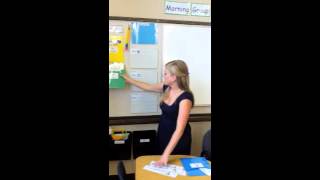
The video walks through the physical layout and instructional materials used at a morning group station in an autism classroom. The presenter describes a table divided into sections for calendar, weather, and social activities, highlighting visual supports such as a monthly calendar, temperature charts, and weather symbols that help non‑verbal or lower‑verbal students participate in daily routines. Social interaction tools include Velcro‑mounted question cards (personal information, preferences, lunch guesses) and greeting cards with pictures for students who cannot speak. A journal area breaks down WH‑questions (who, what, where) with movable visual pieces to teach sentence structure. Intraverbal prompts derived from the ABLES assessment are displayed to practice common conversational exchanges. Adjacent to the table is a kitchen area equipped with fridges, a microwave, a hot plate, and a toaster oven, organized with labeled containers to support community‑based instruction and functional life‑skill teaching during cooking activities. Throughout, the presenter emphasizes how these visual and tactile supports engage lower‑functioning and non‑verbal learners in communication, social interaction, and functional academic goals.
Chapters
—is all over here. So the next big station of our class is morning group. And again, this is very physically divided. This table is pretty much used for group time in morning and morning group activities. So morning group, we do calendar, weather, social activities. So that's all over here. So we have a monthly calendar, a dry erase board, the visuals for the day and the month, what day it is today, tomorrow. Over on this side, I have all of our weather things. So some of the kids that are not verbal or need more visuals, we can identify what the temperature is. Very hot today. What the season is, what the weather is. And this is a great one that I started using and is again how weather relates to our life. Are we going outside today? If it's snowing, then we're not going to go outside. So we put the no visual on here and I keep them right behind so I always know where they are. and that's a good way in the morning to kind of signal what the rest of the day is, because sometimes you go to the playground, sometimes you don't. Um, someone looks up the temperature every day on the internet and then they put it on here, and then kind of our temperature key. So like if it's 90 to 110, it's hot. If it's 89 to 60, it's warm. And then we also have this visual temperature chart. So again, related to what the weather is, we can get a bar the bar graph and put it on for each day to kind of see as the temperature goes. It's a great way to involve kids that are lower functioning and nonverbal in charting and other science-related goals really easily. Um, I got these at IKEA. These are all our materials ready to go. These are awesome because they come off. They can easily sit here when we work on a station. Um, all of our other supplies we need— folders for when we take quizzes. My kids call them our no cheating folders so they don't look Um, some social time activities. So, my info— keeping all these questions in here. I Velcro these all up too so we grab them and bring them to the table. What's your last name? What city do you live in? What's your name? How old are you? So common personal info questions. These have a few types of questions in here. Some of these are visual choices. What's the best part of your day? So a child can hand it to you. Um, other of these are just strips. What do you think we're having for lunch? Name something you can use to eat with. And then we have these question cards, which I don't even remember where I got, but we have a ton of them. They have all like 4 or 5 questions related to the same topic. This is a great way to have kids interact with each other because I know that's a big struggle for my kids. They're better interacting with me than they are interacting with each other. So these all go up here and are greetings. So take— these are for some of the lower verbal students. Have pictures of all of them, and then they can go around and say hi. So like, handing it to someone since they can't talk, they can hand it to someone to say, "Hi, Leon," or, "Hi, Julian." They don't have to use their voice. Our journal topic goes up here, and then we really worked on a lot last year breaking down the who, what, and where. So to kind of have it be very visually separated. This is the who of the sentence, this is the what of the sentence, and this is the where. So it's the wh-questions. Is such a struggle for some of my students. That's really helped to really physically break it down. And then we've even done where I Velcroed these and switched them up. So like, instead of "The girl is eating ice cream outside," you can switch it up and be like, "Outside, the girl is eating ice cream." So they're not just attending to where the board is, but actually to that question. We also have up here a little visual for "How are you?" And then common intraverbals. These I got from the ABLES, the Assessment of Basic Language and Learning, and they're all common things to fill in. So again, kind of prompting that social interaction and teaching children how to respond to questions. So, "You eat breakfast in the..." and the kid would say, "Morning." And then you say, "When do you eat breakfast?" "Morning." So kind of training those questions. We work on those a few times a week too. Over here we have our kitchen. And I really recommend if you have stuff like this keeping it near where you're going to be cooking. So we cook at speech and we cook at the group table, so that's why it's right here. We have 2 fridges, a microwave. In here we have a hot plate and a toaster oven, and I have it a little bit organized like a kitchen cabinet. So like it's all labeled: candy, snacks, food, drinks. So when we come back from the grocery store and we do our community-based instruction, I have the kids put the food away, and that's a great time to work on fridge versus cabinet and organizing things in the cabinet.