Morning Routine, Door Visuals, and Teacher TIme in an Autism Classroom
A special-education teacher shows how she structures her autism classroom with independent morning routines for higher-functioning students and one-on-one support for others. Color-coded door visuals signal transitions and requests like bathroom or timeout. She keeps IEP goal clipboards and data sheets at a teacher-time station for efficient small-group instruction.
Chapters
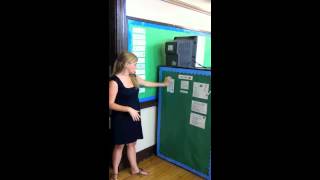
Coming back to the other end of the room, I talked about our AM routine before. So since a lot of my kids are very different levels, I don't really do anything whole group. And in the start of the day, when we work with the more hands-on students that need more one-on-one attention, my higher functioning students do AM routine in the morning, which is kind of their independent tasks that they do by themselves. So I just actually finished making this this morning. So we've done this different ways in the past, and This is the way we'll be doing it this year. So their AM routine, they come in, you have to make sure they put away their homework first. Then they do their binder page. On my blog it's under independent journal pages. And that's what they do by themselves. Basically they're gonna be writing a journal, doing a daily sentence. So I write a sentence on the board that needs to be corrected. And then they're gonna answer the question. So if you remember back over here to this main board, these are the questions they're gonna be answering every day that I'm gonna change out. And then right here, Easy, easy are the other questions, so we don't have to run all over to look for them. And the journal topic they're going to have every day. So that's part of their binder page. The last thing they do on the binder page is they do a daily word sort, and those all go over here in this file bin. And the word sorts, I haven't put them in yet, are from the Words Their Way curriculum. And they basically, each kid takes a test to assess what, where their biggest spelling problems are. So if they're having problems with with digraphs, with CVC sounds, with initial sounds, final sounds. They'll work on word sorts that are kind of specifically for those areas of need, and I'll put those in here. So they're basically little cut-up words that they sort all of the AR words, the ER words, the IR words. They're pictures, and then they write them when they're done. So those all go in there, and that's their binder page. When they're done with their binder page, they're going to do quiet reading. Their quiet reading books all go in these baskets, so they each have their own. They get to pick them out every week or so. We add new quiet reading books. Quiet reading is not always very quiet with my kids. Sometimes they just read out loud, but it's okay because they're still reading on their own. And then last, they're going to do a game. So over here I'm going to write every week who's in— every day who's in charge of the game. My kids love, love, love being in charge, and it's a great way to kind of put someone to be the leader in the group. And even though they usually tend to play the game with the kids, I've never seen like 6 to 8 kids with autism play games like my kids have for, I mean, an hour, 2 hours. They just, they love it. But it's that being in charge and being the one to like tell the other kids what to do. Like, what kid doesn't love that? So every week we're gonna write in like the initials. We worked a lot on initials last year because I think that's an easy way to tell kids whose turn it is. So write down whose initials, whose turn it is to be in charge, and then that student will be in charge. And also everyone, each kid's gonna get a turn every week to type their journal. So we'll also write initials in there. So if it's Monday and your name is here, here's the visual right under here for it's your day to be in charge of the game, and here's the rules on how to do it. So wait for everyone to get done with quiet reading, pick a game. So it really breaks it down step by step for that student. And the same thing for typing a journal. So it's your day to type the journal, how do you do this and how does this look? So I think embedding those steps into your day is so important. So that's kind of what they'll be doing, and then Fridays they'll be doing a class job. So we can either— Velcroed on, so we can easily switch those up. So they'll do a different job every week, so they'll get a chance to practice different life skills. Our classroom schedule is here, which is kind of a rough estimate because everyone's a little different, but that's roughly what we're going to be doing every day. And all the games that they play independently are out here. I haven't labeled these yet, but here's all our independent games that the kids will pick from for AM routine. Over here we have, kind of to note for the color-coded schedule, I have lunch and gym music visuals right here. So again, when they're going to lunch, I don't like my kids to leave with their packs. Some people do, but that's a really great way for them to get lost. So when they're going to lunch, they'll come match it here and then go to lunch. Or if they're going to gym, they'll come match it to gym and go to gym. Other important visuals I have by the door are timeout, I want bathroom. If you think about if a kid's gonna go to the bathroom, they're probably gonna go to the door. So then instead of running out out and you're getting mad, they can grab this and hand it to you. Um, also I have a fire drill social story. This is free on My Teachers Pay Teachers. This is super— has helped me a lot. When there's a fire drill, I can grab it. So my kids that struggle with fire drills, then I already have it downstairs when we're outside. So that's all the Velcroed visuals that are by the door. Other important things I keep by the door are some data sheets. So we take data when they go to inclusion with the paraprofessionals. So that's right here. Paraprofessional can bring this with them, they can do it when they come back, there's a pencil with it, it's all ready to go. Um, hygiene data is also here, so when they go to hygiene in the bathroom, that's right there ready to go as well. And schedule data, I actually, sometimes I keep this by the color-coded schedules too, but I think because we have so many kids on those this year, I put it more in the middle of the room. So it's kind of where you're going to be taking the data is where the data sheets go. I also have all my schedules, which these are last year's, lesson plans, and evacuation plans. They're all by the door so if someone comes in and asks me for them, I know where everything is right away. One of our last stations is teacher time. This is not fully set up yet, but this is where I do my direct instruction and one-on-one work. I have a kind of a file folder for each student that I have their clipboard with all their IEP goals on here. So this is their main data clipboard. I also put on here that since I have data in other parts of the room, sometimes that gets really confusing. So I do put on the main data sheet if they have another goal that's being taken data on, say in language or in reading with one of the aides. I write that on the bottom so when I'm going to an IEP meeting, I know where all their data is. It might not all be on this sheet, maybe we're taking behavior data up on the main part of the room, but I know where to go find it. Um, if each kid has one of these, I keep all of like the common materials I use, dry erase markers, pencils, and this isn't labeled yet, but each kid or pair of kids has a bin and then all materials we're working on are right here. And I also have a visual similar as the other ones, a— all my visuals are in here, the I Am Working Fours and First Signs. I keep all of it here just like the other station so I have everything as well.










