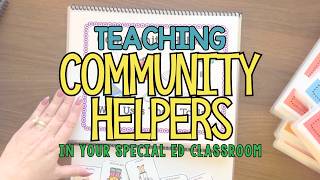
A special education teacher demonstrates adaptable community helpers resources that scale from simple matching to complex sorting and comprehension tasks. The materials include a binding trick for adding pages to interactive books, three difficulty tiers of workbooks, and activities like matching tools to helpers and identifying who works where.
Chapters
If you teach community helpers, you need these resources. I am so excited to share them with you. I want to start down here. These are some of the adaptive books that I've used when I've taught community helpers. I love them because they're very easy to scale up and down. If you don't know, this is my trick for adaptive books. You bind the book like normal, and then the page where all the pieces live, on the very last page of the book, add an extra piece of binding. It makes it really easy to use. So here we are going to flip the book up. I'm a firefighter, what do I drive? So fun, so engaging, and these pieces are interactive and movable. My students loved these so much, and they would actually take these and they would drive the little vehicles on them and make noises. It was so fun to see them. So this one is just a really great basic skill, what do I drive, but now we're going to move to who, who works there. So we've got a field of 3, who works at the school, and then they can choose from that field of 3. If I need to make this errorless, I just simply remove the extra options and then it's really scalable up or down for your learners, and obviously you can make it as difficult as you would like. So, you know, here I'm at a hospital. Who works there? A doctor, a garbage collector, or a mail carrier. I love that this really gives students the ability to dig into all different types of community jobs and community helpers. The next one is a who, and who uses these tools? And so here I am, and so I have to kind of classify these tools. I have to identify the tools, classify the tools, and then figure out who might use those. And so here we're going to say that that would probably be a teacher, um, and you know, here I'm going to kind of look at those items. I can use my context clues and be able to identify from my grouping. And so this one's a really fun one as well, but definitely takes a little bit higher of a skill to do. So let's talk about learners who need like very basic, um, errorless matching, basic matching. So our Easy Matching Weekly Workbooks at The Autism Helper would be a great task for them because this is just very simply putting objects on a page or doing identical matching. And so this is an example of The Community Helper's Errorless Matching and Easy Matching Weekly Workbooks. You You can see that I'm simply just putting those dentist chairs there. I'm putting the toothbrushes where they belong. I'm adding an EMT to the ambulance. Really, really simple, putting animals at the vet's office. If your learner needs something a little bit more complex, I would go to the intermediate version of these books. It's gonna be very similar concepts, but here I am going to be doing some like color matching. So I'm gonna read some basic words. So blue, I'm gonna put the blue tool. Here, very similar, I'm going to sort by color. Here, I'm going to follow basic directions. Here, I'm going to look at a number and look at a word and make a match. Again, I'm going to follow some really simple directions, and these are fun and engaging but really easy to use. If your child or if your students need something a little more difficult than that, the complexity versions are going to be great. So here we are looking at prepositions, we're sorting by the items. So is it an animal, produce, or equipment? Um, here I'm going to answer questions about the pictures. So here's shelf 1, 2, 3, and 4. Which shelf has the most books? What color is the librarian sweater? These are tricky questions, but I can use these clues to be able to answer them. Follow more complex directions, identify beginning letter of words, and then really work upwards of identifying the number and the written word. And so these are just a great way to be able to work on community helpers with a variety of levels within your classroom. The thing about a special education classroom is that there is no one-size-fits-all approach. So being able to have tools like this that will meet learners exactly where they are and be able to work on the skills that they need. It's honestly a lifesaver.