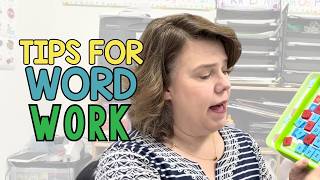
Winnie teaches word work strategies for students with significant disabilities using the Adams Processor Model, which integrates phonological, orthographic, meaning, and context processors. She demonstrates the Making Words approach, which uses letter manipulation and pattern sorting without requiring speech, and reviews practical materials like magnetic boards and AAC word-building features.
Chapters
Let's talk making words for complex learners. My name is Winnie, and I'm a teacher in a self-contained classroom, um, for elementary students, and my favorite educational book is Comprehensive Literacy for All by Drs. Karen Erickson and David Copenhaber. Now today, I want to share a little bit from their chapter 10 on decoding, spelling, and word identification, especially for students with significant disabilities and why this work is so important. So first, word identification is essential for reading comprehension. When students can quickly and accurately identify words, even unfamiliar ones, their brains are freed up to focus on meaning. So if all their mental energy is spent trying to figure out what a word says, they don't have enough left to understand what the sentence means. So efficient word reading allows comprehension to actually happen. Spelling matters just as much. Spelling supports writing, but it also strengthens reading. So when students struggle to spell, they can't focus on their ideas. They often limit themselves to writing only the words they know how to spell, and that restricts expression, creativity, and academic growth. So for students who use AAC devices— that's augmentative and alternative communication— spelling is even more critical because the alphabet is the only sense system flexible enough to allow someone to say anything they want anytime, anywhere, with anyone. And picture symbols can get communication started, but only spelling allows true independence and autonomy. So we teach decoding, spelling, and word identification because they are fundamental to reading, writing, and communication. So without them, conventional literacy is not possible. But how we teach Matters. Research shows that word reading isn't just memorizing sight words or sounding out nonsense words. According to Adams Processor Model of Word Reading, successful reading involves these 4 systems when working together. First, you have the phonological processor. That's connecting the letters to the sounds. Then the orthographic processor, which is recognizing the spelling patterns and whole words. The meaning processor is accessing what the words mean. And then you have your context processor, which is using surrounding text to determine correct meaning and pronunciation. So here's an example. The word wind can be pronounced two different ways. Only by integrating spelling, sound, meaning, and context can a reader determine which way you say it, wind or wind. So if we teach only sight words, we strengthen only one system. If we teach only isolated sounds or nonsense words, we engage just one part of the process. Students need instructions that integrate all four processors so they can independently decode new words. So one research-based method that does this is Making Words. So in this approach, students manipulate letters to build real words. They compare spellings, they sort words by patterns, and then they transfer their learning to new words. It emphasizes real words, meaningful sentences, and pattern recognition without requiring students to orally segment or blend sounds, which can be especially challenging for students with significant disabilities. The key is thoughtful, integrated instruction that builds real literacy skills, not just memorization. So we teach decoding, spelling, and word identification because they unlock reading comprehension, strengthen writing, and give students, especially those using an AAC device, the power to communicate independently. So literacy is not just an academic skill, It is access, autonomy, and opportunity. So let's talk a little bit about different materials that I like to use to help my students with fine motor impairment how to build and make words. Now sometimes it can be just as simple as a whiteboard and Expo markers for students to be able to make words with. Also, I got this from Amazon, absolutely loved it. Um, it is Joy Katz Phonics Word Building Folder. And when you open it up, you can see all of the sounds that we're working on. You can choose to, you could choose to only put out a few at a time, but I put the whole folder out ready to go. Over here it says write the word, and then it says make a sentence with the word. Here you can map the words. You can see that the alphabet, that the vowels are in red and the consonants are in blue. Blue. That's really easy to help talk about words. And then they have the special vowel teams. Love that. And then you have all of your digraphs over here. This is really cool because it has your double letters like the double F, the double L, the double S, and the double Z. And I actually teach that in my phonics rules. And then you have these special vowel sounds, the— with that N and R. And then you have down here at the bottom, you you have the special vowel rules. So that is one folder that I have used and continue to use. I also have used— this is Hand to Mind, and it came in a complete class set. This is great for using it as well. You can add things as you go. You can see we've only gotten to a few blends and digraphs, and it also has the red vowels with the blue the blue consonants, and down here at the bottom, you can see the double letters, and I have introduced NK, NG, and NT. You can see that on the board. But this one's actually my favorite, and the reason I like this one so much is because it comes from Lakeshore, and it is hard, and it keeps things a little bit more organized. It does the same thing as the Joycat. It is a little bit more expensive, But I really enjoyed this one because it seems to be harder magnets that stick to the board, and then you can close it and I can stack them on each other and put them aside and put them away until the next day. I really like this board because I can lay letters out and students that need a bigger manipulative can use these. It also helps for students who like that sensory texture of being able to touch cards. You can easily build words with this type of board. I got it from Amazon. It has pictures that go with CVC words. It also has your letters that you could use. The, the, the consonants are black and the vowels are red. The AAC device also is great for building words because you can go to your keyboard. Your student could actually type on the keyboard. This one is LAMP Words for Life, and it has an actual word building option in the phonics section. If you go to word families, you can see there's the most common word families are right here. And then you can do beginning sound, /b/ /a/ /k/ back. Great for building words and reviewing word families. For students who really like touching things, I have this whole series. It's Touch and Read Phonics Word Match, and these are CVC words. So you actually touch the sounds as you go, b-e-d, bed, and then you match it to the word. And these are fantastic, especially if you are working, like I have students who are working on short vowel words and also long vowel words. These types of word family Flip books are great for reinforcing that. I'll just pull out the "it" family right here. So you can see "shh-ipp" and it keeps going. "Rip" with the picture as well. That's fantastic. But it also has your long vowel ones. Like if I'm working on the long "a," so it would be "sk-ate," skate. And then they just keep flipping and reading, "guh-ate," gate. These are excellent options for word work. I would love for you to share in the discussion below what works for you and your students with making words. When we teach decoding, spelling, and word identification, we aren't just teaching skills, we are giving students the keys to understanding, expression, and lifelong independence. So I encourage you to check out more videos right here in the Autism Helper YouTube channel to learn more strategies to help meet the needs of your students.










