Paraprofessional Training Manual - Product Preview
Sasha from TheAutismHelper.com walks through a 31-page training manual for paraprofessionals in autism classrooms. It covers autism basics, sensory behaviors, communication, the paraprofessional's role, classroom setup, ABA principles, data collection, and independence strategies, with a final assessment to check understanding.
Chapters
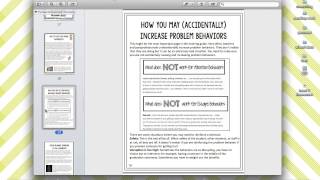
Hi, this is Sasha from theautismhelper.com, and this is a product preview of my Paraprofessional Training Manual. So training paraprofessionals can be so challenging, and I think as teachers sometimes we really forget that part of our job is to be managers and to manage the staff in our class. And that, on top of dealing with a whole caseload of kids and everything that that comes in— everything that that comes with— can be extremely, extremely challenging. And sometimes it's hard with paraprofessionals that have been in the field longer than I, than we have, or that are brand new to the field. It can all be very, very hard. You need to manage in a way that shows that you are running the classroom, but also in a way that's respectful to their knowledge as well and really have a team approach. So I think this is really important, and there's a fine line on this. So I created a manual that can really guide your training process and give them all the information to really clarify your expectations. I am not a confrontational person. I don't like dealing with conflict, and I think the biggest way to avoid this is to share as much information in the start as possible to really prevent conflicts from occurring. Because if you're all on the same page from the start, it's much less likely that conflicts, conflicts are going to occur. So sharing information, explaining autism, explaining your thinking process behind everything you're doing is so critical. So to start this manual off, as a teacher teacher's guide kind of explaining on how to run this program, and then here's the manual. So this is designed to really be something that you print, you bind, you give them. You want to give them this so they can keep it and refer back. You want to have this information at their fingertips so 6 months down the road if they have a question, they can turn to this if they feel uncomfortable asking you questions. So it really is designed to be a manual. It's a 31-page manual, so we're going to go through all the contents real quick. So here's a table of contents. There's, um, 7 different major categories. After each major category, there is a review page too. Um, so each page is kind of with a question or frequently asked question or major comment. So something such as, what is autism? Just describing the diagnostic criteria. What are sensory behaviors? Really explaining what those are and how they're not necessarily bad and how just telling kids to stop stop doing certain sensory behaviors is not going to be beneficial. Um, how can I help this child communicate? I think this is a huge thing to discuss with paraprofessionals on how we are communication facilitators and how important some of those communication devices and strategies are. This is a big thing for me: receptive language. Why does it seem like this child isn't listening to me? I say this all the time, they're not ignoring you, you need to give them processing time. So this really explains what receptive language is and what receptive language difficulties are, what that looks like, and how paraprofessionals and teachers should deal with it. So like I said, after each little section— so this is kind of the section of what is autism and all the diagnostic criteria— there's a page with a take-home message. So this just kind of reviews the major most important points, such as never take away a child's communication system, on one page to review after each section. Um, next is your role as a classroom paraprofessional. This is wordy, but it's important, and I really laid on thick on how important their job is because their job is so important. I couldn't do my job without my classroom paraprofessionals, but they need to take their job seriously. So things like coming back from lunch at the right time and not being on your cell phone are even more important in this setting because we're in charge with taking care of such a special population. Um, so here's the take-home message on that. And then are some classroom basics. I think it's really important to explain why you're setting up the classroom the way you are because because if they have no buy-in, they're not gonna use it. The second you step out of the room, that visual schedule's going to the side, or that data sheet's going to the side. So really explaining why your classroom is set up and giving kind of some examples as well. Visual student schedules, this is my big pet peeve. Everyone needs buy-in into that schedule. So really going in depth and explaining why that schedule's important and what their job will look like related to those visual schedules. Again, here's the take-home messages. Next, reinforcement. This is something I get questions about across the board from paraprofessionals in all different classrooms. Why do we have to give them a candy for this? I feel like we're bribing them. No, we're not. You would not go to work if you didn't get paid, and we shouldn't expect our kids to work without a paycheck either. So this really explains the concept of reinforcement in a way that's easy to understand. Again, our take-home messages. And then this kind of goes into ABA and dealing with aggression, dealing with accidentally increasing problem behavior. So this is kind of a— even if you don't subscribe solely to ABA, this kind of just gives a little background of functions of behaviors and things like that and data in an easy-to-understand way. Next is why is this child being aggressive? So really looking at aggression as a form of communication and not something that they're, you know, just doing bad, something that they are trying to communicate, and that's how we should look to decrease aggression. This is my big thing— how you might accidentally increase problem behaviors. So what are you doing for attention behaviors? Are you giving lectures every time? Because you might accidentally be increasing attention behaviors. So kind of looking at how identifying the function of a behavior will actually show us what not to do. And then a last one is how to use planned ignoring. This is something that's used in a lot of classrooms for students that have a lot of attention-seeking behaviors. You might implement a planned ignoring intervention. For some reason, this is very hard for everyone to follow because people tend to think you're letting them get away with the behavior. So this kind of goes in depth in explaining this strategy in a way that all individuals can understand the process behind it. Again, here's our take-home messages. Um, next up is data. Data is going to be a huge job of a paraprofessional, so I really wanted to explain and clarify how important that data is, what they should be doing when taking data, and what to do when they don't understand. Next, academic data. So some basic ways to make it more efficient, dos and don'ts, things like that. And then our take-home message. Then we have, how can we help my child be more independent? We don't want our kids to be reliant on our paraprofessionals. So really focusing on different ways that they can remove prompt dependency and how that's good, how they should be kind of getting away from over-prompting kids. And then last, preparing for the community. So this is another big one because Some of your paras might be taking kids on field trips, on community trips, and this isn't just a fun day at McDonald's. There's really a purpose to this, and what is that purpose? So then again, our last take-home messages. So like I said, I would bind this all into a book and give this to each paraprofessional. And then because we are data fiends and because we want to ensure mastery just like with our students, the last part is a final assessment. So this is the paraprofessional training manual final assessment. Maybe it's gonna seem weird, maybe your parents will feel uncomfortable, but give them this assessment. You want to show that they really understand what you worked on with them. So it's a 2 to 3 page assessment that kind of goes through some basic concrete questions, so true/false, fill in, just to show mastery that they've remembered some of those important facts. And then the last part is really the important part for me, it's read and respond. So you can really see some of these don't have clear-cut answers, and it's just going to show that they can apply the knowledge and kind of have you explain them to them. So like one question would be, you're running a flashcard station, it's your turn to work with Alyssa. Alyssa's in the play area. What should you do to get Alyssa to your station? So you might be looking for a few different things here. Maybe you're looking for them to say, oh, I'm gonna go bring Alyssa her schedule. Oh, I'm gonna go get her her behavior chart. I'm gonna go get her a sticker chart. I'm gonna go get a reinforcer for her. To get it ready at the flashcard station. So depending on your class and your para, there might be a few different things you're looking at of each of these questions, which is what I really like about it. I want to see that apply knowledge, that they can take this and apply this to this really complex and challenging job because our jobs aren't easy. And then last, kind of a spot for them to give questions. I encourage questions throughout this whole training manual, but sometimes people feel uncomfortable asking questions, so kind of giving the anonymity of writing it might be a little bit easier. So like I said, this manual really has it all. I'm so, so excited to use this this year. I think it's gonna make it a lot easier for me to run a training session with my paras when it's written on paper. For some reason, things just are easier when they're written on paper, and you can be like, "Here, look, we have a manual. I'm not making this up." So I really hope that this— you'll find this as helpful as I do, 'cause I really can't wait to get started using this. Everything's written in really easy-to-understand language, so it'll be understandable by both veteran paraprofessionals, newer paraprofessionals, highly educated people, less educated people. It's really going to be understood by all, which is really the key here. So again, if you have any other questions about this, shoot me an email, but I'm really excited about this. I'm happy to tweak any little things. If you're like, "Hey, we really don't allow this," or "We really need to add this," shoot me an email after you buy it. I'm really happy to tweak it because I know things can be a little different from school to school. So again, this was a preview of Paraprofessional Training Manual by TheAutismHelper.com.










