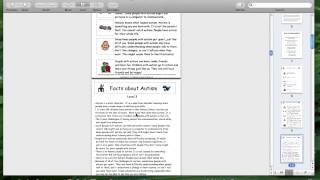
Sasha from TheAutismHelper.com presents an Autism Awareness Unit for K-12 schools with 25 interactive true/false boards, tiered fact sheets, lesson plans, and book lists. The unit includes Velcro-backed boards displayed throughout the school and has transformed her school's culture by sparking ongoing dialogue about autism among general-education peers.
Chapters
Hi, this is Sasha from TheAutismHelper.com, and this is a product preview of my Autism Awareness Unit. And this is probably one of the products I've been most excited about posting, and I can't believe I waited this long to do it, because this is something that has had such a huge impact on my classroom and my school community as a whole. So every year for April, for Autism Awareness Month, I take the opportunity to do lessons in the general ed. So if you're like my school, I have a self-contained classroom that's in a typical school, so it's in a general education building. So my kids are intermixed with the general ed population for lunch, for specials, we share hallways, obviously the school building. So it's really important to raise awareness and allow the kids in the general education classrooms to learn about autism in an appropriate way and ask questions because of course they have questions, why wouldn't they? And I felt like that was really lacking a few years ago when I started and it just has completely changed after doing these lessons. So I'm excited to share this with you all because I really hope this is something everyone will consider doing in their schools, and it just is a great thing to do. So in this unit is kind of a comprehensive all that can— unit that can span all ages because I did lessons from the preschool through the 8th grade. So real quick, here's kind of the table of contents, everything that's included. I explained these true/false boards, which I'll show you in a minute, but I have 25 of these included, and I posted these all over the school. I'll scroll down real quick and show you them. They're just— I made them basically the size of a page, cut them out, posted them on colored colorful construction paper, put some Velcro here, and then I laminated the true/false pieces and put them, you know, one in each spot. And then kids could move it and answer the questions true or false by moving it down here. So you see the pictures right up here. So here's the pictures of these. So it's pretty cool and the kids loved doing it. It just brought this like awareness throughout our whole building. And every time I would walk by, I would just put the answer back so kids could do it all the time. And the kids got really into it and it was cute to hear them talking about it. Like, what do you think the answer to this this one is, and it really got the conversation started in a nice way. Um, so here's my explanation kind of of everything. I give a pretty lengthy 2-page lesson recommendations on different anecdotes and stories and ideas that I've used in my lessons that have been really successful with the kids I've used. I also have a list of book recommendations. I really like starting the early childhood lessons with a book reading, which is a nice way to start. And then this is kind of what the lesson goes around, is these fact sheets. So I have 3 levels. Level 1 would probably be like pre-K to 3rd grade, so maybe 2nd grade, so kind of pretty easy, one sentence with a picture to help. Um, so this Level 2 is probably 3rd through 5th, 6th grade, a little bit longer, still with a picture. And then this Level 3 is probably junior high, high school age. So this is, um, just facts. These are all the facts that are from AutismSpeaks.org. They're all up to date on all the new numbers and everything. So it kind of just gives some general facts about autism, and this is a good way to start the conversation and get it going. I also have a handout for being a good friend and sensory facts, because I feel like sensory awareness and knowledge ties into a lot of the things we talk about. And then there are two different comprehension question worksheets that you can give the students after they're done. This kind of can assess how much they've learned, if there's any areas you still need to talk about with them, and this one is about inclusion for kids that have kids with autism in their classes with them. And then here are the 25 boards. So I'll just scroll through them really quickly so you can see the different facts. So there's a lot that are true, so you know, it's about half and half, ones that are true and ones that are false. And then if you put these up already, you can talk about these in the lesson you give to the classroom. So that's a really nice thing, you know, like, "Oh, you might have noticed one of these things says autism means you cannot talk, but is that really true? Blah blah blah." So you can address all these issues in your lesson. So here's all the boards, and yep, that is it. Um, so yeah, it's a pretty awesome thing to do, and I really do just encourage everyone to try to raise awareness in some way during the month of April because I do think it's really important. Um, so this was a product preview of my Autism Awareness Unit by theautismhelper.com.