Sasha from theautismhelper.com shows a communication system for nonverbal students using PECS to build commenting sentences beyond simple requests. Five scenarios include commenting outside, on food, counting, and identifying animals and clothing colors. Each comes with boards, sentence strips, and flashcards to teach observation and sensory language.
Chapters
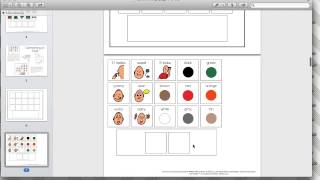
Hi, this is Sasha from theautismhelper.com, and this is a product preview of commenting visuals for students who are nonverbal. This resource is a little bit tricky to set up, so I will be doing a video tutorial as well. So if I don't answer all of your questions in this product preview, be on the lookout for that as well. Um, so I really wanted to create something that took my students who are using PECS beyond just that "I want" statement, so to really engage in more commenting in other types of sentences that are not just requesting items. So I did this for a few different specific scenarios and created kind of a structured communication system for all— for 5 different scenarios. So the first one is commenting outside. Within each system, there's pretty detailed instructions on how to set this up, so you will kind of understand the process here. So with each one, there's a board. This is where all of your pictures will be placed. And the sentence strip. There's an individualized sentence strip included in each system. So here's the board and here's all the pieces. So these would all be laminated, cut out, and then stored on here. So the idea would then be that sentences could be created with the comment "I see." So, "I see a fence," "I see a tree," but also adding in that color aspect as well. So creating that longer sentence and those longer utterances of "I see blue sky," "I see green grass," engaging in a more complex communicative response. The next one is commenting on food. Again, we're always just requesting food all the time. "I want french fries." "I want Cheetos." "I want hamburger." But what about talking about it? "What color is it?" "What does it taste like?" "Do you like it?" So kind of this is the same system, but taking it to that commenting piece. So again, you have the board with all the pieces and the sentence strip. So kind of having that "It tastes yummy," or "It looks red," "It looks green," green. So kind of again going beyond the simple requesting for food, but talking about it. Our kids typically like talking about food, so this is a great way to get started on this advanced communication piece with something that they're motivated by. Um, next is to work on counting. So this is ideally going to be done with school supplies. So I tried to pick things that are going to be commonly, um, used within your classroom so you'll have these on hand. So again, here's our board. And all the pieces, but this will be to use with a counting task. So if you were to put out 4 crayons, the nonverbal student could then be able to put, "I count 4 crayons." Create a 4-word sentence based on a math skill. So it's tying in a lot of skills in here and adding that communication piece. So counting, you know, "I count 4 paperclips," or "I count 2 pieces— 2 papers," "I count 1 pen." things like that. So kind of also adding in that math piece, which sometimes counting can be a tricky skill to assess with kids that are nonverbal because we're not sure if they're correctly identifying the number. So here's giving that assessment and communication piece to the counting skill using school supplies. Um, kind of the same idea here, but we're gonna be working on identifying small and large animals using flashcards that are included in the set. So everything is included in here. So again, here's the board and all of the pieces, and then there are tons of different flashcards with the same animals included on here with big and little. I just did this today, literally, and it went so well. It's a student that really struggles with communication, and he did amazing on this, and I wish I had consent to put this online because I did take a video of him for his mom, and it is the greatest thing, and I was so excited. So basically you'll set this up right here, I'll hold out a flashcard, so I'd hold out a flashcard of this big octopus, and then the student will create a sentence, "I see big octopus." So not only are they identifying this animal by matching, so that's a little easy, but then they have this kind of more complex piece of adding the big or small. So really going to a higher level skill, which is so awesome and is so hard to target for our kids that can't communicate. So there's a big and little version of each animal, so you'll be able to really assess this in a wide variety. The last one is Identifying Colored Clothing. So again, this is gonna be used with flashcards that are included in the set, so you don't have to make anything. So we have our board, all of our picture pieces in the sentence strip, and all the clothing pieces all in different colors. Our kids are really good at memorizing, so if you show the shirt only in the red, they're just gonna get used to doing the red. But this is a great one to work on that, again, that 4-word sentence: I see "Red shirt." When you hold out this red shirt, or when you hold out the yellow dress flashcard, "I see yellow dress." So again, this is a great way to target this skill for your kids that are nonverbal. This was a product preview of Commenting Visuals by theautismhelper.com.