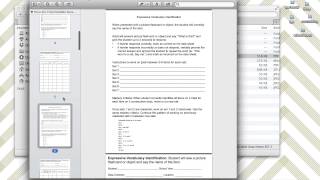
Sasha from theautismhelper.com shows Discrete Trial Goal Sheets and Data Forms Set 2, which covers eight instructional goals for autism including sight words, vocabulary, commands, and imitation. Each goal includes step-by-step scripts, mastery criteria, and tally-style data forms designed so paraprofessionals and parents can run programs consistently.
Chapters
Hi, this is Sasha from theautismhelper.com, and this is a product preview of Discrete Trial Goal Sheets and Data Forms Set 2. So I had such a great response to my first set that I thought I should make a second set with all of the other types of goals that I use in my classroom. These sets are really a must-have in my class, and I think in any self-contained autism room. These would also be great for a home program. The reason I love these is because it details exactly how the goal should be run and then there's the coordinating data sheet. This is literally— like, this is so easy to run. Then you could hand this paper to anyone. I was gonna say idiot-proof, but that sounded mean. But really, you can hand this to anyone and they will be able to run the program. So it literally, for each program, it explicitly writes out when presented the written word, the student will correctly say the word, and what the student adult does, and then what the adult— how the adult responds, whether they get it correct or incorrect. Um, there's suggested mastery criteria as well as suggested, um, order of exemplars. All of these are also editable, so I'm gonna go through the non-editable versions right now just because it's easier, but you can edit these. So when you have this sheet, you can type in exactly what words you want them to do. You can write in the student's name. If you want to go down here, you can write— fill this all in already, so it will make data collection really, really easy. So I'll briefly go through the different sets included and the ways you can use them. So this is expressive sight word identification, and then we also have receptive sight word identification, which is really great for our kids who are nonverbal. We can still be working on, on sight words, but we're just gonna work on receptive. So the student will touch the correct sight word when the verbal name is given. So again, it's written out explicitly and there are specific directions on what to do in the case of responding correctly or incorrectly. Um, next is— and here's the corresponding data sheet again. So this even goes as detailed as to include the field size. How many are they picking between? So we really want to account for all these little details to make sure we're being consistent when teaching these skills and taking data. Um, next is expressive vocabulary identification. And receptive vocabulary identification. So again, we're getting those comprehension skills as well. The corresponding data sheets follow. Next, following one-step commands. Here's a filled-in one with some examples of different exemplars you can use and the data sheet. And then follow two-step commands. And again, there's one with blank and then one with some ideas if you need ideas. So this will really help guide your instruction with these simple data sheets and goal sheets, and then the corresponding data sheet for both. Um, next is imitation, which is one of the most important skills to work on with your early childhood students or your low cognitive functioning. This is where you need to start. We really need to be getting kids to imitate what we do. This is such an essential life skill that will lead to so many other skills once they're able to do this. So this is a really critical one. So here's the instruction form and the data sheet. Next is vocal imitation for our kids that have emerging verbal skills. Again, this is critical. We want to get them talking, we want to get them imitating what we say. For early intervention, early childhood classrooms, this is also a must-have program. Expressive coin identification with the data sheet, receptive coin identification, intraverbals, so looking at a student responding to a common phrase. So when provided the beginning of a common phrase, the student will verbally complete the phrase or say the appropriate ending. So this is really where we're starting to teach students to respond to questions and to get away from that imitation and echolalic behavior that a lot of our kids can exhibit. So I have some examples on what to work on and how the exact script of how this looks. So this again is written out very completely and then the data sheet. So this really is a complete set. If you're doing the ABLEs, this is gonna tie into a lot of ABLEs goals and will be arranged for a wide range of students. So we even have our higher functioning guys, maybe work on expressive vocabulary, expressive sight words, all the way down to imitation. So again, these to me are really, this set and the set one are classroom must-haves because this is how I set up my centers. This is what my paraprofessionals run. Use— run these programs with these sheets. These exact ones are in my classroom and they run so well because even when I have a substitute, they can pick this up and they know exactly what to do. So it's really setting those expectations up right from the start. There's no gray area because you've made it very, very clear and concrete how these programs are supposed to be run. And the data sheets are pretty simple. You're just tallying and it's not very complicated. So data will be taken— is more likely to be taken when it's easier. Again, this was a product preview of Discrete Trial Goal Sheets and Data Forms Set 2 from theautismhelper.com.