Sasha from theautismhelper.com shows the Discrete Trial Data Sheets Set 3, three customizable packets for teaching autism-focused skills like WH-questions, yes/no responses, sorting, and counting. The sheets are editable and ready to print, designed for educators, therapists, and paraprofessionals to track progress and plan lessons.
Chapters
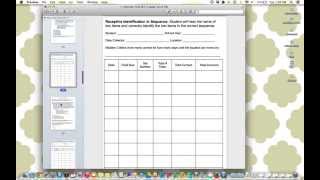
Hi, this is Sasha from theautismhelper.com, and this is a product preview of my Discrete Trial Data Sheets and Program Guide Set 3. So I have 3 different versions of these Discrete Trial Data Sheets and Programs Guide. Each one just includes different types of goals and different goal sheets. These are so great because all you need to do is print and copy, and your data system is ready to go. Your staff training system is ready to go. Everyone knows what the goal looks like because it's written out explicitly. Explicitly. So this is great to not only give you ideas for goals, but the work is done. Everything's set up and ready to go. Included in this resource also are editable versions of everything. So if that's not exactly the way that you teach categorizing, or you teach answering WH questions, or that's not the order you want to teach it, you can customize absolutely everything, which for me is really key. I'm a perfectionist, and I know many of you are too, so I made sure that everything can be completely customizable. So let's go through the different goals included in this resource. So first one is answering WH questions. This is a, this is a goal that I love, love to work on. This gives you a really structured way of how to teach the skill, the order to teach it, with the data sheet corresponding. So this might be something you work on a lot already, but you might just need to add the data component to your day. Next is expressive yes or no. This is something I realized a lot of my students were missing. Can they answer yes or no questions? A lot of our students repeat what we say or are unable to answer yes or no. So this one is really great as well and gives some great different task ideas on how to start this skill. Next is visually tracking items. This is a skill that we picked from the base— the ABLES, the Assessment of Basic Language and Learning Skills, and it's a really foundational skill that's going to look at the attention skills of our students and if they're able to track a non-reinfor— reinforcing item. So follow with their eyes a visual item. This is great for your early learners who need to work on those table-ready skills before jumping into academics. Here's the data sheet. Next is sorting by class, something I talk about all the time. Well, how do we teach this? How do we take data on this? This is something I have aides take data on and teach a lot because it's something pretty simple. You can break it down into a structured way and all the directions for the aide are right here in the data sheet. I can just check in on it and and see how it's going and monitor the progress. Next is seriation or sorting in a logical order. Again, another ABLE skill. Can your, can your student alphabetize? Can your student sort from small to big? So looking at that skill of sequencing in the most basic way. And here's the data sheet for this one. Next is vocal number sequence. We want our kids to learn our phone, their phone numbers, right? If they get lost and the police ask them their phone number, They need to know their phone number. Well, first they're gonna be able to have to imitate numbers in a sequence. And this is a really important skill before teaching their phone number. So make sure that this is really mastered. So here's the vocal number sequence program. Next is receptive identification in a sequence. So we might be working on a lot of receptive identification. Touch ball, touch bee, touch your name, touch the one that you drink with. But what about following multiple step components? In our world, we're not only saying one command, we're saying multiple things. "Get me the pencil and the stapler." "Get me the blue marker and the red marker." So this is looking at identifying multiple items in a sequence out of a bigger and bigger field size. Again, here's the data sheet for this one. Next is Receptive Action Identification. So this is great for your nonverbal students to show comprehension of different actions and verbs. A lot of great teaching ideas and exemplar ideas included in this one. Next is Receptive Two-Component Identification. This is a skill I love, love to work on. We work on adjectives all the time, but our world doesn't comprise of things that are only one adjective. Things aren't only small, or they're not only pink, or they're not only brown. They're little and brown. They're circle and red. They're square and blue. So identifying things that have two components is really key for our students and is really, really tricky. But I think you'll be shocked by a lot of the great progress you can make with this program if you work on it in a structured way. Um, next is picture association. I love working on association because it's kind of that prerequisite skill to categorizing. So what goes with shoes? Socks. What goes with cup? Juice. So you can work on this in a verbal or nonverbal way. So here's the verbal program for this one. Next is with 2 responses, picture association. What 2 items go with 1 item? So really expanding this and making it more difficult. Personal information is a great program that I do with all of my students to ensure that they can answer these different types of questions related to themselves. This is a great functional skill because think of if your child gets lost, are they going to be able to say their mom's name, say their address, say what school they go to? We want to make sure that they're able to answer all of these different questions in a meaningful way and really an efficient way. So here's the data sheet for this one. Um, receptive non-examples is a really tricky one that I think is great to work on. So identifying things that aren't something. So if they have a field size, can they use the process of elimination, identify which one is not a tree, which one is not a dog? So it's really using the different words in the sentence to change the information you're looking for, which is hard for a lot of our kids, but it's really meaningful. Next is receptive following directions pretend actions. So again, working on that comprehension piece and kind of putting in some type of nonverbal comprehension component, which is really cool to work on as well. Delayed sequence replication is working on that attention and visual attention. So if you are sequencing items, can the student imitate that on their own with 2 items, with 3 items, with 4 items? Very often in life we're needing to imitate other people. Even as adults, we imitate other people all the time. So we want to make sure that our kids can imitate complex and delayed actions. Sometimes we'll see something— someone do something and then we'll imitate it right after. So we want to make sure that our kids can do that as well. Counting is a skill that everyone works on, but how do we teach this in a really basic way? And how do we take data on this? This program gives a lot of great teaching ideas and a really simple data sheet that's great for both you or your paraprofessionals. Community Helper Identification is also a really important life skill to work on. So this is a simple program to work on identifying different community helpers, and then here's the data sheet that goes along with it. Next we have Block Designs from a Picture. This is again another skill from the ABLES that works on these really, really foundational learning skills such as visual attention, matching and non-identical matching since it's on a picture. This is a really complex task that you can start at a real simple process and make it much trickier. So here's the data sheet, the teaching program. This is a great one for a paraprofessional, and here's the data sheet for that. So again, a ton is included in this resource. There's loads of different types of programs, a lot that are kind of outside the box that aren't your just basic ones. It'll give you a lot of variety. I really encourage buying all 3 sets because you're gonna have a lot of your curriculum really planned handout. You'll be able to pull exactly what your kid needs and not have to reinvent the wheel. Everything's ready for you to go here. So again, this is a product preview of Discrete Trial Data Sheets and Program Guides Set 3 from theautismhelper.com.










