Sasha from theautismhelper.com presents an 85-page Economy unit for early childhood and special education. It includes 12 vocabulary flashcards, an 11-page Velcro picture book for non-readers, differentiated worksheets, sorting activities, and games like Economy Bingo and "I Have, Who Has" card game. All materials are designed for durability and can be adapted for diverse learners.
Chapters
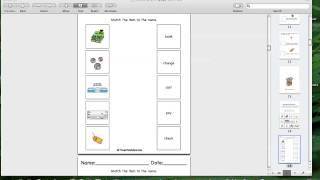
Hi, this is Sasha from theautismhelper.com, and this is a product preview of my economy unit for early childhood or special education. So I felt a little bit proud of my students when I was making this because the economy to me seems like such an intimidating issue and something that's so overwhelming and challenging, but I really think my students are going to do such a great job learning this, and this is going to be so easy to align to Common Core that I generally have a hard time using for some of my lower functioning students. So I'm really excited to kind of get started on this topic because I feel very age appropriate with this. So this is a very, very basics on the vocabulary involved in learning about the economy. So here's the— there's 12 different flashcards with definitions included, and those are kind of the vocabulary, the vocabulary terms that go throughout this entire unit. So the terms are money, credit cards, good, services, needs, wants, cost, savings, pay, change, check, and bank. So I think these are terms that can be really concrete and that our students can really grasp fully and have a good foundational knowledge about the basics of the economy to move on to more challenging areas. Um, so to start off, I have an 11-page adapted book that's very basic and introduces all of the terms, and all the terms are included in this story. They're all— each page has a movable picture that you can Velcro and match. So for your lower functioning students, they can be involved in this text even if they can't read. So you can laminate this or use page protectors, and the pieces are at the end. There's also directions for setup as well and a label for the baggie. So these pieces you can laminate, put soft Velcro on the back, and then put hard Velcro on each page of the book. So the book kind of just introduces the terms in a very basic way, but it's good to refer back to as you're doing this unit, I have found. Here's all of the different pages of the book with all of the relevant terms, kind of expanding a little bit on them as well. Then next we have a variety of types of matching worksheets. I like these units because they are really able to hit my highest functioning student and my lowest functioning student. I have some matching worksheets that are a little bit harder and some that are easier. These are just identifying picture to word. And there's 5 of these. For my students that do struggle with reading, I have the flashcards out on the table in the other units I do and then have them refer back to and find, like find the word "check" and look at the picture and then they're able to match it. So it's kind of taking that a step farther for the kids that have a hard time. Then there are 5 just simple match picture to picture, which is great for your kids that do struggle with writing and reading. Kind of, they're still involved in this activity. Then I have 4 different kind of posters or kind of guides on the goods versus services and wants versus needs, and I made 2 versions of each. So this is goods versus services, so kind of as a visual explanation of what are goods and what are services, and then a written one. And then I have the same thing for wants and needs. So here's wants, here's needs, and then the written one. So I like leaving these out in our social studies center for the kids to refer back to as they're doing their worksheets. Then there's a bunch of different fill-in worksheets. There's 2 that are just basic question answering that can— are great to assess comprehension. There's 2 true and false worksheets, and there's 3 definition worksheets. These are great to really build and practice these vocabulary words. Then there are a bunch of different kind of creative writing worksheets as well. These ones some of my higher students do need more help on, but I like being able to have some challenging work included in this. So "If I only had money to buy what I need." This is a harder concept that you might have to talk out with some of your kids, but it's really gonna help them really understand this topic. There's 5 different ones of these as well. Next, I have 3 different sorting activities. I've been using these as cut and paste, but you could also laminate them and make them a file folder task if you wanted to keep them to have them be reusable. This one is sorting wants vs. needs. You could have students cut these out and glue them or laminate them. Under what are wants and what are needs. And then this is for goods versus services, goods versus services. And again, those flyers might come in handy during these tasks as well. And then the next one is using what you can, things you can pay with and things you cannot pay with. So kind of, you know, illustrating that we can pay with a credit card, a check, money, but you can't pay with strawberries or pencils, etc. Then there are 6 different coloring pages that are just real basic. So not the following instruction ones yet. I like having these to still have my lower functioning students involved in our thematic unit in an easy way. So there's a bunch of different coloring pages, and we're still building fine motor skills while we're working on the coloring as well. And then there's some kind of taking this a step further, following direction coloring pages. So this one is coloring the goods red, the services blue. So work on following the steps and applying the knowledge. So it's really taking this a step farther. Same things, coloring the wants and the needs, and then identifying basic vocabulary by following the color direction. Next is Economy Bingo. There's 2 levels of play included in here. There's easy level, which has just the vocabulary terms, and then hard level, which has the definitions, and then there's 15 boards. So this is great to have your kids play independently with maybe the easy level, and then you can play with them with the harder one. That's what typically we do. So there's 15 boards for the Economy Bingo, and And then there's I Have, Who Has Economy Game. I love these games because it really works on building social skills and building attention while working on whatever skill, academic skill, you're working on. So you laminate these cards, pass them out, and then the students kind of read them and it follows, bumps along in the circle. So the first student will read this card and then it passes it along to whoever has this one and so on and so forth with all the vocabulary terms. And that's it. So this, this is a huge unit. It's 85 pages and I have been really successful using these units with, like I said, with my highest kid and my lowest kid. So we're still all working on the same academic unit, just in different ways, which is what really needs to be done in our self-contained special ed classrooms. This was a product preview of an economy unit for early childhood or special education by theautismhelper.com.










