Sasha from The Autism Helper shows Froggy Fill-Ins, a classroom game that teaches intraverbal skills and vocabulary through written prompts. Activities progress from phrase completion like "Ready, set, ___" to matching and categorizing tasks, with each level scaffolding language complexity. Teachers can collect data on student responses using inexpensive, laminated materials.
Chapters
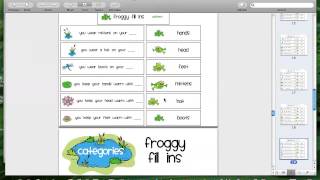
Hi, this is Sasha from The Autism Helper, and this is a product preview of Froggy Fill-Ins. So I've talked a lot about different ways I use in my classroom to teach question responding, and kind of the very, very basics of responding to questions. Before you can even get to there, I like to use phrases, common phrases that kids need to fill in. So you kind of omit that last word and prompt them to fill it in. In the applied behavior analysis world, this is called intraverbal. So kids needs to use your verbal language, what you're saying, and respond with other verbal language. So I do this a lot and take like very consistent data on this. There's some blog posts about it that I'll link to in this blog post, um, but I made a game to kind of work on this, have it be in a fun way, and also provide that written language prompt because some of my students actually have more written language than verbal language sometimes. So there's a few different games and activities to work on kind of this intraverbal behavior. So there's 4 different boards like this, and there are— you could laminate this. I actually put them in page protectors and then laminated the cards so students could be matching the final word to the lily pad. So, ready, set, go. So the teacher would say, ready, set, and they would need to find the go card and put it on there and say go. So they're still responding to your ready, set, and saying go, but it's not as difficult as answering a question, if that makes sense. So there's another one with the same kind of very easy common phrases. So this is the most basic level. And then there are also some puzzles with these same phrases, so matching the lily pad and the frog, because again, some kids will have more written language than they do the verbal language. Um, next is working on function. This has really, really helped my students that are the kids that are able to answer the very basic questions but can't go much farther. So working on building vocabulary through learning about these verbs and prepositions and how they relate to each other and answering the questions. So there's 7 different puzzles kind of all working on function and kind of how the sentence structure leads you to answer the question. So you're not gonna say, "You cut with a cut." You cut with scissors. So, and you use scissors to. So kind of practicing those in the same set of exemplars. So there's 7 different versions of these and I use this type piece is the label for the baggie. So I just laminated these and cut these out, and these are pretty quick to make, um, to work on function. So 7 different types, um, kind of categorized by genre. And then last is categorizing. Categorizing is a super essential skill that helps build vocabulary and teach students to organize their thoughts. That's kind of the whole basic basis of how we think about things and language is organizing our thoughts into category. Okay. Categories. So there are 6 different— or 4 different categorizing boards, um, and you would use these as a worksheet so students can just write in their own, which would be the kind of hardest level. And then they're also cut and paste, and you could do the cut and paste for first and have students write it later as an extension activity. So you could cut these and, you know, mix them up, and then they'd have to glue them, or just have them write them. So there's, um, different categories on each one. To kind of work on that vocabulary building and categorizing. And then that's another great way to teach this intraverbal behavior by saying after they complete this activity, "A type of food is..." That's what the teacher would say, and then hopefully the student would say, "Pizza!" Or, "A type of tool is..." and they would say, "Drill!" So it's not as hard as answering questions because they have this prompt here, but they're still kind of starting the basics of that skill. So yep, this was a product preview of Froggy Fill-Ins by TheAutismHelper.com.