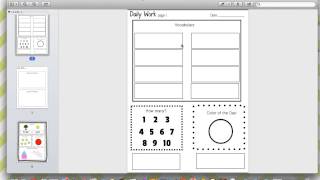
Sasha from theautismhelper.com shows the LEVELED Daily Work Level 1 resource, a 180-day worksheet system for lower-level learners with autism. Each page includes two vocabulary words, counting 1-10, a color of the day, and a picture-copying task. The simple, consistent layout reduces cognitive load and builds foundational language and fine-motor skills through daily repetition.
Chapters
Hi, this is Sasha from theautismhelper.com, and this is a product preview of my LEVELED Daily Work Level 1. So if you watched either of the other 2 video previews for Level 2 or 3, this runs in a similar format, although this one is going to be a little bit different because of how basic this level is. So your learners at this level will obviously need to have some writing skills because these are still worksheets, but the writing skills are going to be much more basic, and it's going to be more copying and imitating, things like that. So this is great if you're working on the Assessment of Basic Language and Learning Skills, the ABLES. A lot of similar skills tie in, and it's very repetitive, so it provides your students multiple opportunities to practice the exact same skill every day, which for a learner at this level is very key. So that was done very purposefully. So I'm gonna kind of go through the different examples, and then I'll show you the different pages. So again, there's 180 different pages So there's a different prompt for every day of the whole year. So this product's gonna get you through the whole year, and I'm super, super, super excited about it for myself. Um, so what this product does come with that the other ones don't is kind of a little mini anchor chart that I utilize all the time in my classroom. So for some of my learners that are getting a little bit more advanced, they do know some of the color words and some of the number words, but I kind of want to give them a reference guide. So this might be something you want to post nearby where you're working if your students are working on these types of skills. They don't have to be. I'll kind of show you. So here's the student worksheet. It's two-sided, and as you can see compared to the Level 2 and 3, there's a lot less going on, and that's very purposeful. I wanted to keep it this simple and very, very structured so our students will know where to work in each part of the page. And even the different types of borders will coordinate to the types of borders on the prompt page, so it'll really match on where they're going to work. So with each prompt page, there are 2 different vocabulary words every day. I think it would be great to practice saying these words, pointing to these words, discriminating. Show me tree, show me sun, show me sun again, where's tree? Practice saying them. If you have a student who has expressive language, let's say tree 5 times, let's say sun 5 times. If you have a student that is nonverbal, practice pointing to the tree, pointing to the sun, pointing to the letters in each word. Then they're going to be copying the word 5 times each for tree, 5 times for sun. Um, and the reason I want to copy it so many times is if students struggle that first or second time, they're having multiple opportunities to really practice copying the word and writing it correctly. So 5 times each for each of the daily vocabulary words. The next one is counting under 10. So there's a different array of numbers counting how many, and then they can circle. So for your students with limited writing, that's gonna be okay. They can just circle 5. And then if you want to take it a step farther, you have the option of writing the number, just writing the numeral 5, or again using this anchor chart and writing F-I-V-E under here. So you could kind of play around with the level that you want to utilize this at. Next is Color of the Day. So again, work with your students, practice saying red, this is red, let's find the red crayon in our box, let's color the circle red. And then again, you can color the box if you wanna just work on very limited writing skills, or if you wanna take it a little farther, matching it to here and writing the word of the color. So you really can, again, play around with this part also. The last part is copying a picture. So the different pictures are just different shapes and dots and different patterns in different colors in a different order every day, and the student is to copy it. This is so such, such a great skill to work on. It's almost the most foundational journal, I think, because they're gonna work on visual perception, they're gonna work on fine motor, they're gonna work on attending to all of these little details that'll really lead to all of these more advanced skills later in life. And again, I'm giving 2 opportunities because if you mess up, guess what? Let's try again. With kids like this, we really need to focus on error correction and this daily work packet builds that right in, so they have the opportunity to practice it twice. So we can really correct the errors and really finally master this skill each day. So that's what the student worksheet is. So you could photocopy this double-sided, make a whole set, and you are literally set for the whole year. And then here are the 180 prompt pages that you will post every day or work on each day. So once you print this once, you're really going to be set. So I'm going to go through and show you the different um, prompt pages so you get an idea of what they look like for each day. Um, so the vocabulary are all basic common words that would be great for kids with no receptive language or minimal receptive language or no expressive language. Either way, this can be for students who are verbal or nonverbal to work on, but some common words that they might already be familiar with. Um, the counting is between 1 through 10, as you can see, and the color of the day alternates between the basic kind of colors that we work on. And some of the pictures are complicated. You know, we really do want to test our kids to identify, you know, how are we putting these patterns in order, and is the purple block smaller than the blue block? So really identifying those differences and discriminating and copying it correctly. So these are tricky on purpose. This should be a challenge. So I really do want to challenge you to push your kids and try to get to that harder skill. If they don't get it right every day, that's okay, but you're gonna see improvement throughout the year. Because they're having the opportunity to practice this skill every single day in a very structured way. And with kids like this, structure is really the key on advancing these skills because when the format stays the same every day, they don't have to relearn the format. They don't have to relearn the orientation of where they're supposed to fill in, where they're supposed to look, where they have to write, what's expected of them. By, you know, a month in, 3 weeks in, 4 weeks in, they're gonna know what's expected of them. And even if they're not 100% doing it correctly, they're on their way there and they don't have to take the time to relearn the format and they can focus on the content. So that really is done purposefully because I want to give that structure in the same way. Um, so again, here's all the different 180. Everyone is different, every vocabulary word is different. I think there's a few, um, kind of even more advanced ones like snail, so ones towards the end So we're really working on advancing their vocabulary. So really, I have said it about all these products, but I'm hugely, hugely excited about this because it's just going to be such a time saver and really get you through the whole year. I think this resource would be great for a center, great for a paraprofessional to work on, great for starting some independent skills with your lower-level learners like this. Great for teacher time, um, homework. So there's a wide, wide range of options for this resource. Um, again, this was a product preview of Level Daily Work Level 1 by theautismhelper.com.










