Product Preview - Measurement Mega Pack!
Angela Kulcsar and a co-presenter show the Measurement Mega Pack, a collection of printable resources for early childhood and special education classrooms. It includes anchor charts, leveled activities from matching tools to names up through real-life measurement scenarios, file-folder games, task cards, Measurement Bingo, and an "I Have, Who Has" game designed for mixed-ability learners.
Chapters
This is a product preview of my Measurement Mega Pack for Early Childhood or Special Education. So if you've checked out any of my other Mega Packs, um, this one's fairly similar. It's really big, it has a wide range of resources, so you'll be able to include multiple types of learners within this same unit, which I really love and I think is a common situation in a lot of our classrooms, whether early childhood or special ed. We have kids with a varied range, so I want to have things that are still challenging for our higher guys but still we can include our lower kids as well. So I have a table of contents that is page numbered. I did not number these, the pages within here, because obviously you're not going to want those on your anchor charts and worksheets. So just pay attention when you're printing that you're printing exactly what you want because I know some people might not want to print everything at one time.
So I have a bunch of different anchor charts included. When we are doing this unit in my class, we post these through the classroom so we can kind of check in on everything. So this one kind of just gives basic the basic measurement tools and what type of measurement they take. This one gives kind of an equation of the type of measurement tool, the picture, and the types of measurement they take as well.
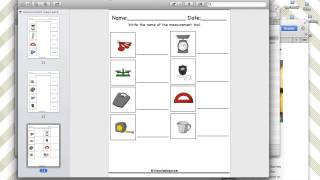
And here are some common abbreviations. Throughout a lot of this unit, these types of things are discussed, so these are great to review back that what abbreviations are we using, which type of measurements take which type of measure, you know, what do they measure. and things like that. Um, so I'm gonna carry on. So first we have leveled measurement activities. So I kind of organized them into vocabulary identification, types of measurement, and then measurement units. So there's gonna be a lot of different concepts to work on here. So the first few are just basic matching the tool to the name. So this might be great for introducing this topic for some of your early learners. Bunch of different types of that.
Here's matching the tool to the unit of measurement. So we would measure—
match the measuring cup to cups, the scale to pounds, etc.
So this is where some of those anchor charts might come in handy. There's a bunch of those. And then matching measurement tool to the type of measurement. So the, you know, the spoons are doing volume, the scale weight, etc. So these are really some higher-level concepts, but I honestly, I think measurement is so functional because this is something that is gonna— that we do on a daily basis. When you're within your house to see if something fits, we have to use measuring tools. So this is a really functional skill to work on. These are some simple fill-ins to just fill in the name of the measurement tool. These are to fill in the type of measurement, and this is bolded to kind of give a little extra cue of that. These are tricky, but I've been loving these with my kids. So this, we have to write in the amount in cups. So these, if you can't see, I'll zoom in a little bit. They, um, this does have cups and different in ounces.
So they have to pay attention to what is being asked here.
So again, working on that discrimination, that they're attending to the directions. Often our kids don't. So these ones are ounces, so again, left to attend to what it says.
And this one in pints, right? So different, identifying the measurement. This one is circling the one that has 1 cup, you know, circling the one that has 1/2 cup. So I'm matching the amount to the written amount. A bunch of different versions of those. And then here's some simple following directions ones. Again, maybe great for introducing or lower-level learners, but again, working on multiple skills in here. Coloring the balancing scale yellow, color the gallon pink. So having to attend to not only what the item is, but following the directions and coloring it the right color. I love these in my room.
I think it's great to work on multiple-step directions while incorporating some vocabulary. Here's some measurement sorts, which I was really, really excited to make. If you use my math sorts, it kind of follows along the similar pattern. So you'll want to laminate this whole page. This is the label for the outside, and then just cut these all up. So when you sort them out, they'll just go in this baggie. Um, so when students do these, they'll pull them all out and they'll have to put all the things about volume under one column, all the things about weight, and all things about length. So this is really great to kind of coordinate in their minds and teach students how to organize and discriminate and put things that are similar together for certain reasons.
So here's even some with quantities. So a bunch of different versions of that. Um, now we have a few different file folders. These are great, again, to have on hand for any downtime or again for introducing this topic. So this is just a simple matching measurement tools. So again, this might be for some of your really early learners, just working on matching. They're still being involved in the concept, just in an easy way. This is matching measurement tools to name. And this is matching similar tools.
So working on that non-identical matching.
So putting scales together, putting timers together, putting things that measure volume together.
So again, a little bit trickier. And then here's some measurement task cards. Um, again, great things to work on downtime. You can do this in guided instruction, you can have the students play this as a game. Um, I just laminate and cut these out, and here's the label for the baggie. So different kinds of, um, problems that they have to solve. So what tool would I use to measure how long an alligator is? What tool would I measure to use to measure an acorn?
So kind of just having to identify with different common real-life scenarios how they would have to utilize the different measurement tools. So really making this functional and applied to their own life. Next, we have Measurement Bingo. You know I love a good bingo, so here's the calling cards and the bingo label and the different bingo boards. So this is just a fun way to work on the vocabulary in a different method. And then we have Measuring Bingo with quantities. So these are all quantied cups, and then we're gonna read out 12 ounces, 5 ounces, and you have to identify the right one. So this is really pretty tricky, but again, a really fun way to work on this skill. And then we have I Have, Who Has, which is one of my favorite games because it works on socializing, attention, while incorporating the skills. So I love getting to hit multiple things with one activity. So it's gonna—
just gonna pass around with the common uses and names of the vocab— of the vocabulary measurement tools. Again, this is the easy version with just the names of the items, so ruler, thermometer, stopwatch, and then this one has the measuring the items, so who has 6 ounces, who has 2/3 of a pint, who has a 1/2 cup. So again, a little bit trickier, so it's going to incorporate all of your types of learners. So like I said, this is a really big pack. There is stuff for all types of learners in here, so I really hope if you decide to purchase this, you enjoy it, and it suits the needs of your classroom. Again, this was a product preview of My Measurement Mega Pack by theautismhelper.com.










