Product Preview of Anchor Chart Mega Pack
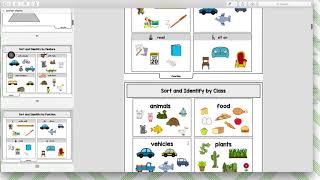
Sasha from The Autism Helper walks through the Anchor Chart Mega Pack, over 100 charts organized into ten themed booklets covering letters, vocabulary, grammar, writing, and math. The charts work as low-tech reference tools that let students find answers independently without asking an adult.
Chapters
Hi, this is Sasha from The Autism Helper, and this is a product review of my anchor chart mega pack. So I had a bunch of requests to put together the anchor charts from the curriculum, and I didn't want to do exactly that because the anchor charts in the curriculum sets are organized by the contents of each unit, so it didn't necessarily make sense. So instead, I kind of created a whole new set of anchor charts. There's 10 different booklets that they're included in. I'll go through how those are set up Each booklet has between 8 and 12, so there's over 100 anchor charts included in here. If you already have the curriculum, these will still be really helpful for you. There's some components that are similar, but there's a lot of extra materials, and I really like that the way this is set up, you can easily find the exact anchor chart right away. So if you're working on one of the skills in the curriculum, you can find the right anchor chart and kind of keep going So this would still be helpful along with the curriculum or on its own as well. So there's a table of contents. It shows you what's included. You can print just the books you want. You can set these up as booklets, or you can just use them as anchor charts that you post. So the first section is the basic skills. There is an anchor chart. I'll kind of go through what's included in here, and then I'll show you these tabs. I also have photos of how these are set up. So these are set up in sections. So you can bind this all together and then there's a tab for each subject or for each anchor chart and it's all tiered. So when you open up the book, when you open up the COVID of Basic Skills Anchor Charts, you'll see the 8 different or the 12 different anchor charts that are all included. You could grab the tab if you wanted to work on upper and lowercase letters, grab that tab really quickly, open up and you're right there. So all the books are set up in this tabbed system, but again you could also just print this and post this if you wanted specific skills in your classroom. So basic skills, we have uppercase letters, lowercase letters, upper and lower, letter, word, and sentence, color words, number words, shape words, big and little, sorting by feature, sorting by function, sorting by class, and same and different. That's all included in the basic skills. Again, you could put these in that tabbed booklet or just post them. To me, I love, love anchor charts as having this be a tool for students to work on problem-solving. Instead of, you know, you needing to sit and help a student to find all of the shape words, you You would provide them with this anchor chart, anchor chart, and they would have to reference that on their own. So by utilizing anchor charts, we're really teaching problem-solving skills, and that's such a critical skill our kids need to learn. Our kids need to run into problems. They need work that's a little bit too hard that they need help with, and then they have to figure out where to get the help on their own, not from an adult, from an anchor chart. So this is just like so pricelessly valuable for me. Next is vocabulary. So this is all sets of vocabulary. So if you're working on writing words or These would be great for looking at word-to-picture, sight word vocabulary, etc. So we have food, clothes, animals, school supplies, weather, body parts, holidays, seasons, households, community, community helpers, and transportation. Next we have parts of speech, and we have two different parts of speech anchor charts. The first set is the basics and the next one's more advanced. So here we have noun, verb, adjective, adjective, preposition, pronoun, contraction, adverb, and then a list of all of these together to work on discrimination. So that's the basics on parts of speech. And then we have advanced parts of speech. We have common and proper noun, plural nouns, irregular plural nouns, collective nouns, possessive nouns, possessive pronouns, comparative and superlatives, determiners and conjunctions, verb tenses, verb agreement, irregular past tense, and types of verbs. So tons of important grammar skills included in that. These would be great to focus on a certain skill for writing activities, for when you're looking in guided reading groups, and these just will pair so beautifully with the curriculum as well because a lot of these concepts are included in there. And then we have additional grammar and language anchor charts: uh, WH questions, vowels and consonants, non-literal language, comma rules, sentence rules, simple and compound sentences, types of sentences, subject and predicate, synonyms, antonyms, homonyms, homophones, um, all included in there. So great to work on some of those more complex language skills. Next we have writing. We have paragraph structure, introduction, details, conclusion, story elements, point of view, character traits, proofreading, narrative writing, opinion writing, informative writing, and research steps. So really essential for teaching some of those advanced writing skills. Next, basic math anchor charts. So similar to our foundational skills before, these are gonna be like the real basics. So we have numbers 1 through 10, 11 through 20, numbers 1 through 50, number words, big and little, more and less, odd and even, simple patterns, coins, bills. I will have Australian, Canadian, and British versions of these as well. So if you want to purchase this but don't need the American money, don't worry, we'll have the international versions available as well. 3D shapes, sorting included in there. Next, advanced math anchor charts. So this is everything besides kind of these operations. There's this operation sign, but there are specific books for addition, subtraction, multiplication, and division. You'll see in a second. But differentiating between the operation signs, skip counting, tallies, irregular patterns, time to the hour, time to the half hour, telling time, hour, minute, second. Adding money, enough and not enough, rounding to the dollar up, making change. Now this book's all addition and subtraction. Adding 1 through— adding 0 through 9, adding without regrouping, adding with regrouping, when to regroup. And then subtraction, subtraction 0 through 9, subtraction without regrouping, subtraction with regrouping, subtraction when to regroup, addition and subtraction word problems, time word problems. Money word problems and using a calculator. And last, multiplication, division, and fractioning charts. So this is the last set of math ones. Single-digit multiplication, double by single digit, doubled by double, multiplication word problems, single-digit division, division no remainders, division with remainders, division word problems. And then for fractions, we have just basic, what a fraction is, fractions on a number line, equivalent fractions, comparing fractions. So as you can see, there's just so much included for all levels. Like I said, anchor charts, to me, they're like low-tech Googling. When you and I don't know the answer, we look it up online. So by utilizing the system of anchor charts, you're teaching your kids to find the answer by themselves. They no longer need you. They can do it without you. They're solving a problem without you. Just such a really critical life skill to target by utilizing this type of strategy. Any other questions? Direct to theautismhelper.com.










