Sasha from theautismhelper.com shares eleven customizable social-skills rubrics that break down complex behaviors like greetings and turn-taking into observable criteria with explicit ratings. The editable PDFs include a data sheet for tracking growth across a quarter, and rubrics translate directly into measurable IEP goals like scoring 8 out of 9 on conversation skills on three consecutive days.
Chapters
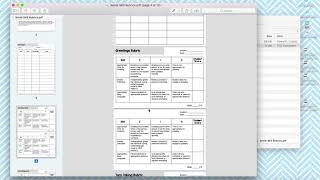
Hi, this is Sasha from theautismhelper.com, and this is the product preview of my social skills rubrics. So when you download this resource, it'll be a zip file of the PDFs and the editable version. So since our skills can change and the needs of our students can be so varied, um, this is all about customizing. So I wanted to make sure to give you the editable version of all the rubrics so you can switch around text or add or delete columns or components in case it doesn't exactly work for your students. So these can be customized as much as possible, adding students' names, etc. So there's a really pretty in-depth discussion on how to utilize these. If you are new to rubrics and are feeling a little intimidated, this will completely explain how to use these. And there's also this really great data sheet that can go with any of the rubrics because you might not want to be keeping all of the rubrics in a file. That's going to get kind of— there's going to be a lot of paperwork and then you have to flip through pages to see growth. But you can also just here put the dates, put the score you got, the total possible, and then any notes, and then you'll be able to really see growth over time. So this is great to go in the student's file, um, to bring to IEP meetings and kind of show overall growth over a quarter or a semester, um, and kind of keep track of the rubrics that way. So basically the reason that I initially created these was it's so challenging to take data on social skills because they're so complex. Even with something as simple as greetings, there's a lot of things that are included in greetings that we want to account for. And in order for our data to not only be meaningful but to make sense, we really have to account for all of those different skills. And a simple plus-minus— we can't say just had a conversation plus or minus. We need to include all these components. And how do we write IEP goals for that? You can use these rubrics right into your IEP goals. Instead of saying, you know, student will have a conversation with 90% accuracy, which means nothing. Who knows what that means? We sometimes, you know, inadvertently write these goals because we don't know what else to write. Instead of writing that goal, you can say, "Per attached rubric, student will have a score of 8 out of 9 on having a conversation on 3 consecutive days." So it makes it a lot more objective, and it's going to give you so much more information. So there's 11 different rubrics included. The rubric is repeated twice on each page, so you can keep these in a file, on a clipboard, in a binder. and track student progress over time, or if you're working with a group, you can look at 2 students and have it on 1 page and easily score. So there is greetings, turn-taking, basic conversations, group play, advanced conversations, group work, manners, visual group play, visual conversations, and visual manners. So the visual sets, the last 3 visual ones, can be used for both student feedback and for your own data, which is really great. And then these text ones also can be used for student feedback but might be a little bit more complex as far as giving feedback, but will provide you all this great information. So for example, it takes a skill like group work and breaks it down by leading the group, working cooperatively, doing your share, and taking turns. And then it's going to, you know, explicitly define what each rating within the rubric means so you can score the student appropriately based on the behavior and come up with a final numerical value. So based on this rubric, student scored a 10 out of 12. You can see, ooh, they're really struggling with taking turns. That's something I need to target. So it's going to give you some really great and valuable information. And again, this is something that as teachers we really struggle to take data on because we can't just do percentage or correct or incorrect because these are really complex skills. So this was a pretty brief rundown. I also have a very lengthy blog post on these social skill rubrics, but wanted to give a quick, quick rundown of the rubrics included here, and these visual ones are super helpful. Again, all this comes with the editable version as well. So this was a product preview of my social skills rubrics by theautismhelper.com.