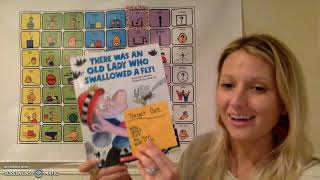
Gina from The Autism Helper shows how to use a core language board during storytime to teach vocabulary to students with autism. Highlight target words on the board, involve students in turn-taking and pointing, and use props to keep them engaged. She demonstrates with books like There Was an Old Lady Who Swallowed a Fly.
Chapters
Hi everyone, it's Gina from The Autism Helper. I'm here to show you, by popular request, how to use a core board during storytime. Of course, I can't record another student, an actual student, so just bear with me as I kind of give you the best example that I can. So the materials you'll need are one of your favorite stories. I have two that I'm gonna show you today. A core board. It does not have to be this big, but it's whatever that your classroom is using. Of course, if your child or one of your students has a dedicated dedicated device, you want to make sure that you use that device as well. But there's nothing wrong with having a big board in your room. And you can also use some washi tape, highlighter tape, pipe cleaners, whatever you want if you feel like you might want to highlight one of the core words that you're working on with your students. So for maybe like a big group instruction, a story or read aloud, there are certain words that maybe you want to target that week. Maybe it's just one word, maybe it's three, it's whatever is best for your students and what you're working on. But my first suggestion is, is to pick a story that targets the words that you want to work on and write them on the outside so that way you remember as the teacher what words you want to target on your core board. And then next, if you're worried about not remembering maybe where the words are, the symbols are on the board, one of my tips is using some washi tape and highlighting the words so that your eyes do go a little bit faster to the actual word. And then also it can help your students identify where they are on the board. A lot of the times I think we're afraid to use these language boards because we're afraid of not knowing where the word is. And the more you use it, the better you'll get at it. And you can't make a mistake, it's okay. So for example, I wanted to read "There was an old lady who swallowed a fly." So for my pretend class, the words that I want to target are who, what, eat for swallow. And you could even do my turn, your turn, because Sarah has already adapted this book with pieces, and you can get this for free on the Autism Helper website for downloading. And you can also use props if your kids are younger, or maybe if you need more engagement. I've seen on Pinterest, and I've used the small trash cans where you cut out a picture of the old lady and you put her on, then you can actually feed the old lady. Or maybe you have a paper bag or shoebox. Just different ways to engage your learners. So what you want to do after you've written your target words, depending on the length of time, your attention span of your crowd of children, sometimes if it's a longer book and I start to lose kids throughout the book, um, I will paperclip some of the pages together that are a little bit longer to keep their engagement higher. Obviously, this is a great book and you don't really want to skip any words, but sometimes to get your point across about core words or something that you're really targeting, it's okay to skip a few pages and get to the— what you're really looking for. So if I were in the classroom, um, if I had an assistant, I might have my assistant with a pointer point to the words as I emphasize them. Of course, we would know ahead of time what words we were going to emphasize. I might have a student helper up here emphasizing, or if I'm by myself, which I know a lot of us are, then I'm just gonna point to the word as I say it. You do not have to model every single book in, or every single word in your book. Remember, you're just looking at your target words. So for example, for this one, if I was reading it to my class, I would say, "There was an old lady who swallowed a fly." Now, is this the word swallow? No, but it's eating and it's going in our mouth. So it's okay to kind of use that same word. Swallow, swallow the fly. And those are my words. So I would go on, there was an old lady who swallowed a fly.
I don't know why she swallowed that fly, she won't say why.
And then I might have someone come up and pick the fly off of the page, or maybe I just have Eroliz and I hand them the picture, and I might say, it's Your turn to come up. Your turn, Mackenzie, whoever you pick. And then so on. And then I'm gonna turn the page. And obviously I paper clipped them a little bit.
There was an old lady who swallowed, who swallowed a spider that wriggled and jiggled and tickled inside of her.
So again, I'm not saying every single word and pointing it to on the board. I'm just emphasizing the who, and the swallow, the eat part of it. And then I might skip this page because maybe my learners are getting, you know, a little restless already. It depends on your age. And then they can come up and bring the spider on there, or you could say, oh, it's my turn, Miss Russell's turn to put on the spider, and so on. And then go to the next page that I have kind of paper clipped out.
There was an old lady who swallowed a— what is that? Bird! Good job, a bird!
And so on. So you get the point of that with this one. Another one of my favorites are the Adapted Farmer Series books. Again, you can target who, where by questioning first, my turn, your turn, if you're gonna have kids come up and actually do it or if you have a small group in front of you. The word in is in this book.
So for example, farmer, farmer, Who's in the tractor? Who's in the tractor? In the tractor. Hmm, let's find out.
So you're gonna see, use the same read aloud strategies that you would on any book.
Farmer, farmer, who's in the tractor?
Oh, and depending on your prompting level, who's in the tractor?
A, what is that? A pig? A pig is in the tractor. Oh no, a pig. Who can come up?
And so on. My turn, your turn. And this is a repetitive book, so you're just gonna keep targeting who and in. And then you might have, you know, it's your turn to come up or it's my turn and so on. So lots of different ways you can use this board. You can extend depending on your learners and the type of comprehension that you're working on. Did you like, did you like this book? Yes or no. If they're working on yes and no. How did the character feel?
Let's open the book.
Oh, it's stopped. It's all finished.
The end.
The book is finished. So lots of different ways that you can incorporate core language, but focusing on those target words really does help when you're reading a story. I hope you enjoyed this tutorial.