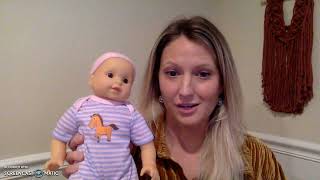
Gina from The Autism Helper shows how to teach receptive language through play with real objects like dolls and pizza, using hand-over-hand prompting and descriptive words like big, small, fast, and cold. She then moves kids from concrete objects to picture matching with multiple descriptors, embedding the same language into books and daily routines.
Chapters
Hi everyone, it's Gina from The Autism Helper. I am here today to show you some fun differentiated receptive language activities. You can use these with your toddlers, preschool, all the way up depending on what skills you're working on. I recently printed out these awesome receptive language cards by The Autism Helper, and they come in different levels with, um, a descriptor such as find the small animal and then adding in an additional descriptor such as find the small fast animal. So these are obviously going to be a little bit harder. My little toddlers aren't quite to this level or maybe even this level. So I wanted to show you how you can get here over the years or over time. So what I love to start with, especially with my little ones, but you can use this for any age and it could change, um, the appropriateness of the object could change depending on the age level of the child. I like to start with using real objects, especially things that are preferred to a child. So, it's doing during play type of activities. Find the baby doll and then have your child look and scan and find the baby doll. Maybe this is too much. Maybe 2 is too much and you just want to do some arrow lists. Find your baby doll. Touch baby doll and you can be holding it out or you could have it on the ground or up on the table or in the child's view. But using objects that are preferred to the children will help reinforce this activity even more. So again, you could choose from two, you can make it errorless, and then you might even have to start with hand over hand. Touch baby doll, and then have their hand touch it and find it or hand it to them. As you're doing this, it's also really important through play to work on different types of descriptors. So not only baby doll, but "Find the pizza, touch the pizza." Change up your language a little bit so it's not always robotic. "Find pizza, touch pizza, where's the pizza?" Switch them up a little bit. And then you can work on other descriptors such as big and small. "Find the big cheetah," or "Touch the small cheetah." So big and small, because these are all the skills that they're going to need to eventually do the cards later on. You can practice hot and cold. Maybe later on you're playing, um, with the pizza and you pick it up and you say, "Ooh, hot, hot, the pizza is hot." Or maybe you have an ice cream cone and you say, "The ice cream cone is cold." So using that language that when they get to an activity like this, that's a little bit more abstract being on the paper and not tangible like an object, they'll be able to do it. And then I love to bring them together during reading and when you're going through like a first words book or maybe you're reading about brown bear, instead of just pointing and saying, "Look, it's a bear," you can say, "Big brown bear." So increasing that language opportunity. You can always— I always love using a Core Language Board teaching big and little. And then there are also a different level card that are just find the match cards. So, "Touch the zebra." Maybe they're touching it here, and then you have to put— help them touch it on the card. So just finding the match. Find the zebra. And then you can eventually work your way up to the one descriptor, find the small animal, because these are all animals. If there was, um, some other type of, you know, food or something in there, then that would be even a little bit more probably challenging. But find the small animal, so that there's a lot of skills that go into it. They know, have to know it's an animal, that these are all animals, and they have to think about the size. So they have to have some type of background knowledge from that. So that's why doing this type of thing when they're little or working up to that and describing things differently instead of just banana, but yellow small banana or big orange cheetah is going to help you get to this level. And then eventually throwing in another descriptor, finding the small fast animal. So again, when you're playing with cars, it's not just a purple car, it's a fast car, or maybe it's a Slow purple car. So I hope that's helpful and gives you some different ideas to do at different age and skill levels.