Science Leveled Daily Curriculum Video Preview Level 1
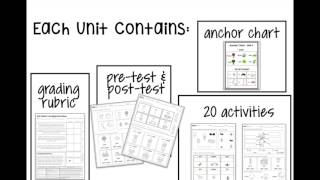
A science curriculum for students with special needs organized into eight thematic units like Plants, Animals, and Weather. Each unit includes 20 hands-on activities, identical pre and post tests, and a rubric that tracks specific error patterns to guide follow-up instruction.
Chapters
I'm really excited to share my— the little bit behind the scenes of my science curriculum. If you've checked out my language arts or math curriculum, the layout is very similar, and obviously with science content. So this is a video preview and kind of in-depth look at Level 1. So the Level 1, um, there's 8 different units, kind of gonna give you a little bit description of some of the content included in the unit. So this Level 1 looks at these very basic science concepts, and I also wanted them to be very functional, so things that could apply to not only our students' lives, but other curricular academic areas. Um, so Unit 1 looks at same and different and more complex sorting. Unit 2 looks at basic body parts as well as living and non-living items. Unit 3 looks at plants and adds 4 more body parts. And then Unit 4 looks at animals. Um, Unit 5 is seasons and bugs, really applying those seasons out not only to identifying, but identifying relevant items and clothing items, things like that. Unit 6 is day and night. I love, love, love this unit. There's so much great categorizing and discrimination that our kids can work on with day and night. And Unit 6 looks at space vocabulary: Earth, Sun, Moon, and Stars. So not really getting into planets yet, but kind of giving in that basic concept of outer space. Unit 7 looks at weather. The words are sunny, cloudy, rainy, snowy, foggy, windy, storm, rainbow, and lightning. And 8 is landforms. So some basic landforms, not getting too advanced yet, but still incorporating, um, different, you know, ideas like hill and river, mountain, desert, things like that. So every unit— there's 8 different units and a review unit. I'm just kind of giving a little sneak peek. I went ahead and bound mine with a cover. These covers are included. Um, but kind of a little view of the types of work included. There is some writing, but the writing in this level is very, very minimal. And even if you have a student that's a non-writer, I have a lot of great ways to accommodate this, and I use this system with a lot of non-writers as well. So each unit contains the same kind of set of things, and there's 8 units overall plus the 9th review unit. So each unit contains the grading rubric, a pretest, and a posttest. The pretest and the posttest is identical, and then you'll use that rubric twice. There's a spot to circle whether using it a pre or posttest. And then there's also an overall data sheet that comes with this whole unit, with this whole level, where you will track the date, the pretest score based on the rubric, and then the posttest score based on the rubric. So you'll be able to see growth, and when you're not seeing growth, it'll— there are some kind of analyzing the error section within each rubric that will show you what to do, whether you want to repeat the unit or you just want some focused instruction on certain concepts. So my favorite part of the rubric is that it breaks down not only where the errors are, but if there are errors on only specific content. Since each unit targets multiple types of content, you want to know what types of review activities to do that. So that's all built right into the rubric. Each unit has the anchor charts, which I love. People have done all kinds of creative things with the language arts and math anchor charts, giving their kids them in their binders, posting them in the front of the rooms, putting on the smartboard, things like that. And then there's 20 activities. So the idea is this unit could run for the whole month. You could do one page a day, or, you know, some kids, especially on, on level 1, you might want to be kind of practicing a little bit more and having each of the activities take a day or two as opposed to one day, but it depends how you want to structure it. Here's the anchor charts. Again, these are all the concepts included. Unit 1, Same and Different. Unit 2, Living, Non-Living with Body Parts. Unit 3, some more body parts plus plants. Unit 4 is animals. Unit 5 again is seasons and bugs. Unit 6 is day and night and outer space. Unit 7 is weather. And Unit 8 is, is landforms. So throughout all those units, you're really getting a well-rounded science curriculum here. You're getting everything from, you know, body parts and more biology-based concepts to weather to landforms, more geography-type concepts. So you're really getting a little bit of everything, which I really like. Um, each unit also, if you've used the language arts and math, kind of this also has another same feature, is that as the units build, within each unit there'll be a few review activities. So for example, in Unit 4, you might have an activity about living and non-living or body parts. So you're going to always be kind of looping back to that previously mastered content, which is so important for our kids. Here's an example of the grading rubrics. Like I said, it's very objective. There's gonna be no room for misinterpretation. You can score each assessment based on the instructions here, and then at the end you'll be able to analyze the errors and it'll show you within which, depending on how the student, you know, errors were allocated, what type of suggested activities are follow-up. So when your principal, your administrators ask for data-based instruction, here you go, data-based instruction. This is the data you're using and doing those follow-up and activities based on their errors, you're using that data to drive your instruction. So this is really key. Um, the pre and the post-test— here's a little example of these. The vocabulary can be used with students who are nonverbal by assessing receptive language, and there's instructions on how to do that. And then the 20 activities for each unit. Um, so Level 1, like I said, it's a lot of circling, a lot of matching, a lot of discrimination activities, sorting, categorizing, things like that. There is some writing, but it's pretty minimal, and you can add in that tracing component if necessary. So I'm just going to scroll through a few different examples of some photos and some completed tasks to kind of see exactly what is included and the different types of activities that are included in this unit. I really am so happy with how this turned out. If you have any other questions or want to see any more examples of this unit, please don't hesitate to contact me. I'd be happy to give you some more feedback. Please come check out theautismhelper.com.










