Setting Up ABLLS Task Cards in a Special Education Classroom
A guide to organizing ABLLS-R task cards in special education classrooms, covering how to set up cards by skill area, store them in photo organizers or baggies, and score them on a 1-4 difficulty scale. Cards include real photos and clipart prompts, with built-in data collection checklists for tracking progress.
Chapters
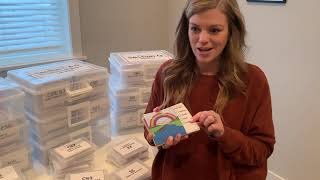
Hi guys, I feel like I'm Vanna White showing off my Ables set, but that is what I'm doing right now. So I finally got everything all the way organized and I want to kind of give a little bit more in-depth tour of everything that's included. I do have a video tutorial of the actual product of like exactly what's in each set on TPT, so if you're looking at the set and you're not exactly sure, there is a video linked of exactly what the task cards look when they're ready and they're made and all that. So I'm not going to show every single task card, but I'm going to more go over kind of like the layout, what's included, and then how you can buy it. Because you don't have to buy the big set, you can buy them individually, or there's some smaller bundles. So it's a little bit different than other ways I've set up. So let's rewind. The ABLES is the Assessment of Basic Language and Learning Skills. Oh my God, I just blanked. And it's an amazing assessment and protocol that I've used for years and years. It's evidence-based. Which is so great. It gives you an idea of not only where your student is at, but what skills they should do next. And in the ABLES, each skill or concept is labeled with a letter and a number. So the letter is what section the type of skill is. So G is labeling, so this is a labeling skill, and then 30 is the exact skill, so identifies a problem. So it's nice that everything is really organized. Previously, I've sold the ABLES assessment kit, which was all the stuff to give the ABLES. That was something I really struggled with as a teacher. I loved giving the ABLES, but I couldn't get all the stuff together. So that's a separate product. That's to just kind of give the ABLES, see where you're at. But what I was figuring out was that, okay, I know where I'm at, but now I want stuff to work on all these skills. And there's so many different skills included. If you have a multi-level class, you want to be able to know exactly what skill each student is working on and find it quickly. So that's where this kind of started. So these are all task cards that are specifically aligned to the ABLES-R The scoring's all included in here, which I'll talk about in a moment, and it's all kind of set up ready to go. If you don't use the ABLES and you don't want to use the ABLES, that's totally fine. You just disregard the letter and number. These are still just quality skills and concepts that your kids need to work on, whether it's language or reading or writing. There's so many great skills, so there might be a set in here that you're like, oh, I don't really have anything for that, but I don't use the ABLES. It'll still work for you. So this is kind of everything. I've organized mine in these photo organizers. I got them on Amazon, but I know Michaels and Joann's and sometimes Costco sells them. This was nice because everything fits in one set. The cards also fit really well in baggies or index card holders, so you could do that too. Um, I then labeled all of my boxes according to the skill section, so I have 3 boxes for Section B. Section B is visual performance. I've got 3 for C and G. I included— I kind of combined these because some of the skills that we'll talk about, the task cards work on both C and G. C is receptive language, G is labeling. So I've got 3 for C and G, I've got 1 for Q, 1.5 for R, which is math, and then half of this one is the writing, which is S and T, the T is spelling, there's one of those, and then H is intraverbal. So every bin is labeled, kind of gives you an idea of how many sets are included. So if this seems super overwhelming and like, how am I gonna get this all set up? You can get all of it in one massive bundle. So if you use the ABLES a lot, if you have a multi-level class, you'll be able to target your early learners who are just starting to build some of these skills and then your more advanced kids that are working on kind of more inferential learning. So that would be a good fit for you. If you are, let's say, a speech-language pathologist and you don't need the math section, you can also just buy bundles that are individual sections. So you can get just C and G together or just B together. Also, third option, you can buy them all individually. So you can get a set that is just the function cards or just the block design cards. So that's nice to pick and choose, especially if you're a parent or you only have specific kids in your caseload that are working on these skills. That's kind of a nice way to set this up. So in the ABLES, the scoring is specific to the exact skill. It gets harder and harder whether you score a 1, a 2, a 3, or a 4 on a skill. The, like, parts of the skill are gonna get more complex. So that's all included in here. So everything is labeled not only with the skill but with the score. So So for this, this skill is B9, Block Designs on a Card, and this one is score 3. This one has exact score 3 on here. Some of them, like B5, which is Match to Sample, the score's all written on the card. So these are the score— these are the cards for score 3 written on here. Score 4, as you can see, 3 is a little bit easier, 4 has a bigger field size versus Score 1 and 2 is just out of a field of 2. So these are nice, like I said, even if you don't use the ABLES, it's just going to take this skill and take it from easier to more complex. So that's kind of an example of one of the cards. I would say most of the cards are kind of this version where there's no Velcro involved, just laminate and cut and that's it. I wanted to make the prep as easy as possible. The section that is an exception to that is B because B has is visual performance. So we're working at how we organize things and how we attend to spatial awareness and things like that. So this one's going to be a little bit different. This one does have some Velcro involved. So an example is, is this one is sort by function. So there's 4 items that we're going to sort by function. We're going to sort things we write with versus things we cut with, putting the items here. We cut with scissors, we write with markers, we cut with a knife, We Write with a Pencil. They're still set up as a task card, but there is some laminating in these ones, but these ones are really, really cool. If you have kids with limited language, a lot of these are really fun to work on things like sequencing and seriation. The seriation ones I just love, so putting things in order whether it's numbers or parts of a picture or by size, just a great way to target this skill. You don't need any language to work on this, so So these are a great kind of set to work on. Section C and G are receptive language and labeling. I really love these because there's just so many skills in here that I hadn't thought of teaching. When I started using the ABLES, I was like floored because I had had kids for a long time and I just didn't know what to do next with them. And then once I did the ABLES, I was like, oh my gosh, we have so much to work on. So things like identifying a problem, I didn't know if my kids could do that, and once I started working on the Ables and going through, then it was a great thing to have new ideas of things to work on. So things like this, like identifying what's wrong and being able to explain that. A lot of these cards include a real photo and clipart version. There's a lot of real photos in here, which is nice because I feel like that's harder to find. Um, the function, feature, and category sets are all sold as kind of bigger series And these are nice because there's just a lot of variety. As you can see, these are all like pretty thick sets of task cards. I included a lot of examples and they'll get more difficult as you go on. So which one do you cook with? And now it's out of a field of 12 versus out of a field of 3. Um, the social interaction one I pulled because this one is one of my favorites. Again, having real photos, finding the correct photo of a social interaction, and we use the same social interaction multiple times. You have to find multiple versions of what celebrating looks like, what arguing looks like, what teasing looks like. So just words that you might not think to directly teach. This is another one. I think I'm saying everything's my favorite. This is another favorite. I just, I'm kind of obsessed with this set. First of all, super big set. This is Objects in a Picture, and I love this little checklist setup because you could almost use it as independent work or something like that. So you have to find the 4 items in the picture and check it off. This is a great way to kind of incorporate data right into your, um, into your activity as well. Find the flags, find the castle, find the fish, find the plant. Um, so this one is super fun to work on. Next we're on to the more academic-y sections. We have Q, which is our reading skills. Tons of cool stuff in here. My favorite set, I would say, from Q is this match words to pictures set. Just because I— whenever I show stuff like this, I make stuff like this a lot for one of my in-home clients. So whenever I show stuff, everyone— I get like a million messages because again, this is a great way to work on literacy with kids that have limited verbal skills and are still improving their verbal skills. You can still work on sight words. Like, just because your kid can't talk doesn't mean they can't read. So this is a nice way to access literacy skills without it being something that you need verbal skills for. Score. So finding the correct word for each picture, clipart, and real photos included in this guy as well. Um, for math, there's about a box and a half worth of math tasks, kind of all over the place, starting from like basic one-to-one correspondence all the way through finding zero, finding more and less, and touching a little bit on addition, subtraction. I love these match number to quantity ones. Again, the score is written on here, so a 3 is gonna have a higher quantity than a score— let's find our other one— score 1 is gonna have a lower quantity. And we have these both ways, whereas there's the numbers and then you find the quantity, and then we also have the quantity and you have to find the number. So working on it in both ways, which is really fun. The Ask section, you can buy all as one set because there's only like 5 or 6 tasks included, but these are pretty fun. I laminated mine still and and I'm going to use them with dry erase markers. So S is the writing, and a lot of it is for kind of our early guys, like early tracing, copying, um, whether it's a straight line to a curved line to a shape. So they really break down the sequence, which to me is really helpful. So S6 is copying curved lines, so just a range of different types of curved lines that get more complicated. Like the score 3, you can see, is easier than the score 1. And students can copy it right here. So a nice way to build that in. These are great, like I said, for work boxes also. And then our last section that I kind of skipped over here was H, which is intraverbals. And this one I set up a little bit different. I didn't label everything, but I put these on rings. So intraverbals are a verbal response that responds to another verbal response. We're getting fancy ABA here, it's okay. But basically it's different ways of answering questions, responding to comments, And these tools are really for you. They're for the teacher, they're for the parent, they're for the clinician, but they're gonna give you a wide range of types of prompts to use. Because I don't know about you, whenever I was working on some of these skills, these language skills in my class, I would get stuck on different ideas to think of. So if I was asking why questions, I'd be like, why do you cry? Why does the dog bark? Why does the dog cry? Like, I would have a hard time of thinking of a bunch of good ideas. So this is basically what these are— big lists of prompts. I love them on a ring because I think they're great for like the last 5 minutes in the center, to put on your own lanyard when you walk in the hallway. You guys can work on these. So like this one, H30s, discriminate between questions. So it's 4 different questions on one topic: where do you buy apples? What color are apples? Who could buy you an apple? When did you eat an apple? So giving you those prompts right here here. H40 is describing an item, so list different things to describe. H8 is— let me find my label here on it— is filling in the function for an item. There's a ton of cool feature, function, class ones in here. So you throw a and you have to fill in the item based on the function it's giving you. You sit at a, you wash with a, So these are just so cool. When I started working on these interval skills with even some of my kids with a lot of language skills and realizing that they were struggling on a simple concept like that, when I'd say you throw a, and they're like, yeah, throwing, like they weren't able to match the item with that function. It was really great in their language building skills to start on this. So that's a lot of information. I was trying to summarize this as much as possible, but obviously I really love this set. So if you have any questions, feel free to email me, drop a comment, happy to answer it. Like I said, everything can be individual in kind of these separate little bundles or one massive big bundle. So the best time to grab this is when it's on sale, um, because it is such a big product, it is more expensive, there's a lot included. So when it's on sale, definitely take advantage of that and grab the discount. Thanks!










