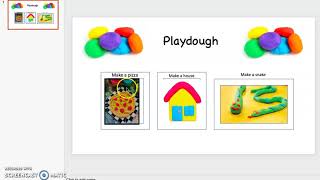
Gina from The Autism Helper shows how to use a Play-Doh board with three visual choices to move kids away from solo, repetitive play toward shared activities. Start with 20 seconds of joint attention, model the activity out loud, gently guide their hands, and gradually add choice language to build collaborative play.
Chapters
Hi everyone, this is Gina from The Autism Helper. I'm so excited to show you this idea today. We're talking about fun activities to distract a child who might engage in what we call self-absorbed behaviors or stereotypical movements or play that often results in them playing completely by themselves, not paying attention to adults or peers or moms or dads or their siblings, and so they're missing out on that shared connection, that joint attention that, you know, helps them look at facial expressions and share those experiences. So once you start grabbing your child's attention a little bit more at a time, maybe it's 20 seconds, a little bit longer, um, I made this little Play-Doh board for a student who enjoys Play-Doh. Or maybe your child enjoys cars or spinning the wheels of the cars, not necessarily playing with them appropriately quite yet. So this is a way to create that share, that joint attention shared experience so that, you know, you're increasing them from not playing just completely by themselves. All right, so for Play-Doh, say your child likes Play-Doh, but maybe they just take the Play-Doh and they just, you know, crumble it between their fingers and let it fall on the floor, or they take one of the tools like the roller and they just wave it, you know, calmly in front of their eyes, and that's all they do with it at that point. And not that children aren't allowed to just play and do what they want with certain things. Of course, they're not going to play exactly the way we might accept them, but if it is an unusual way, you do want to interrupt those activities. You don't want them just completely always being by themselves, always playing, never noticing the world around them. We don't want that all day long. So for Play-Doh, I just did a simple board with just 3 things. You can beef it up, you could have 2 things, you can do whatever you want. And I thought these would be fun, such as making a pizza, making a house, and making a snake. So, with your child, you know, when you have the Play-Doh out, maybe they start out doing their typical, you know, stereotypical behavior, and you're trying to grab their attention, and maybe you're doing something by yourself and they're not paying attention. So, you could put this card in front of them, or if you have it on iPad if you don't have it printed, and say, "Which one do you want to make? Do you want to make a pizza, a house, or a snake?" And maybe they'll pick one, or maybe they'll look at it, or, you know, If they don't at all and maybe they move a little farther away from you, you say, "Okay, I want to make a snake," and you point to the picture. Maybe they glance at it. That could be the first step. Then you are just going to model out loud what you're doing. "I'm going to take my green plate. I'm going to roll, roll, roll, roll, roll." Then maybe you slide it next to them and you take their hands lightly and you go, "Roll, roll, roll, roll." Maybe they do that with you for a few seconds. "Okay," and that's okay. And then maybe they go back to crumbling, you know, their little pieces. A lot of time they need to just learn how to use, you know, the material in a different way. So you can use this to increase your play with your child and maybe they look at you for a second and you're smiling. "This is so much fun. I'm making a snake roll, roll on the table. What color do you want?" And then you can get into choice and core words and just kind of go from there. But the point is, is to give yourself a little bit of structure and the kids structure and to make those shared experiences so that they start paying attention to you more. And then the more you do this, I think the more likely you will see them starting to engage with you even more. So I hope this helps. Like I said, you can make this for any type of activity that they enjoy and then just work up from there.