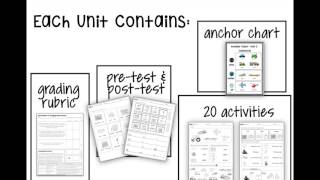
In this video Sasha from The Autism Helper introduces a ready‑to‑use Level 1 social studies curriculum designed for early learners and students with autism. She explains why social studies often gets squeezed out of the school day and how this complete, pre‑packaged program can fill that gap. The curriculum is organized into eight thematic units—basic geography, places in town, transportation, government, community helpers, family roles/personal information, holidays, and basic history (now vs. long ago)—plus a ninth review unit. Each unit follows a consistent layout: a grading rubric, pre‑test and post‑test, an anchor chart, and 20 functional activities that rely on circling, coloring, matching, sorting, and minimal writing. Anchor charts serve as visual reference tools to promote independence. The grading rubric and accompanying data sheet enable data‑driven instruction by tracking pre‑ and post‑test scores and identifying error patterns. Sasha emphasizes flexibility in pacing (a unit can span a month or be repeated) and the suitability for students with limited verbal skills. She invites viewers to contact The Autism Helper for more details.
Chapters
Hi, I'm Sasha from The Autism Helper, and I'm super excited to share my social studies leveled curriculum, Level 1. So this unit focuses on the most kind of foundational entry-level concepts, but still a broad range of social studies concepts that will give your students that well-rounded social studies knowledge. Social studies is something that I really struggled to fit into my day. I was very focused on trying to get in all those language arts and math goals, and by the time you do that, you're often not left with very many minutes gets to work on science and social studies, much less plan for it. So having this complete curriculum that is ready to go and you can have fully prepped and ready for your students before they even walk through the door will be huge for your year. And you're going to give them so many great functional skills because I really made sure to put a functional spin on everything that it's going to be really valuable for your students. So here's the curriculum map. Um, each unit, each level has a curriculum map to show all of the skills that are taught in each unit and kind of give those details so you can see that sequence of skills over time. With things like Science and Social Studies that have so many different content areas, we want to really make sure we're not jumping all over the place, that we're spending some time delving into each concept before moving on to the next one. The first unit teaches some basic geography vocabulary focusing around the map, globe, and compass. Unit 2 looks at places in town Unit 3 looks at transportation vocabulary. Unit 4 looks at government vocabulary. Unit 5 looks at community helpers. Unit 6 looks at family roles and basic personal information. Unit 7 looks at holidays, and Unit 8 looks at basic history items from now and long ago. So there's 8 units included in this resource, as well as a 9th review unit. Every unit is based on those concepts that I just talked about. Since this is Level 1, there's very minimal writing. I understand that a lot of us have students that can't write or are new to writing or writing is a big struggle. So a lot of these activities will involve circling and coloring and matching and sorting. There is some minimal writing, but I can share some— I'm doing some blog posts right now on some tips for eliminating the writing component altogether in these units. So each unit has the same layout. Each unit includes a grading rubric, It includes a pretest and a posttest, an anchor chart, and then 20 activities. The anchor chart gives that visual component to the concepts being taught, and we really want to teach our kids to use these anchor charts. We want our kids to be problem solvers, so when they don't know the answer to something, when they don't know how to spell restaurant or they don't know which one is a globe, we want them to reference the anchor chart to find the right, right answer, not rely on our prompting for the right answer. So this kind of shows you exactly the concepts that are being taught in each unit, as well as how you can use these to teach your students these concepts. So Unit 1 is going to look at some basic map vocabulary, as well as land and water and things like a street. Unit 2 has 12 different all-around town concepts that students will be working on. Unit 3 looks at transportation, but it also divides transportation into land, water, and air. So there will be some categorizing and sorting in this unit. Unit 4 has 6 major vocabulary terms related to our government. Unit 5 has 8 community helpers as well as the associated items with those community helpers. Unit 6 has the 4 kind of main family members: mom, dad, son, and daughter. And this anchor chart you'll individualize for each student, and each student will have their own copy because we'll be working on their name, address, and phone number. Unit 7 looks at holidays, not only the date of the holiday but associated items. And then Unit 8 has several items, the corresponding components from now and long ago. So not necessarily looking at what time period things are from, but just knowing that things are current first, things are from our history. So starting to teach that passage of time to our early learners. So the grading rubric to me is the most valuable component of this whole curriculum. Because it's going to give you a numerical value related to all of these different concepts we've been talking about to show growth. So you'll give the pretest before you start the unit. After the whole unit's complete, you'll give the posttest. There's a corresponding data sheet that will allow you to track the date of the pretest and posttest as well as the score. And then you're looking to see that growth. Did your student get more points after you completed the whole unit? And if they didn't get all of the total possible points, How can we analyze those errors and look at where those errors are on that post-test to plan further instruction? So that data-driven instruction that everyone's talking so much is built right in. So you'll be able to say that you are doing that and know exactly how you are doing that as well. So here's an example of the pre-test/post-test for our, our students with limited verbal skills. We'll be looking at building that receptive language vocabulary, which is really key. And then there's 20 activities. So the activities can be spaced out where you're doing one a day and have each unit last a whole month, have this curriculum last a whole year. But I know especially with our early learners, sometimes that speed and pace of instruction is a little bit too quick, so you might want to even go through the whole unit twice or do activities more than once. So here's some examples of some different activities included in the unit, um, things with following directions. Um, again, I love the vehicle transportation unit because That sorting items by land, air, and sea, I really, really like. Finding the match for different vocabulary terms, finding the correct word. And even if your kids aren't readers, they can reference those anchor charts, and if they can match, they can do this activity. Finding the right community helpers item, finding the— again, finding the right community helpers item, and looking at those items related to now and long ago. Again, this is a matching task, If your student can utilize that anchor chart, find the correct item, match it to the word "now" or the phrase "long ago," they'll be able to complete this task. Here's what some of the pages look like in full. If you have any questions about this unit or any of the units, please don't hesitate to let me know. I'd be happy to kind of get even more in-depth via email about if this would be a right fit for your students. Please visit theautismhelper.com.