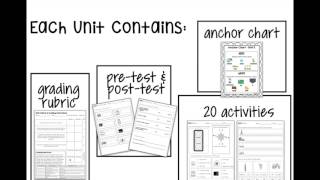
Sasha from theautismhelper.com walks viewers through the complete structure of the Level 2 Social Studies curriculum designed for learners with autism. She explains that the curriculum follows the same format as her Language Arts and Math programs, featuring a curriculum map that sequences eight units: (1) cardinal directions & map vocabulary, (2) city vs. country & traffic symbols, (3) famous world landmarks, (4) basic government & roles of president/vice‑president, (5) needs vs. wants, (6) extended‑family vocabulary, (7) holidays around the world, and (8) famous historical Americans (with a planned non‑U.S. alternative). Each unit contains a grading rubric, pre‑ and post‑tests with corresponding data‑sheet, an anchor chart, and 20 differentiated activities. Sasha emphasizes that anchor charts serve as “Googling” tools to promote problem‑solving rather than rote memorization, and that the pre/post‑test data drive instruction by highlighting error patterns and suggesting targeted activities. She notes flexibility in pacing (one activity per day or multiple per day) and the intent to build generalization across varied examples. Finally, she mentions an upcoming version of Unit 8 for non‑U.S. users that will replace the American‑focused content, and invites questions from educators.
Chapters
Hi, this is Sasha from theautismhelper.com, and this is an in-depth video tutorial of my Level 2 Social Studies curriculum. So I want to give kind of some in, you know, an in-depth look on everything that's included in this unit, the structure of it, and the content that's taught. If you've used my language arts or math, or you've checked out those video tutorials, it's set up in a very similar way. It includes a lot of those same components. I've gotten a lot of great feedback on how easy it was to set up and how much you liked the rubrics and the data sheets, everything like that. So I wanted to be really consistent, not only for your students but for yourself, so you'll have a lot of the same systems in place for this other content area. So the curriculum map is really kind of the guiding force of this, of this whole level, and shows you exactly what concepts are being taught in each unit and kind of the in-depth details of it. With things like science and social studies, there are so many different concepts that you can teach that it's easy to kind of be all over the place and do a little bit of this, do a little bit of that. But this curriculum map will really show you how you will be sequencing out and going through all of these concepts throughout this whole level. So Unit 1 teaches cardinal directions, basic map vocabulary, and some basic map comprehension. Unit 2 looks at the difference between a city and a country and traffic symbols. Unit 3 looks at famous world landmarks. Unit 4 looks at basic government vocabulary and the role of the president and vice president. Unit 5 looks at needs and wants. Unit 6 looks at extended family vocabulary and family features. Unit 7 looks at holidays around the world, and Unit 8 focuses on famous historical Americans. Um, so kind of giving a little sneak peek, I went ahead and bound my copies and used that cover, which is also included. I just want to give a little flip through of the different pages to see what the different activities look like. If you looked at the Level 1 video, the Level 2 has more— a little bit more writing, a little bit more focus on literacy, as that would be the level of these learners. So there's 8 different— 8 different units. Each unit includes a grading rubric, a pre and a post test, an anchor chart, and 20 activities. Here's an example of the anchor charts. So the anchor charts in Level 2 and Level 3 definitely get a lot more detailed because these are some trickier concepts we're looking at. I really want our kids to use these anchor charts. These are not cheating, these are not them, you know, looking up the answer, you know, finding the answer in a bad way. This is our learners becoming problem solvers. You know, I might not know exactly where the Taj Mahal is, but I know where to go find the answer. If it was me, I'd probably Google it, but our kids maybe don't always have access to Google. These anchor charts are gonna be their Googling. So in the activities, if there's a question they don't know the answer to, I don't want them to rely on our prompts. I want them to come to the anchor charts to find the answer. So Unit 1 looks at cardinal directions, some basic map vocabulary. Unit 2 looks at the difference between a city and a country, as well as some 8 common traffic symbols. Unit 3 has 8 famous world landmarks, a description of what it is and where it's located. Unit 4 looks kind of getting into the very basics of government— what a government does, what citizens do, and then two important leaders in our country, the President and Vice President. Unit 5 looks at discriminating between things that we need versus things that we want. Unit 6 gets into some extended family vocabulary: grandma, grandpa, uncle, aunt, and cousin, and then some features of a family. Unit 7 looks at six holidays around the world, what the holiday is, when it's celebrated, and where it's celebrated. And Unit 8 looks at four famous Americans of the past. If you are not from the US and you are looking to use this product in your country, like if you're from Canada or Australia, I'm in the process of working on a resource that will not include Unit 8 but will include different content in Unit 8, so you can still utilize this as you might not be obviously interested in famous Americans, but this will include new content. So be on the lookout for that. It will also obviously not have the president, vice president stuff. So grading rubric. Each grading rubric will be used to grade the pre and post test. There's also a corresponding grading data sheet. So the goal here is really seeing growth in the numerical value from the pretest to the posttest. You'll give the pretest before you start the unit and the posttest at the end, and you want to see your students' score improving. You want to see that all of that learning that they've been doing, all that instruction that you've been doing, is translating into increased knowledge and increased ability to demonstrate those skills. When our students are still having errors on the post-test, we also want to be able to use that data. We don't want to just say, "Okay, well they don't know how to do this, let's move on." We want to know, "Okay, well what do I have to do to make sure they know this in the future?" So that's built right in. This whole section at the bottom that says analyzing the errors will be used to assess exactly where the errors in the post-test are and what suggested activities you should do with that student. So you will be using the data you take to drive your instruction. So that data-driven instruction that everyone talks about is built right into this assessment. Here's an example of the pre and post test and then the 20 activities. So there are 20 activities in each unit, so you could do one a day and have this unit last the entire month. Science and social studies might be laid out a little different than language arts and math. Maybe you want to do two a day and have this be every other day or do this in little sections. So there's a lot of options on how you can kind of organize and set up this whole unit. So here's some pictures and examples of what the pages look like. A lot of different ways to demonstrate the same skill. I really want to work on generalization and build that generalization right in so our kids aren't memorizing one activity, they're showing the same concepts that they know them in a lot of different ways. So some different ex— examples here, things like needs and wants, famous landmarks. So a lot of different examples on how to work on these same skills. If you have any questions on Level 2 or any of the Social Aids levels, please don't hesitate to let me know. I'd be happy to answer any questions. And thanks for watching. Please visit the Autism Helper