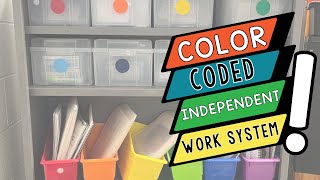
Jen, an autism teacher, walks through a 3-shelf independent work system for K-2 classrooms. Color-coded task boxes on top hold differentiated ABLE cards matched to each student's level, the middle shelf has file-folder activities and adaptive books, and the bottom offers choice items like puzzles and manipulatives. When students work independently, teachers can run small-group instruction and interventions instead.
Chapters
You know what makes for a successful classroom? Independent work. I'm Jen. I'm a K-2 autism teacher. I'm one of the bloggers here at The Autism Helper, and I want to show you how I use independent work in my classroom because when students are independent, things run so much smoother. Let me show you the system I've got set up. I am positive that you have heard of the 3 drawer system. If not, it is simply 3 drawers with 1 activity each for students to complete, and when they are done, they're done with their independent work. I needed something a little bit more diverse for my students, something that I could really diversify not only the contents but the length of activities and the number of activities that my students were doing. So this is what I came up with, a 3-shelf system complete with reinforcers at the end. I love color in my classroom, but it all serves a purpose. All of my students are color-coded, so each student has a color, and when they go to look for their independent work or a bin or their cubby, It is all color-coded. A lot of that comes from the reason that my students come to me as kindergartners and sometimes they don't know their name yet, and so name identification can be hard, but color matching is a lot easier than name matching or name ID, so we start with color. So the first part of our 3-shelf system are task boxes, and that's what's all the way up here. Each bin looks like this. Students come and grab their color, they bring it down, and each bin has a unique number of task cards or task boxes in it, and so the difficulty and the number of activities is differentiated for the child. I love using the ABLE task cards for independent work because as soon as they master that skill, you can move it right over into independent work. It's something familiar, it's something students have already mastered, and it's easy to pull and it's easy to organize. Next up, work boxes, and these are the colorful bins right there. Students grab their work bin in their color and they come on over. There are two components to work bins: file folders working on different skills, and then also adaptive books. I love the Easy Matching Workbooks, especially for students who are new to independent work, and maybe they are just at an error list or they are just at matching skills. These are phenomenal for those types of learners. Look, put the food on the table, put the laundry in the baskets. This is the life skill set. I honestly own every single set, so no shame in your game if you do too. Step 3, time for student choice. I love incorporating student choice whenever and wherever I can, and one way that I do it is on my independent work shelf. Students can choose whatever activity they want from the bottom shelf. Now inevitably, students are going to maybe choose something that is too easy for them, That's fine, I really don't care. My purpose here is that the task is independent. I love adding fine motor things like puzzles, those sort of things, pop beads, learning toys, learning activities, sorting kind of manipulatives, something hands-on and fun for students to do that they get to choose. Ta-da! There you go. It doesn't have to be fancy, it doesn't have to be pretty, it just has to be functional. If you have a shelf, You can make this happen. So if you don't have independent work and you are feeling like you are spread so thin in the classroom, I urge you to take a look at that independent work piece. And even if your students aren't at the level to where they can do complicated work, you can get easy tasks that they can do and you can work with your students so they can become independent. That independence comes with freedom as a teacher because then you can run small groups, you can run fluency stations, You can do all kinds of things because your students are independent. And remember, our job is to work ourselves out of a job. We want our students to be independent. We want them to be functional without us. And that's what independent work does.