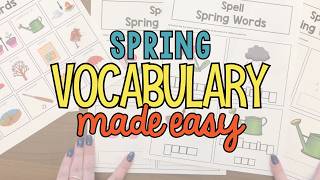
In this video, the presenter showcases the revamped Spring Vocabulary Kit from The Autism Helper, emphasizing its utility for teaching seasonal vocabulary in special education settings. The kit includes colorful anchor charts covering spring holidays (Earth Day, St. Patrick's Day, Easter, Mother's Day, Father's Day) and a variety of differentiated activities such as picture‑picture, picture‑word, and word‑word matching, as well as multi‑level spelling tasks (cut‑and‑glue, tracing, boxed writing). The presenter, who has used the materials in K‑1‑2 self‑contained autism classrooms, highlights how the resources support learners of diverse abilities, allowing teachers to tailor instruction while keeping lessons fun and engaging. The video serves as a practical demonstration of the kit’s components, instructional flexibility, and relevance for spring-themed vocabulary instruction.
Chapters
I love teaching vocabulary in the classroom, and one way to keep it fun and fresh is by using seasonal vocabulary. And that doesn't just mean spring, summer, fall, or winter. I want to show you this brand new revamped product from The Autism Helper because I think it really does a great job of differentiating how you can teach vocabulary in the classroom, keeping things fun and fresh, but yet meeting the needs of every learner in your classroom. You can see this is just packed with materials for you. So when you purchase this kit, you will see that there are so many pages to it. And so you get directions, which I just love. It tells you all the different pieces that you're going to get, but every unit comes with this fun colorful anchor chart, and there's one for all of the holidays in spring. And so, you know, there's regular spring vocabulary, Father's Day, Mother's Day, Easter, St. Patrick's Day, and Earth Day. So plenty to choose from, lots to fill your spring with. The thing about spring and teaching in the spring is that you can try new things. So even if you haven't taught vocabulary now's the time to try it. It's something new, something fun, and something engaging, and something that can be done for all of your learners. I used this in the K-1-2 classroom. I taught mostly self-contained autism, and I had a wide variety of learners. And one of the reasons that I loved this product is how differentiated it was. I could use just this anchor chart and have students do matching, with it. I could have students do matching picture to picture, so I would cut these out and have students match the picture. I could do picture to word, or I could do word to word. So really a wide variety here. There are so many great things that you can do with this anchor chart. One of my favorite activities is the spelling activity. Now you might be thinking, um, my students are not ready to spell. That's fine, but if they are able to match word to picture, you can cut these words out. These are all the vocabulary words found on the anchor chart. Cut them out and then have the student glue them. They can use the anchor chart as reference. Of course, if your student is ready to write, they can just write the word in the box. If they need tracing support, there's tracing support as well. And if they're ready to write, but they need a little bit more structured support, there's the boxes to where they can write as they go. And so this just makes this activity so differentiated. This is 4 different ways that my students can work on spelling these vocabulary words, work on the vocabulary word recognition in a fun and creative way. And this activity is available for all of the anchor charts. So you will find that for every single vocabulary word for Earth Day, St. Patrick's Day, Easter, Mother's Day, and Father's Day. It really is such a comprehensive vocabulary unit. It is a great way to add something fun and fresh this spring.