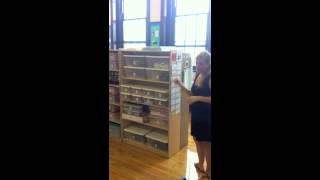
An autism classroom teacher shows how to organize 50 labeled bins on two shelves for table-time work tasks, using baseball-card holders and milk crates to save space. Students pick a bin, complete the task, and return it with a number marker for unfinished work. The system fits simple and complex tasks side by side for differentiated instruction.
Chapters
The main station in the middle of the room is the main tables here. We use these for kind of big group tasks, but also for table time. I called this on my Teachers Pay Teachers the most space-efficient and— now I'm forgetting— the most organized and space-efficient work task system ever. And that's a mouthful, but I really think it's true. I saw this in a training a few years ago, and I'm so happy I did this because I have over 50 tasks on 2 shelves. That's it. And you know what? My lowest kit and my highest kit all use the same work task, the work system. Like, everyone uses this system. There's 50 tasks. It does not take up that much room. It does not look that bad. This takes up 1,000 times less room than having 10 3-bin work drawers, and everything's right here. So the way this system works is each bin is labeled with a letter or a number. and each kid has a schedule. So over here, I call this table time. Each kid has a schedule, and I just put a few up here so you can see. So this student has letter F, letter E, and letter D. So when he comes to do it, he takes letter F off, he matches it to F, he takes it down, he sits here, he does the task, and then he puts it back. He leaves the number, which is kind of key because then you know which ones you need to redo at the end of the day. End of the day. So he comes back over, gets the next one, he has E, he does the same thing until he's done, no more left, and then he goes on to his next piece in his schedule. The way that this is so awesome too is you can put super easy tasks in here and super hard tasks. Like I have a lot of these index card tasks, sorting by date, alphabetizing, sorting coupons by category, some like higher level thinking skills. I also have sorting screws and some really easy things that my lower kids can do, like assembly tasks, putting nuts and bolts together. So I can have these easy tasks right next to a complicated task like figuring out items on a menu. So all of this can be in the same two shelves, and I just can't say enough about how much easier this has made my life. So I really recommend if you have students that you think this would work for to do this. We keep all of our table time pieces, the letter and the number pieces, in baseball card holders. You can get these at Target. I just keep my text pictures stored in here. This is super easy to store everything with a list of the tasks, and then my aide sets this up at the end of the day. The last thing I want to show you just really quick is my closet and how we organize all of our work tasks. So since we are a very old building, we have a lot of storage which is nice, but I've like packed it to the brim as you can see. I did this one of my first years because I had no nice storage materials and didn't know where to put all my stuff. Well, I get crates for free because milk comes to my school, so they don't really care if you take the crates, or I mean, I just did it without asking. So I put 9 crates on the side, labeled them, and I keep all my tasks here. So Matching tasks, math, assembly, life skills, reading, fine motor, all go here. And all my file folders go in here with manipulatives in the back, math materials. And here's all my reading materials with all my different flashcards. Here are the word sorts that I was talking about earlier too. Um, so everything's stored in one spot. Everything's labeled to an almost embarrassing degree, but that way everyone that comes to my classroom, since I have several aides, therapists, if people need extra art supplies, paintbrushes, pencils, everyone knows where everything extra is. So that's pretty much it. Thanks for watching, and if you have any other questions, come to theautismhelper.com. Thanks!