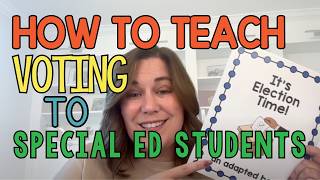
Jen, a former autism teacher, shares scaffolded strategies for teaching elections to students with special needs. Start with concrete voting activities like choosing between fruits, use adaptive books like "It's Election Time," and progress to understanding candidates and parties. Visual games like election bingo and picture-matching activities work for varying skill levels and AAC users.
Chapters
As we near November and an election year, I want to share some strategies for you for teaching your students all about the election. I'm Jen, and I am a former K-12 self-contained autism teacher, and teaching the election and the process of an election, especially a presidential election, was always tricky because I wanted to make sure that my students had access to the content, but it was appropriate. Appropriate. I've got some resources here today that I think are gonna really aid in that if you are in the same position in your classroom. First strategy I suggest you try is simple voting. This doesn't have to be complicated and it doesn't require a lot of stuff either. Gather some things in your classroom and start asking your students, would you rather do this or this? Or in my example today, would you rather eat a banana or a kiwi? What I'm doing here is I'm associating language with objects. So I want you to do the same thing. For example, maybe you pick blocks and cars and you ask your students today, "What would you rather play with, blocks or cars?" When you do that, I want you to provide the object and allow the student to pick the object or provide pictures of the objects so students can pick. That in itself is a skill. Having a student pick something is a skill, especially from a variety of 2, 3, 4, or 5. You can make that as big of a field as you want. I always start with just 2. It makes it a little bit easier in the beginning. Now that I've got my students being able to pick, I'm gonna move to more and less. So now we're gonna start tallying, and we're not just gonna talk about what I would pick between the 2. I'm going to vote. In order for students to vote, we need to keep count. So I'm gonna keep tally marks on the board. Maybe 5 friends want a banana and 3 friends want a kiwi. At the end, we will count all of the tallies or all of the marks, maybe even all of the pictures, and I would count those votes, and then we would count and figure out which one was more and which one was less. By doing that, I'm showing majority rules. Now, I know it's not that simple in an electoral college and that process, but remember, these are the building blocks of learning towards an election. And so I'm starting very basic and very small. My second strategy for you is to make sure that you're making content and vocabulary accessible for your students. One great way to do that is adaptive books. This is one of my favorites. It's called It's Election Time. It walks students through an election and the voting process with easy pictures and matching vocabulary. So really, students have adaptive materials at their fingertips to make sure that they have a way to understand the content. Additionally, I wanna make sure that I'm providing opportunities for students to be successful and show their knowledge. And so most of my students are matching students. So here we are matching simple vocabulary picture to picture, and this is all Election Vocabulary and students will be able to match this. Additionally, I just like to have a variety, so I use these as well. For my students who are above picture to picture matching, maybe they are picture-to-text matching, this is a great option. So now I'm giving the definition and the picture and the students have to match the two. If my students are beyond that, um, what a dream, maybe a true or false that goes along with my book to measure comprehension would be the way that I would want to go. Once my students have gained that general election content and knowledge, I want to move forward to teaching the presidential election. Now this election a big one. You know, our presidential elections, those are the ones that we think about when we think about the election process. And so this is a great adaptive book that talks about the two candidates, and it does it in a really factual way. And so it just talks about when the election is, who the candidates are, what parties they represent, and it's done in a very adaptable way for your students. I love that it talks about Whoever has the most votes wins the election, and it really reinforces the concepts that I've been teaching and the strategies that I've been teaching all along. Additionally, I love a good visual, and so this unit right here actually comes with all of these materials and these visuals, comes with games. So if you've got higher-level learners, you could do election bingo. I mean, how fun would that be on Election Day? Or even I have Who Has. I'm excited to laminate these and cut these out. But if I were just using that adaptive book and I wanted to measure student comprehension, I could use this. This would be amazing. I would read the question to the student and then ask them to pick, or I could have the student read it to themselves. If a student is beyond picture prompts and they don't need to match, I could just use this one, which is just text. Or if I have students who are writers, they could use this one. I really love this option for students who struggle with fine motor, and we know so many of our special education students need fine motor support. So I love that my kids can show me their knowledge and I don't have to rely on that fine motor support or possibly an AAC that doesn't have some language programmed in it. So this is a really great way for students to be able to show comprehension. Always, I love learning from you, so if you are teaching the election, definitely let me know how and what strategies you're using, what materials you're using down in the comments. I will link all of these things for you so you've got them at your fingertips if you are interested. But no matter what you do, don't be afraid to teach the election process. Even our students who are simply making choices or matching can learn about the voting process.