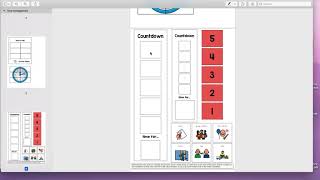
In this product preview, Sasha from The Autism Helper demonstrates a comprehensive visual resource pack designed to teach and support time‑management and waiting skills for children, especially those on the autism spectrum. The pack includes a variety of manipulatives and printable templates: Velcro‑based waiting countdown pieces for short and longer intervals; two sizes of “Build‑a‑Clock” visuals that can be assembled as time passes; customizable countdown boards for different transitions; a stoplight‑style waiting system with movable arrows; step‑by‑step visual task analyses for using timers; several schedule and graphic‑organizer templates ranging from simple daily schedules to detailed time‑blocking sheets; wait‑cards and social‑story visuals that outline appropriate waiting behaviors; and choice boards that let students select expected waiting actions. Sasha explains how each tool can be used in classroom or one‑on‑one settings to make abstract time concepts concrete, promote independence, and give students control over their waiting strategies. The overall message is that the pack offers flexible, hands‑on supports for teaching waiting and time‑management across a wide skill spectrum.
Chapters
Hi, this is Sasha from The Autism Helper, and this is a product preview of my time management and waiting visuals. I am super excited about these. There's a ton included for a wide range of skills, for both simple waiting to more advanced time management. There's a lot in here, so I'm excited to show it all. I also have a real photo— a real video of the products kind of prepped already on the TPT description linked there. So first up are two different versions of a waiting countdown. So these timer pieces are Velcroed here, and this is a nice way to show the passage of time. So whether you're waiting 20 seconds or 5 minutes, you can slowly pace out giving these pieces to show that, hey, when you get all these pieces, waiting is over. Waiting can be really hard, especially when some of our kids don't understand yet what 5 minutes means or 2 minutes means, so this is a nice way to show that. Another twist on this is with this Build a Clock picture, and there's 2 different sizes. You will cut out these pieces and same idea, add the clock pieces as time goes by. When the clock is completed, like it says on the bottom, we're all done waiting. I love this big size for a group, for even the whole class to show, and then there's a mini one as well that you could keep, work one-on-one with the student. This is a really nice way to show that as we build that clock, waiting is all done. Other variations on this, two different versions of a countdown visual system. Pick the transition, whether it's, you know, maybe an undesired transition, transition like working, or a fun one like we're waiting to do something fun or play. We're gonna count down, add the buttons here, 5, 4, 3, 2, 1, or with a dry erase marker fill in to show the passage of time until the activity we're waiting for. The two different sizes of a stoplight waiting system, you can Velcro the arrows, put Velcro here, and then move the arrow as we kind of go through the process of waiting. No, it's not time yet. When we're almost there, you can move it to yellow. And when it's ready to go, maybe ready to transition, ready to do something fun, move it over to the green. Then we have two different versions of a visual task analysis for using a timer. So a lot of our classrooms, we use visual timers like this or even just a digital timer, but we want to make sure kids know how to use that, not just hand them a timer and expect them to understand what to do. So this is a really nice, simple step-by-step list that you can go through with them to use a timer for some type of work activity. Now we have a few different templates and graphic organizers for helping the time management process. Here's a simple one of making a schedule. We really wanna be pushing our older kids to be making their own schedules and starting to manage their own time. Not always us telling them when they have to transition to a new activity, but having them write down what time they should transition to something new and that they manage it, 'cause that's a really important life skill. This one gets a little bit more detailed, listing out the tasks you have to do, the start time, end time, and your total minutes, and then really pacing out those activities here with what time you need to be done with each part of your task or each activity, and then using this as a tool as you're going through and checking each one off and making sure you're staying on task. The last one here is, the last section is visual sets and rules and social stories for waiting. So, real simple with just a few waiting cues. Adding a little more text. I love this wait card that has options of what I can do while I'm waiting. A great one to hand to students while we're in the waiting process. A little bit more language and then a lot more language versions of visual social stories of what we do when we wait. Great to review and practice before a waiting activity or a time to wait is coming up. Here is a choice board for picking how to wait. So a lot of our kids obviously like being in control, like making choices, like having freedom, just like you and I. So this is a nice way to give them choices but make sure that all of those choices are expected behaviors. So you can pick how you want your hands. Your hands can be folded by your side or in your lap. You pick. I like this laminated with a dry erase marker, having the child pick, "How do you want your hands? How do you want your body? How do you want your mouth? Okay, that's how you're gonna wait." Um, here's a waiting choice board that you can set up with a few different options so students can pick an activity to do while you're waiting. And yeah, that's it. So tons included, lots of variety. I'm super excited about this set.