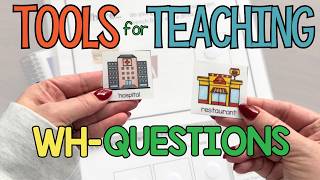
A special education teacher shares three strategies for teaching WH-questions to students of all ages. Start with where and who, the most concrete words. Use adaptive books with real photos and limited choices, then task cards paired with anchor charts for each question type to track progress and provide visual support.
Chapters
Targeting WH questions always seems like such a daunting task, but in reality it doesn't need to be. I want to share with you some of my favorite ways to target WH questions. The first thing I always do is take a really great inventory of where the student is. I want to know which WH question they understand, and if they have very little understanding of any of the WH words, I'm going to start with really basic WH words. So such as where and who. Those tend to be the most concrete out of all of the 5 WH words. So when I'm asking where and who, those are really simple to be able to target. Some of my favorite ways to be able to work on these skills with students is through adaptive books. I personally love these. They ask questions and then we have the community locations as an option. So, where do you go to get a cheeseburger, fries, and a drink? Students can choose restaurant. Now, all of these choices are available, and one of the things that I can do is limit the choices, right? I don't have to offer all of these choices. I could just give the student two choices. Which one? Where do you go when you want a cheeseburger? Now, notice we've got the visual images here, so I'm really helping kids connect the language to the question. This whole book is packed with locations like that. I love that they're real photos too because it really translates across grade levels. So I could use this with a student who is in kindergarten, I could use this with a life skills post-high school student, and it would still be appropriate. I also love these questions because really I'm looking at items and making a generalization. So I see these items. So where am I? Am I in the kitchen, the kids' room, or the office? Again, I can make this errorless. I could just provide the opportunity and I could have students just put that one item there, but I could also give them a field of two or even a field of three to be able to choose from. This really allows me to scaffold this one book into multiple opportunities for learners and really hone in on where they are and where they are able to answer these wh-questions. And I again love real photos, and we're using everyday items. I could even have the students label those items and then think about, where do I find those items? Hmm. And then I could be able to identify that. The third way I love to target wh-questions is by using task cards. I love task cards because I think they're so simple to be able to very quickly collect data, but also as students become more and more cohesive in a skill, it lets me figure out how fluent they are. So can they answer where questions with fluency? Are they able to very quickly identify? And these are again done with real photos or age-appropriate clip art. So I love that I can use this with any learner, and there are so many. Not only do we have this product for where questions, we have it for every single wh-question. This is the when pack, so you can get a feel. These are— oh, this is actually the why anchor chart, but this is the when anchor chart, and you can see that it matches the books just perfectly. So now my students are again using real photos, being able to identify, and we have so many task cards that go along with it. So again, really great way to be able to quickly see where students are within this skill. A simple way to be able to target a complex skill is an ultimate win in the classroom. Um, anything that makes my job easier as a special education teacher, but really does what's best for students, you know, that's a win. So I absolutely love, love, love these products, and I know that you will love them too.