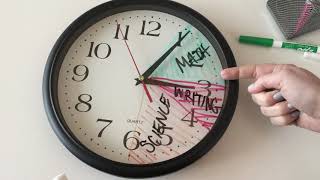
A dry-erase analog clock divided into colored segments teaches kids time management by showing how long each task takes. Color-code math, writing, and science assignments, or break a one-hour writing project into brainstorming, outlining, drafting, and editing phases so kids see exactly where they are in the day.
Chapters
Okay, I'm going to show how to use an analog clock to work on time management skills. So this is just kind of your classic school office analog clock I got on Amazon for $10, a little battery one. Um, but the plastic top is nice because you can draw on it with dry erase markers and it erases. So this isn't for the wall, this is like, this is a teaching tool. So let's say I have a child that has a few different assignments to do, maybe independent work, maybe it's homework, and it's 3 o'clock right now and at 3:30 we have to leave for baseball, or we have to leave to pack up to go home. So instead of just being like, hey, you have these 25 minutes, good luck getting all your work done, we're going to kind of have this clock work for us and illustrate exactly the amount of time we should be working on each activity. So the first thing this child has to do is math work, and it usually takes them about 10 minutes. So I am going to cut out 10 minutes and color this in right here. This is kind of a light color. I could do on another sheet like in green math, or I could even write on here math, or write over that with black if he can't see. So when we are in the green, that's when we're working on math work. When we get to the 3, we should be done with math and transitioning to our writing assignment. And this is a short one. It's only gonna take about 5 minutes. So we've got writing here. In the red. So when we get to the 3, we should be doing our writing. And then when we get to the 4, we've got 10 minutes left, which is perfect because that is my science assignment. So we're gonna take those last 10 minutes, color that in, and that is science. Oops. So this is a nice way to keep on track the whole time. If we're still working on math midway through here, we know we're running late and we're not gonna accomplish everything. So as that minute hand goes through each section, we can kind of track how long we should be working. So this one will erase really easily with In Tissue, don't even need anything on there. And let's do a project that isn't as discreet, not 3 different things. So something that we have to manage our time within one activity. So maybe it's a writing assignment. And we're gonna have 3 stages, we have to do brainstorming, We're gonna do outlining and then writing and then editing. We have 4 stages to do, so we have an hour to accomplish this task. So we have from 3:05 until 4:05. So let's break up our time. Let's spend the first 10 minutes— so I'm gonna do this same chunk, 10 minutes— and this is going to be brainstorm. Then after we brainstorm, we need to get our outline together. That's gonna take another 10 minutes to do our outline. So for some kids, you know, we sit there in the brainstorming section and we can spend the whole hour brainstorming. So we want to make sure that we're moving along on all of the parts of the assignment. So that's outline. So now we got the big chunk. We want to spend a good amount of time on our writing. So I'm gonna take from 3:25 all the way until 3:55, this whole half an hour. This is going to be writing. So I want to spend a good amount of chunk on writing. And if you had lighter colors, it'd be easier to show. You don't even necessarily have to color it in. And then we have my last 10 minutes for editing. So this is going to show as that minute hand goes, okay, right now I know I should be in brainstorming. When it's 3:20, I know I should be in outlining. When it's 3:45, I should be writing, and now I should be in editing. It's gonna show that whole process. So let's do one more example how we can do this for something like a morning routine at home. So we're gonna pretend it's not 3:05 because that doesn't quite work for the morning, but let's go through and let's pretend it's the morning and our first 5 minutes of the morning I'm not gonna color them in actually so we can see a little better. Our first 5 minutes of the morning, we need to do our bathroom activities. So that's brush teeth, wash face. So I'm gonna write bathroom. Our next 5 minutes are getting dressed. Our next 10 minutes are breakfast, and then let's schedule 5 minutes to pack up because we gotta schedule that. Already did orange, let's do some blue. Pack up. And I'm gonna even give a 5-minute buffer here because, you know, life happens. And then our last little section here is just a note that bus is coming at 40. So we have time for the bathroom, getting dressed, quick breakfast, pack up, and then kind of 5-minute leeway in case we're running late somewhere.