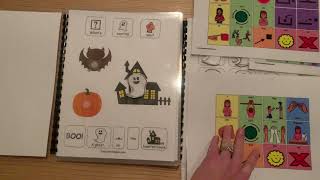
A tutorial on using three-tier core language boards with the adapted book "What's Scaring You." The presenter models scripts that teach turn-taking, labeling, and WH-questions by having learners place symbols like ghosts on pages. She covers prompting strategies and customization tips for different learner levels, stressing that flexibility and practice matter more than memorizing every symbol.
Chapters
Hi everyone, I wanted to show you how to use the different level boards, the core language boards that we developed with the adapted book by Sarah, What's Scaring You. I just want to show you different ways that you can use the different boards even on the same page. So depending on if you have different level groups or you're working on specific words, I'm going to show you how you can use these. So for example, um, with the low-cell board, meaning there are just not that many, as many symbols on here. There's 3 by 4, so there's 12 on here. What you can do is say, you know, go through the book, "What's scaring you? What's scaring you? Boo! A ghost on the haunted house! Okay, let's find our ghost. It's your turn." And then you can let them have a ghost and so on. And then say, you know, you turn the page and then you can say, "It's my turn, my turn to put the ghost on," if you want to model that way. So that's one way you can use this more, um, this lower cell board. "Is there a ghost on the haunted house?" "Yes." "Is it on the pumpkin?" "No, not on the pumpkin." So this is the low cell board. Next we have the mid board. So we have a little bit more array of some words on there. We have some prepositions over here, some So same thing. What's scaring you? Boo! A ghost on— see, and I even have sometimes trouble— on the haunted house. And then you're gonna put it on. Oh, I put it on the haunted house. On. And so on. And it's your turn. You can also do a little bit of requesting. You want to do more? And then we have the Hi-Cell board, which has 56 symbols on it. This is also great. I use this for young learners as well. It just depends on kind of what you're targeting. Um, but again, you know, the symbols, um, are— there's getting more of them. And there's some WH ones over here, which I really love because obviously we have what. So you can say, what's scaring you? What? What's scaring you? Boo! A ghost on the haunted house. Oh, he's on the haunted house. And then again, they can put it on the haunted house. Where is the ghost? He's on the haunted house. On the haunted house. So just keep going back and forth like that. Um, more. The book is all done. Um, is it on the pumpkin? Yes or no. Is it on the bat? Is it little, big? So on. You can do so much more with, um, a book like this. Uh-oh, it's on the haunted house. So just a little example of what you can do. And then obviously The objects change, which I love. If, you know, you have a learner who's just starting out, you can cover up the field, you can just do arrow lists where you're covering up and you're just giving them, or you're just showing them how to put it. Maybe you're doing full physical prompting at this time, but you can still emphasize these valuable core words: what, you. And obviously they're going to match on the board. So hope you try it out. Just get used to doing it and play around with it, and it'll become more fluent with you. But you obviously see that I also can't remember exactly right off the top of my head where every single symbol is, especially if children are using different devices. So just play around with it and it'll become more natural.