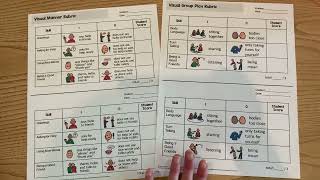
Gina from The Autism Helper shows how to use social-skill rubrics to observe and teach play behaviors in young learners. The rubrics come in picture and word versions, track behaviors like sharing, turn-taking, and greeting, and score actions as present or absent. They work across settings and can be customized for group play or circle time.
Chapters
Hi everyone, it's Gina from The Autism Helper. I am here to show you how I love to use the social skill rubrics by The Autism Helper. I think a lot of the times, um, when we talk about social skills and play skills, sometimes we don't really know exactly what it is we should be looking at. And you want to keep in mind age-appropriate type skills, but I love these that you can start with and you can modify if you want depending on your age level and where kids are starting, but it gives you a really great place to start. So, um, it comes with a bunch of them in the pack, but I just printed off these two to show with you. It's two-sided, so you can do two students at once on one page board, which I love, or you can cut it in half and just have one depending on how many kids you're looking at. Um, and I love this— this version has the pictures, which for me is super quick. Here's another one that has just words, but I love it with the little visuals on it because that cues me in for what I should be looking for as well. So here are just some ideas when a child maybe is in centers. Um, are Are they sitting together or during circle time, or are their bodies too close? Are they sharing by taking turns, or are they just taking toys from, from each other and running off with them? And are they listening, or do we see, you know, um, biting or pushing or snatching? Um, these can be your visual cues, and then you score it. So if, um, your kiddo is good at sitting on the carpet and sits next to someone, then you would give them a 1 and put it over here. If they're sharing, you could put a 1, or maybe it's a 0 and you put a 0 here. So again, you could even like cross off one of these and put in what you want to look for in your visual, uh, group play, or maybe like I said, circle time. And then the visual manner rubric, you know what they're looking at. So a lot of kiddos, maybe they're not yet greeting others, so that's something we want to work on. Um, asking for help— are they hand leading or are they pulling you over? Are they just throwing something to get your attention? So it may not be specifically rudely, but maybe they're doing it in a different way. And that'll affect your scoring. But this again just gives you a really good place to start, even with really little young, um, brand new learners to a daycare classroom or in school or maybe even at home. You can teach parents how to use these as well at home, and it just gives a really good starting point of what to be looking for for social skills.