Gina from The Autism Helper shows how to make visual supports for young children with autism using photos, Boardmaker, or PowerPoint. She demonstrates a point board for preferred foods, modular picture holders you can add or remove, and a Velcro board for the fridge. The key is personalizing visuals to the child, pairing them with spoken language, and keeping choices simple.
Chapters
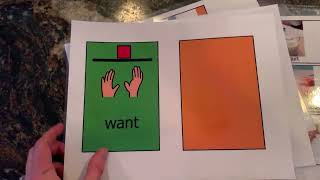
Hi everyone, it's Gina from The Autism Helper. I want to show you a couple different visual activities that I'm using for some families at home. You can easily reproduce these in Boardmaker, which is where I made these, or you can do them in PowerPoint using Google Images. Whatever program you have, it doesn't matter. You can also use real photos from the family, which I'll show you that as well. But here's a couple different options, and my whole point of this is I really want to stress that it is whatever is best for your student and your family. So, um, when you're first starting out with visuals with someone new, you're maybe not sure how they'll react with them, which will be— which way will be more engaging. So I do have a couple different options for two different families, and I just want to show them to you. The first one is, um, just a regular just point board. I don't know if this will be too overwhelming for this for this child. He's not quite 3, so this field may be too overwhelming. We have no idea yet, but it may not be. We might just pair it with some language. So for example, we know he loves peanut butter crackers. These are all preferred foods for him. And I was specific to ask if certain brands of things were important, or, you know, different kinds of fries or shapes or whatever. And for this student, as of now, it is not not. But we do know he loves peanut butter crackers, so I definitely put that on there. For example, so when it's time for snack time or a meal, mom can either cover it with Post-its, the ones that are not available, or just tell him no. Um, or she could pair it and just give him crackers and say peanut butter crackers to start with. Um, if this isn't a good fit for the student, I also cut them up and put them in these baseball card page holders. That way mom can take them in and out. They slide in and out of the back to show that that choice is not available. And maybe, maybe this is again is too many options, so mom might want to take out, you know, the, um, the cookie and the ice cream. Which one do you want? Or she might just want to take out one at a time, or she might want to take out the ones that are not available at this time for this student because he is very young. So these again are preferred foods for the student: baseball card holders, I think it was like 2.5 by 3 inches. I read, um, the front of the COVID and then made them accordingly in Boardmaker. Um, so you can either do point board, you can have them hand them over like you would do in like a PECS system, or you can, um, take out certain pictures. The other, um, rendition that I made was for another student for the refrigerator. So this will be posted on the refrigerator. I'll have some Velcro on here for this student. And I, um, we have actual pictures of the things that she prefers. So her actual iPad, her actual bottle, and then some just standard pictures of some foods that she enjoys. And the idea with her— again, we have not started with this yet, so I'm not sure which ones will be appropriate— is that we think we might try and have the options up on the refrigerator, and then she'll get to pull it down and put which one that she does want. Want pretzels. And I don't like to get into only just saying— be able to say want pretzels, want TV, want iPad. However, this is a good place to start to show a student um, you know, when they truly want something to eat, especially if food is reinforcing, or the iPad or bottle. Um, if this is too much, then this family can simply again present two options and let her point or put her hand on it, or bring out the two items, and when she chooses from the physical objects, say, "Yes, you wanted the yogurt," and so on. So lots of different ways. Um, these can be cut up or not cut up, it doesn't matter. It's really truly what is best for your kid. So I just wanted to show you a couple different visual ideas for at home and in school. And just remember, you do what's best for your child, and then you follow through with consistency and reinforcement when you're, um, using these visuals.