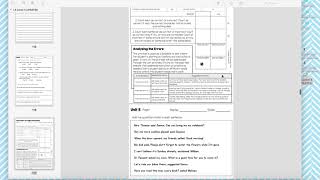
Sasha walks through the Level 4 Language Arts curriculum, which has nine thematic units aligned to state standards and Common Core. Each unit includes twenty activities, anchor charts, pre- and post-tests, and grading rubrics that track skill gaps. Units cover parts of speech, prefixes and suffixes, story elements, main idea, and three types of writing: narrative, opinion, and informative.
Chapters
Hi, this is Sasha from theautismhelper.com, and I want to give a really quick little video preview of Language Arts Level 4. So if you've checked out or utilized any of my other level daily curriculum, it's set up exactly the same, which makes it really consistent if you're using different levels with different students because it's just really easy to implement with the same structure. So here's the curriculum map. This also— the curriculum map makes it really easy to align to specific state standards, Common Core, IEP goals, etc., because Each unit is themed around 2 to 3 major concepts, so all the details are included here, the focus topics and then some kind of extension as well. And this is a great thing to hand into your administration or your principal to show what you're doing throughout the whole year. So there's 8 different units. Each unit includes an anchor chart, a pre and post test, a grading rubric, and 20 activities. And then there's a 9th review unit. So the units do build. There are some— so once you're in Unit 4, there might be some activities from Unit 1, 2, or 3, so we can make sure to kind of remember all of that. That. There's a few different data and grading sheets included. This one looks at the pre- and post-test dates. This is a unit data sheet, a whole class lesson plan, whole class weekly lesson plan. So a few little options. So I'm going to go through quickly, kind of briefly talk about the subjects and show a few of the activities to give you some idea of what's included content-wise in the Level 4. So Level 4 starts out with a review of parts of speech. Parts of speech, irregular past tense verbs, and possessive pronouns. So it kind of starts out a little grammar heavy, but we do go into a lot of different areas related to literacy in this level. So this one mostly focused on those grammar topics, kind of reviewing the parts of speech. A great thing for the start of the year. Parts of speech is a big focus of Level 3, so it's kind of nice to review it. So here's some, some examples of the level of the activities. Um, I like that it's really straightforward, super visual, etc. Unit 2 looks at prefixes and suffixes and literal and non-literal meanings. So for our older and higher students, we really want to be getting into that more complex language. So the literal and non-literal language is really key to target here, as that's a big focus of text that our kids are reading at this point. So some examples of some of the activities here and everything that's included in Unit 2. Unit 3 looks at story elements and 3 types of traditional literature. So this is a great place to kind of tie this into guided reading groups and really pull some more text into it. Here's the pre- and the post-test and the grading rubric. Each grading rubric specifically aligns to the pre-test— you'll score it— or to the post-test. And the greatest part of these rubrics for me is this analyzing the errors. So it will show you, based on the— that post-test score, what your student still needs to work on. So your data-based instruction is really really all included. So this has a lot of great things to identify story elements and folklore, fairy tales, myths, things like that. So some different examples here. Again, this level is a lot more text heavy as these students are ready for that. Um, Unit 4 looks at main idea and supporting detail and comparative and superlative adjectives and adverbs. So there's going to be a lot of text examples where we're pulling the main idea, pulling the details. So a lot of examples for students to work on that. The more practice, the better. The more opportunities we have to read short passages passages and pull out that main idea and those details, the better. So here's everything, um, that's included in that. Unit 5 is when we get into the writing. So the next 3 units are going to focus on different types of writing skills. This one looks at narrative writing. It also looks at character traits and quotation rules, which really tie in nicely with the narrative theme because these are things that we're going to be working on in narrative anyways. So with the rubric for these 3 writing, um, 3 writing units. The rubric is really, really awesome because based on the student's story that they write, there's like this little mini detailed rubric included, which I love. So it looks at everything that you need to include in the narrative, if they have it or not. So you'll be able to give a numerical value that's really objective to their writing and really see growth before and after you teach this whole unit. Um, so there's— it starts out kind of looking at narratives with graphic organizers and really structuring how to write it, really structuring how to set up problems, which is great, and then gets to more open-ended and having the student write more of it on their own. Um, the character traits activities are some of my favorite because it really looks at that inferencing and context clues skill as well. Unit 6 looks at opinion writing and cause and effect, so we have that embedded rubric here as well. And then the same thing, we're going to start off the opinion writing a little bit more structured, and as we go through the unit It's going to become more student-focused on writing more of the text themselves. So really scaffolds on that skill. The last one is informative writing as well as steps for research, which ties together really well. And that same mini rubric is included in this Unit 7 rubric. And again, we're going to build through teaching steps for researching, teaching how to utilize the internet and Google, and kind of the process for that is all in here. So that's Unit 7. And then the last unit, Unit 8, is making connections, looking at text-to-text, text-to-self, and text-to-world. So you'll be bringing in some of your students' favorite books here, and then point of view. So really building on some of these writing skills and reading skills to understand kind of why points of view are utilized. So here's some of the examples for text connections and point of view. So it's really building and getting into a lot more of these complex and higher-order thinking skills, which is great. A lot of our kids really need— Unit 9 is a comprehensive review of the previous 8 units. If you do this curriculum throughout the whole year, Unit 9 is great for summer school. It's great for the very end of the year. It's great to send home for homework throughout the summer. This is also a great one to start the following school year with to make sure you have that review of all of these concepts. So this was a very quick, um, little rundown of Language Arts Level Daily Curriculum Level 4. Again, really building into a lot of those more complex cognitive skills, but still in a really structured and straightforward way. Um, if you have any questions, please check out theautismhelper.com.