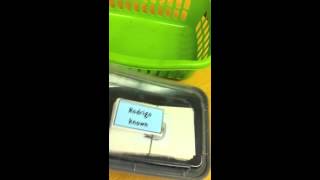
Sasha from theautismhelper.com shows how to set up a fluency station using timed flashcards in Tupperware containers and data binders. Students rotate between working with an aide on flashcards and independent binder tasks 2-3 times weekly, with content customized from sight words to math facts. She reports significant improvements in reading, math, and vocabulary.
Chapters
Hi, this is Sasha from theautismhelper.com, and this is a video tutorial of my fluency station. This is one of the stations that I wish I would have set up my first year teaching because it really is not that much time to set up, and once you get it going, it runs really smoothly with the help of a paraprofessional or an aide, and you get such great data from it. It really has— really helped me improve a lot of my kids' reading, math, and sight word vocabulary. So basically what the station is, is a flashcard— is a timed flashcard station. So I have— it's just pretty much takes up just this shelf here. Here's a data binder for each student and their flashcards. I'll go into more detail on exactly what the flashcards are, but I store them— each kid has a Tupperware with their name on it with their sets of flashcards. I was gonna buy note card holders, but honestly the Tupperwares work fine. So I have a Tupperware for each student with their flashcards, and then a data binder for each student. My students will run my stations in pairs, so obviously both kids can't be working on flashcards at the same time. So I made this visual. The kids sit at this station by the table, by the way, for when they work. I made this visual which shows I have binders today and then each student's name. So if they have a bind— if they have— if their name is on here, they do their binder, and if their name's not on here, they do flashcards with the aide. So that's kind of a good visual so they know what they're going to do at this station. So if they're not doing flashcards, they do their binder work. So I have a binder for each student with some independent writing work. So I have a nice visual on there. They're going to do one, one page from each section. There's 5 different sections with different work in each section. So they'll go through and they'll do this independently while the aide is working with the other student on flashcards. Um, I have a group of kids that go around one-on-one through my stations So they just do flashcards every day, and that kind of works because those kids need the extra practice anyways. So like I said, each student has a Tupperware with their flashcards in here. So each kid has a different set of flashcards depending on their instructional level. So this student has a set of kind of functional Chicago words, Dolch words, and addition. So every student set is a little bit different. So that's examples of his cards. He has Dolch words, money combinations, so they'll see this and say 40 cents, time to the minute, and addition. Um, I like to do a good combination of reading and math skills in here. We go through the Dolch sets until they master all of them, and then I do some functional words as well. So this student has kind of recipe words, so buffet, um, he has like teaspoon, toast, so common kitchen words. He has time, and another set of Dolch words as well. So it kind of just depends on each student. Um, those are for my higher kids. My other students do a little bit of a different set. So he has letters, numbers, and then I categorize his picture vocabulary by type. So he has food, kitchen items, and animals. I do this a little bit different for my other student. Um, this student seems to work better with categorizing, But for this student I've just done, who kind of has emerging vocal abilities, and this honestly went so well and has really improved his speaking, and he went through this whole set last year. I just did 2 takeout containers, one with unknown words and known words, and she worked on 5 new words until he mastered them, and then they went into his known set. So the unknown words were discrete trial, just practicing each one, and then the known set she did a fluency. So set the timer and went through the math— already mastered words to see if he'd get them as quickly as he can. And this super improved his speaking vocabulary. So that is for that student. So what the data looks like is each student has a data binder. And so when she sits down with them, she's going to get out their cards. So he has 4 different sets. And I made a kind of cheat sheet in the front that has each type of word when they started it and kind of what it looks like, because sometimes you'll get confused if things get wrong. So this one's written in pen, Dolch First Grade. Just so I know, and like maroon. I just give myself a little code so I know exactly which cards they are in case they get confused. The date started and their baseline fluency. So the data sheets initially look confusing, but they really do make sense. So this is gonna be to do several different types of flashcards on one page. So first, my age just kind of writes pen or clocks or just a quick note, but I can always refer back to my cheat sheet to be like, okay, pen words, our pen first grade is Dolch first grade words. So she writes each one: pen, money, clocks, and addition subtraction, how long she's doing a fluency for. So he's on 30 seconds for, for his Dolch words, 30 seconds for money, 1 minute for clocks, and 30 seconds for this. So she'll set her timer and go through the flashcards with him. So it's very easy to run. Once the timer goes off, she counts up how many correct and how many incorrect. And that's it. It's really not a lot of work for the aide to run, and it's really easy to train someone, which has been super awesome. So that's how that one is run. So she goes through each kid. Every kid gets it 2 to 3 times a week, because every other week they're doing their— every other day they're doing their binders or they're doing their flashcards. Again, we call this station language. This is something that I really wish I would have set up earlier, because I get so much great data on my kids, and it's run by an aide, and I really set it up, and it's ready to go. I update the data in my iPad every Friday so I know exactly what's going on with them. It's been a really awesome station that I, again, as I keep saying it, I highly recommend you setting up in your classroom because it really has gone so well and made such a difference for my kids. For more tips, resources, and materials, please come to theautismhelper.com.