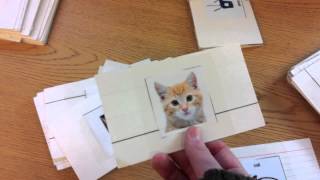
Sasha from theautismhelper.com shows how to teach skills that actually transfer to real life by using multiple versions of each target. Use four different examples of each item (colors, letters, coins) and require four correct responses on five consecutive days. Varied flashcards with different fonts, photos, and formats prevent kids from memorizing one specific picture instead of learning the concept.
Chapters
Hi, this is Sasha from theautismhelper.com, and this is a video tutorial on using multiple, multiple exemplars in discrete trial and fluency training. So I think it's super important when you're doing discrete trial or fluency that you're using multiple examples of each, of each target you're using. So for colors, for example, not just having all of your flashcard colors that look like this, but having ones that are are words written in that, you know, from the computer, and shapes, just a few different examples of each one. So children aren't responding only to this orange heart being orange, they're responding to all different examples of orange. In my discrete trial packet, I talk about mastery criteria, and I know this sometimes is a little bit confusing. What I like to do is I like to do 4 trials of each color correct, or whatever target you're using, 4 4 correct of each target correct on 5 consecutive days. So that would be getting blue correct, getting blue correct 4 times, getting yellow correct 4 times, getting orange correct 4 times. An easy way to kind of reduce the counting and the back and forth is just make that many examples, however many is your— in your mastery criteria. So if my mastery criteria is 4, I have 4 examples of blue, 4 examples of yellow, 4 examples of orange. So for each session, my pair only has to go through this deck one time. There's no counting back, how many examples of each should I get? There's there's an even number of each target, and there's multiple examples included. So that's a quick way to incorporate that into your discrete trial training. But even in my fluency instruction, I make sure to have multiple examples. So I have different types of faces of clocks. So they're not only responding to this certain type of clock, they're able to generalize this to other ones. Generalization is really why this is important. We don't want this skill to be only in a center or in school, we want this skill to be a life skill that they can use all the time. This is especially also, I keep saying especially, but it's really for everything, it's important, but I do a lot of picture identification with common vocabulary, animals, food, things in the classroom for my kids that have lower verbal abilities, and I make sure to include a lot of examples in here as well because these are, since these are words we want them to be saying in the environment, we wanna make sure that they're responding to a lot of different exemplars. So I like to double side my flashcards, it just saves less space, saves a little paper. So you can, I do like to do the same picture on either side so then we can just shuffle them up and they're not getting the same ones all the time. They're getting different examples, whether it's on this side or on this side, they're responding to fish in multiple ways. So then I'll mix it all up and they'll have different ones to respond to every day. So that's for fluency timing. And the same with food, like I like to have Sometimes I use the, you know, the Boardmaker pack picture and then an actual picture. So they're responding to multiple pictures and depictions of the same object. So here's all the different examples. And I even think this is important when working on letters. They're not only responding to computer-typed letters or letters written in pen. Generalization is hard for our kids. They need a lot of examples. So even with letters, using things in different colored markers and smaller size fonts written a little bit differently. You know, an R is still an R if it has a little loop like that, even if it doesn't connect. Those are both Rs. So making sure that you have a lot of examples, even with something as simple as letters, is so important. One more quick one is money, and I like to do the same thing that I talked about with colors. So for this target, this child does 5 of each coin, so I just made 5 flashcards of each coin, fronts and backs. A penny is not a penny just from the front, it's a penny from the back. And a dirty penny and a clean penny are both still a penny. So thinking of all those different types of money we see and making sure I'm including that in my flashcard set. So I have 5 penny, 5 dime, 5 nickel, 5 quarter. So I can just shuffle these up and go through one time, take data on each one, and I'm done. It's really quick, it's not a lot of— it's not time-consuming on figuring out which targets I haven't taken data on yet. So this was a video tutorial of the importance of multiple exemplars for discrete trial and fluency training by theautismhelper.com.