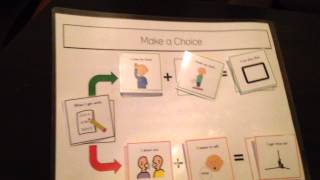
Sasha from TheAutismHelper.com shows how to build behavior contingency maps, visual tools that link student actions to consequences or rewards. The laminated system organizes over 60 behavior and reinforcer pieces into labeled pages. An example shows a good sequence (raising hand, completing work, earning iPad time) versus a bad one (shouting, swearing, timeout).
Chapters
Hi, this is Sasha from TheAutismHelper.com, and today I want to share a video tutorial of contingency behavior maps. Behavior maps are a great way to show in a concrete, in a concrete method exactly the consequences of an appropriate behavior and an inappropriate behavior. So it's going to clearly illustrate the choice that you have between the appropriate responses and the inappropriate responses and what those behaviors will result in. In my set, I have some pre-made ones for common classroom scenarios, but I love this interactive one. Our classroom situations change quickly, reinforcers aren't always available, so I like to have one that I can individualize to exactly the situation and the student who needs it. I also want to share the storage system. I like storing the pieces in categories on this storage page. It makes it really easy to find the piece you're looking for, and it avoids that big baggie of pieces that you have to dig through. So I laminated this store— the storage pages on double-sided, and each section has the category name, so situation pieces, good behavior pieces, consequence pieces, and bad behavior pieces. So I'll set up my behavior board pretty quickly. I can say, "When I get work, I raise my hand, I finish my work, and when I do that, I can earn iPad." My bad behaviors could be, "I shout out, I swear or yell," and the bad behaviors will result in timeout. So I can quickly develop the behavior map for exactly the scenario that I'm dealing with. Um, there's over 60 options for behaviors and reinforcers in my set, so these aren't the only ones, but I like just keeping a few options of the common ones used so you're not overwhelmed. This storage system works really well. Like I said, having that big baggie of pieces, you'll be digging through looking for the ones you need, and of course it'll be hard to find. So this system works really well. You can store it in an easy part of your classroom. The behavior map is great. You can go over it before the situation, at the start of the day, as it's going. It's great to post these in a central part of the classroom or put it near the student desk so you can remind them of what hap— what will happen if they make the good choice or the bad choice. So this is great for kids with special needs or early— or students in early elementary to show with the visuals in a concrete way exactly what will happen when they engage in the appropriate behaviors or the inappropriate behaviors. If you need more information, please visit my website, theautismhelper.com. Then again, this is a video tutorial of behavior contingency maps.