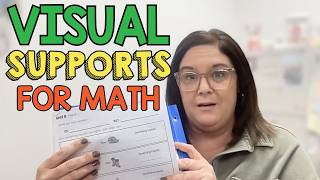
Amanda, a special education teacher with 20 years of experience, built a laminated folder system with visual math supports—multiplication charts, fraction circles, operation clue-words—that lets students work independently while she manages the classroom. The folder holds daily worksheets from the Autism Helpers curriculum with pre-tests, post-tests, and matching anchor charts for each unit.
Chapters
What if I told you that math doesn't have to feel overwhelming? Not for the students or the teacher, in fact. Math time used to be one of the most stressful times of my days. I was trying to figure out how to individualize different learning levels, how to provide support to all of my students during independent work time. I'm Amanda. I've been a middle school transition teacher for over 20 years, and And today I'm going to share with you some of the different visuals and organizers that I use within my classroom to provide support for all different levels of learners. I'm going to show you an easy way to organize these different supports as well to help build independence for all students within your classroom. This folder right here, it changes everything. Inside of this folder are the visual math tools my middle school students use every single day during math class to not only stay organized and understand their concepts faster and even work more independently. I'm going to show you exactly what's inside of this math folder and how we use it in class and why it's such a game changer for math success. Let's take a look. Inside this folder are laminated visual supports that my students can use every single day, no matter what their learning level is, because my assistant and I cannot be right next to every student every single moment. These tools help them stay independent. They help them stay on task, even when we can't be right next to them giving them that one-on-one attention. So first, we have a multiplication chart. I also have a hundreds chart. These are great for students that are building fact fluency, need a quick visual reminder without feeling stuck. The next tool in the folder is something I like to call Operation Clue Words. These we use for word problems. This helps students that might feel stuck when they get to a key word. Even if they're a non-reader, they can match the word. That's what I always talk about, matching that word. You could even use visuals instead of the words if you have a student that is a lower-level reader. They can choose those with confidence. We also include Fraction Circles in the folder, and they're perfect for students that need more concrete and more visual help. If they would get to a problem that would involve fractions. And finally, the last tool that we use is a place value chart. This supports everything from basic number sense to multi-digit operations. And all of these tools are laminated so students can easily write on them. They can erase throughout the lesson if they're using a dry erase marker as well. It allows students who are at different levels just to access the same math content and give them just the correct level of support. On the other side of our math folder, I have attached a calculator just with simple Velcro. It's just a simple 4-function calculator that I allow students to have access to. I feel like it promotes independence and life skills for middle school students. Using a calculator is just something they need in their everyday life. Inside this side, I also include students' independent work, which is the Autism Helpers math curriculum for each day. This is their independent work as well as things they might need one-on-one attention with. Every, every lesson is individualized to meet their needs and just the different level they're on. They provide a pretest, a post-test, different rubrics, practice worksheets. It's just a wonderful component to my math classroom. I also include the anchor charts that go along with each lesson, each level they're on. So for example, this is Unit 4, 4, and it just gives tips and tricks and different prompts that students may need that don't include adult prompting at that time. With this setup, students can access the tools they need. They can work at their own level, their own pace. It builds confidence and independence. I can manage the classroom from student to student, just providing multiple levels in providing individual instruction as well as independent work time for all students. This makes our math class a little bit more bearable.