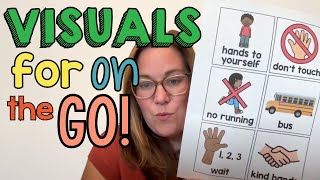
Jen, a K-12 autism teacher, shows how portable visual cue necklaces help staff stay consistent while moving around campus. The necklaces include general prompts like "walk" and "be quiet," regulation cues for transitions, and crisis cards for quick communication without drawing attention. Color-coding and flags make the right cue easy to find fast.
Chapters
If you find that you're having a hard time using visuals and staying consistent using visuals because you are all over the place and moving all over campus as a teacher, you are not alone. I am Jen and I am a K-12 self-contained autism teacher, and I'm telling you, in my world, self-contained means that I am all over campus. Wherever my students are is where I am, and even though most academics are done in my classroom, that doesn't mean that my students just stay in my classroom. They are wherever is deemed least restrictive. So if they can join music, they join music. If they can join art, they join art. If they can join lunch and recess, they go to lunch and recess. And even if they can't go with the general education population, they need all of those things anyway. So we are all over the campus all of the time. So if you've ever seen me in other videos with my lanyard on, You probably see that I have this big necklace ring on, and I'm gonna tell you why today. These are my traveling visuals. Not only do I have these, but everyone on staff with me has these visuals. Let me tell you why. I think that my job as a teacher is busy. I think back to when I was an assistant or a paraprofessional. In my district, we call them assistants. And I think about how many steps I took as an assistant, and I'm gonna tell you them, I moved so much more, and I cannot even imagine that now as a teacher. Paraprofessionals, you have my utmost respect. Our world could not happen without you, so kudos to you. But I just think about how often I was pushed into a general education classroom, or I was there to support a student, and I wanted to be able to cue that student in a way that did not bring attention to that student. Enter visual cues. Visuals, we know they're worth a thousand words. If I'm going to use my voice, everyone notices. If I give a visual prompt, not everybody notices. It can be private, it can be between just myself and a student if they're right next to me, but also I can cue a whole classroom if I need to on what I need them to be doing. So Visuals are huge. We know this as educators, but the problem came up when we were roaming the school. How do we stay consistent? Do we put visuals in every classroom? Sure, that works sometimes, but sometimes we end up in unexpected places. Maybe we are going on a walking field trip. That's something that my district does a lot. We've got trails and parents sign permission forms and we can go, and sometimes it happens quickly and we don't even know. And so we need to be able to walk, and we need to be able to go, and I need to have visuals on the go. And so these visual necklaces have been huge in my classroom. Not only did I make them just for myself, I made one for every member of my team, but I actually made one when we did a behavior training, um, that I worked on for every single paraprofessional that came. And it is so cool to see everybody walk around with these on and use them. And so we had training on how to use them. But as great as these are, Autism Helper came out with brand new ones. There are two sets and they are better than ever. Set is just an update to the original set that I have on my lanyard. I think you saw this was the original set. All they did is go in and update clip art and fonts and just make it a little bit more relevant for our students. And these are fantastic. I use them every single day. Things from walk, cover your mouth, be quiet. They're fantastic. Love them. Next though, we have a second set. And I find this one to be just as useful. If you've got a student who you work on regulating in the classroom, or maybe they're in the gen ed classroom and they need cues for regulation, This is fantastic. So we've got things like take a breath, or reminders of we have 5 minutes, 3 minutes, 1 minute, a reminder for some personal space, cues of great work. I think that's so important. Sometimes our students are looking for us, like, for that reassurance that they're doing the right thing. We can give them a cue that they are. Um, and sometimes social things in the classroom are just difficult. They have a hard time knowing, is it time to line up? Is it time to stand in line? Hey, Bathroom cues. So if we are supervising in the bathroom, we don't have to be calling that student out. We can just give a visual prompt. I love this one, schedule change. Oh my goodness, let's just talk about how a schedule change can just like, rue the world, right? So schedule change is so important. And then use your words. There's actually two. You can see this one is an AAC device and this one is for a verbal student. Cues for like, we have 1 more, 2 more, 3 more, or we're all done. I love that. And calm body. Love all of these. These are going to be so helpful. One tip that I have for you is when you prep these, you don't have to put every single one on a keyring. If you are not going to use turn it in, don't put it on your keyring. And in fact, when you find ones that are really, really useful that you know that you're going to use all the time, You might even color them or outline them in like a red or a green Sharpie so you know, or some people on my team put little Post-it flags right there so they know instantly where to turn so they can get there quickly. If you are a teacher and you find yourself managing behavior crises or trying to stop behavior crises before they happen, I think we are all there. Sometimes we need to cue other adults. Who are probably trying to help that might be making the situation worse, or you need to quickly communicate to other adults what you need, but you need to stay focused on the student. Autism Helper came out with these behavior crisis visual cards so you can cue other adults things like, "Get help," "Please don't talk to the student," or like, "Hey, I've got this, please just go." Like, "I know that it might look like a hot mess, but I promise." I got this. Um, or, hey, I need to swap out, I need a break, don't touch them, I need a crisis team. My favorite, no eye contact. Sometimes eye contact is like, you know, uh, just an invitation to a, um, power struggle, and nobody needs that. And so we have that one on there. But exit and clear the room, that one's super important. So you can just have people go Please stay close if you need somebody to stay close. Or I love these: hey, we're planned ignoring. Or hey, this student's looking hot, can I get some water please? That's gonna, that's gonna help. I need to make sure that their needs are met while they're in crisis. Or hey, let's back up and give them some space. Us crowding around them and getting in their face is not helping. Let's back up and give them some space. Or hey, I need to tap out, or I need to swap, please. Please. This would be huge in the classroom to be able to help communicate better with your staff and then staff around you. Again, everybody has best intentions, it's just sometimes we need to give directions so we can make sure that everybody's doing what's best for the student and they can follow that behavior plan. Because the staff walking by probably doesn't know the behavior plan and they just want help. So now you can guide your staff, which I think this is the coolest thing. I have come out at a better time because the Autism Helper always has great things to prep in the summer, and they're always saving me time. And this is something that I really wanted to continue to use in my classroom, and I think is going to set my paras and my assistants and the staff that I work with and the fellow teachers that I work with that we push into their classrooms— it's going to help set them up for success. And that's what I want for my students. I always want them to succeed. So I'm super excited about these, and I think that they are worth your time in precious summer, because I know how precious summer is and how precious your time is. It is worth the time to take and to prep and then figure out what you're going to use and share that with your team.










