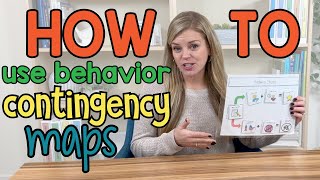
Sasha Long, a board-certified behavior analyst, explains behavior contingency maps, a visual tool showing how antecedents, behaviors, and consequences connect. She walks through two classroom examples: moving choice time from escape behaviors to work completion, and shifting attention from shouting out to raising a hand. The maps help students see why positive behaviors lead to better outcomes.
Chapters
Behavior contingency maps are basically a visual representation of a behavior plan. These are a great addition to your toolbox to help explain to students the different consequences between positive and negative behaviors. I'm Sasha Long. I'm a former special education teacher and board-certified behavior analyst, and I am passionate about bringing positive behavior strategies to your classroom or to your home. So let's talk about behavior contingency maps. These are an evidence-based practice that follows the 3-term contingency in the ABA world, meaning it has the antecedent, the the behavior and the consequence. What I love about a behavior contingency map is that it's going to show the different consequence between the positive behaviors and the negative behaviors. This is a great way to visually explain a behavior plan to a child. I also use this quite a bit when showing unintended social consequences with some of my older learners. I actually have a template of this that's just blank that I write in on and talk about like, hey, if you engage in these behaviors, there could be people that laugh at you, or there could be people that don't want to be around you. So, for some of our teens that are struggling with those unintended social consequences, this is also a great tool to do. The really key to setting up a successful behavior contingency map is making sure that you get the consequences correct. So, let's take a look at how to set up a behavior contingency map and what types of consequences to use.
So, let's go through an example to show how the consequences are really important when setting up behavior contingency maps and how we want to ensure that the reinforcers for the inappropriate behavior are now the reinforcers for the appropriate behavior. So here in this scenario, the student commonly had challenges when doing their work, and of course we want to use a lot of proactive antecedent-based interventions in addition to this strategy. So here's the common antecedent: we have work to do, and the negative choices are, "I run away" and "I stop doing my work." Now, what was originally happening when this student did this running away and stopping doing the work was they would go to choice time. So they would get to run away from their task, stop doing their work, and go to the break area and get to play with the items in the break area. So they would get choice time. Well, we're going to change this. So we are going to move this consequence over to the positive behaviors. So when I work hard and I keep working, I get choice time. So now that choice time, the going to the break area and playing with the toys, is going to result from doing your work and keeping working. Now let's think about what consequence to add for the negative behaviors, because remember, we're changing this contingency and we're going to starve the negative behavior to make it not as effective as the positive replacement behavior. So, "I run away and I stop doing my work" means I need to finish my work by myself. So the learner is not going to get their choice time, they're going to have to finish their work by themselves. Choice time will come as a result of working hard and continuously working. Again, with escape behaviors, there's a lot more that goes on into this, and there's a lot of other strategies we want to use as well. But this shows that we want to really shift and think about what consequence was previously for that inappropriate behavior and how we can let our kids still get access to that same consequence by using those positive behaviors. Here's another example of how to use the behavior contingency map for a less disruptive behavior, something that's common in many classrooms: shouting out instead of raising your hand. Of course, this behavior is not dangerous. It is not something that we that we would necessarily need an intense behavior plan for, but it is something that we wanna teach our learners how to do and how to raise your hand and wait your turn. So let's look at this behavior map and how it was previously set up before we started Starve It and Replace It. So first we have the antecedent as during class, and when the student would shout out and talk out of turn, they have a turn to share. So when they do that, they have a turn to share. Everybody listens to them, they get to talk, they get attention, right? So our positive replacement behavior here is I wait, raise my hand, and I wait my turn. What we want the consequence for the replacement behaviors to be is the same consequence that was previously for the inappropriate behavior. So I like doing this kind of visual activity with, with teachers and with groups because we want to literally move that consequence over to the replacement behavior. So now I raise my hand, I wait for my turn, I'll have my turn to share. Now we need to select a consequence for the inappropriate behavior, for the shouting out. And when we think about how to starve it, how to remove what was previously working, we're gonna say here, "I will not have a turn to share." So there will not be a turn to share when I shout out, but there will be a turn to share when I raise my hand and I wait my turn.
Now remember, behavior contingency maps are just one tool in your toolbox. This is not a comprehensive behavior plan, but this is one way to really illustrate the contingency to your students. And that's a piece that we often forget about. We set up a whole behavior plan and we don't tell our kids. We want to make sure to explain behavior plans and behavior strategies that we're using in an accessible and understandable way. This is for a lot of students because it's visual, it's simple, it's color-coded, and it can be a great way for our students to understand what is going on. I'm Sasha Long. I'm the founder and president of The Autism Helper. Please click follow on our YouTube channel for more behavior strategies.