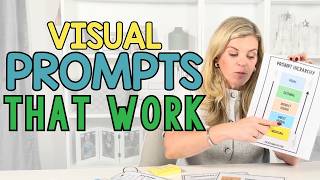
In this instructional video, former special education teacher and board‑certified behavior analyst Sasha Long explains why visual prompts are a powerful tool for fostering student independence. She introduces the prompt hierarchy, describing how prompts range from highly invasive adult‑directed cues to minimally invasive visual cues that students can use autonomously. The central goal is prompt fading—gradually reducing adult involvement so that the learner “loses the job” of prompting for each skill. Visual prompts sit at the top of the hierarchy because they can be self‑administered; once taught, students rely on pictures, text, schedules, or other visual cues without adult assistance. Long illustrates this with everyday examples (e.g., a Dyson hand dryer) and classroom applications such as visual schedules, break cards, coping strategy cards, choice boards, and staff schedules. She emphasizes moving from direct verbal prompts to indirect verbal, gestural, and finally pure visual prompts, highlighting how this progression builds independence across academic tasks, transitions, and even staff coordination. The video concludes with a call for viewers to share their own visual prompt strategies and to follow for more classroom‑focused behavior‑analytic techniques.
Chapters
Visual prompts are the key tool to building independence. I'm Sasha Long, I'm a former board cert— Visual prompts are the must-have key strategy for building independence. I'm Sasha Long, I'm a former special education teacher and board certified behavior analyst, and today we're going to break down why visual prompts actually work and how do you want to be using them. Now, visual prompts aren't new to any of us. We use visual prompts constantly in our classrooms and in our homes, but let's break down why these are really so effective. And it all comes down to the prompt hierarchy. So on the prompt hierarchy, at the bottom of our kind of hierarchy here, we have the most invasive prompts. By invasive, I mean adult involved. I'm the most involved in these prompts. These allow for the least amount of student independence, but they're gonna give the most amount of support. So when we're learning a new skill, when we don't have a lot of practice in something, these types of prompts are great. Our goal is to move up the prompt hierarchy. As we go up the prompt hierarchy, we're gonna be using prompts that are less invasive, we're less involved, and students are giving more independence. Our goal with every skill we teach is to lose our jobs. Your job is to lose your job. It's a terrifying phrase, but don't worry, it's not really gonna happen. Your job is to lose your job in that interaction. In that skill. I want you to lose your job in telling Johnny to flush the toilet after he goes potty. I want you to lose your job in helping Johnny take off his jacket when he gets to school. I want you to lose your job in reminding Sarah that she has to pack up her materials before she switches classes. Our goal is that our kids are doing those things by themselves, that they no longer need us. Prompt fading and visual prompts is the key way to get there. We want to build independence. This happens on purpose, not on accident. Now visual prompts are always at the top of the prompt hierarchy for me because they allow for the highest level of student independence. Why? Because students do not need us to use a visual prompt. They can use that tool all by themselves. We might start off using the visual prompt with them, teaching it, but eventually they're gonna be using it by themselves. The example I always give in trainings is, have you ever seen those Dyson hand dryers where you put your hands in like this? Do you know what I'm talking about? They're often in gas stations or airports or things like that. Now, the first time you saw one of those hand dryers, was there a Dyson rep standing right next to it that helped you learn how to use that hand dryer? No, that would've been super weird. You used a visual prompt. There's a little picture right on the top of that hand dryer that you used all by yourself and you figured out how to work that hand dryer. Love that. Visual prompt was successful in making us independent. So that's why we wanna lean on visual prompts in our classrooms because we can pull ourselves away and have students transitioning between centers, asking for help, communicating things, dealing with transitions all on their own. Now, when I say visual, people right away think about a picture. They think about Boardmaker, they think about a clipart image. But visual prompts can be so many things. Visual prompts can be something with a picture. It can also be something with a text. Text is a visual prompt. This schedule is a visual prompt. I no longer have to tell Neil, "Hey, you just finished table time, go take a break," or, "You're done with math, go to your math binders." He doesn't have to look for me to know what he's doing next. He looks to his schedule to tell him. So it's going to build independence. So this is a visual prompt. Something like this is a visual prompt. All of these tools can be used without us. I can put this in the technology area, and when Johnny needs help logging in, instead of me trying to prompt that communication like, "What should you say? What should you do?" he can grab this and ask for help on his own without my help. That's the goal here is independence. And we can do this in all areas, areas of our classroom. Something like this is also a visual prompt. This is a schedule for me and my staff members in the classroom. It shows what we're doing throughout the whole day. I'm running a morning meeting, I'm doing language arts, one of my paras is doing fluency. I have what everyone's doing. This is for my team. I'm giving my team a visual prompt because I don't want every 15 minutes, every half hour, me to verbally tell them what to do. That's not a lot of independence for my colleagues. I want them to do these things on their own, so I'm giving them a visual prompt because remember, it can be used on their own. So in your classroom, default or have the end goal be to end at a visual prompt. The things you're already doing are getting you in that direction. Visual schedules, break cards, coping strategy, choice boards, all of these things build independence, and what you need to focus on then is pulling yourself away, moving from direct verbal prompts to indirect verbal to gestural where you're just pointing at the visual, to then letting that visual do its work without you. I would love to hear what visual prompts you're using in your classroom, in your home setting. Drop me a comment below and give us a follow for more strategies that are game changers in your classroom.