1:28
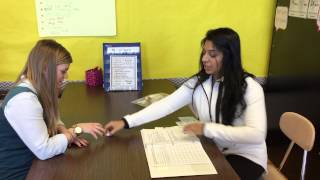
Amber and Sasha teach a student to answer yes/no questions about pictures instead of just labeling them. They use prompt cards showing the correct answer and track right and wrong responses on a data sheet to monitor progress.
Amber and Sasha teach a student to answer yes/no questions about pictures instead of just labeling them. They use prompt cards showing the correct answer and track right and wrong responses on a data sheet to monitor progress.
Hi, my name is Amber and this is Sasha, and I'm here talking to you today about an expressive vocab identification program that we created for a student who is unable to answer questions with yes or no. So we first started with 3 sets. We first start with Set 1, which is previously mastered items. So these are items that are already in his vocabulary and that he can differentiate. We started with showing the item and asking him, "Is this chicken?" And he was supposed to answer yes or no, reflecting if it actually is chicken. We ran into a problem where he would just answer "chicken" instead of saying yes or no, or just answering no for everything, which wasn't necessarily reflecting if it actually was chicken. So what we decided to implement was yes/no cards. So as we show the item, we'll show the correct response, and which will prompt him to respond correctly. So we will show you how this program works. Is this apple?
Yes.
Good job. Is this apple?
No.
Good job. Is this an elephant? No. Good job.
Is this an elephant?
Yes.
Good job.
So for each correct response, we'll put yes for correct, we'll put a tally for correct on our data sheet, and if it was an incorrect, we'll put a no. So an incorrect would look like saying no if the item was actually what it was, for example, or for saying what the item is that's pictured instead of saying yes or no.
So I think the next step on this program is fading these yes/no cards because we want the child to be responding to the question of, "Is this an elephant?" And this is a really functional skill, thinking about if you're in the community and saying, "Is that dangerous?" or "Is that your mom?" or "Is this your house?" Those are questions that you really need to know how to answer. So the next step after they're successful with these yes/no cards, I I think the next step that we're going to go to with fading is even having them just out and pointing to the correct one, and then fading that even more, just fading from afar, and then getting to the point where we can just have the cards present but the student can be answering on his own. So I think that'll be a great way to eventually have the student answering this on his own. Once we're done and mastered the previously known vocabulary words on its own, we're going to move to colors and people to really show that the skill is generalized to other skill sets as opposed to only these types of flashcards. And after that would be generalization into the classroom, into the community, and into the school setting. So again, this was a video tutorial of a yes/no expressive language program from theautismhelper.com.










