Paul Sloane explains open innovation and crowdsourcing, from Henry Chesbrough's framework to real examples like P&G Connect & Develop and Innocentive. He maps four types of crowdsourcing by audience size and instruction level, then gives ten practical tips for running these initiatives successfully, from goal setting to legal arrangements.
Chapters
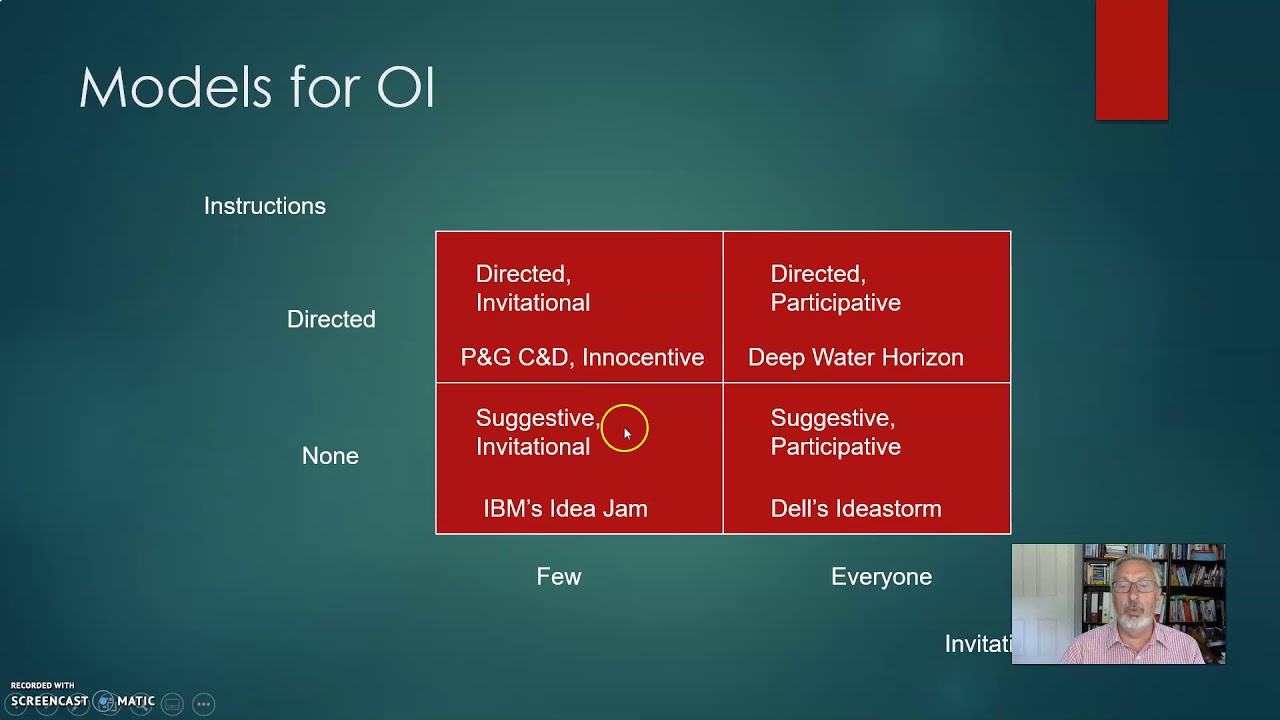
So this lecture concerns open innovation and crowdsourcing, 2 big waves which have rolled into the world of innovation in the past few years, and now they've become very much a thing which large companies use and smaller companies can benefit from. So what we're going to do in this particular lecture is we're going to look at what is open innovation and what is crowdsourcing, I'll give you some examples and give you some best practices, give you a way of looking at analyzing different approaches, and in the next lecture, well, I'll actually demonstrate some websites that show good practice in open innovation and crowdsourcing. Open innovation is a phrase coined by Henry Chesbrough in his book in 2006 on open innovation, and he was the leading thinker behind this. He's an academic from America, and in it he talks about open innovation strategies. So we have ideas coming into the funnel from an internal technology base and externally, and then some of those ideas we can develop and take to market, some we might want to spin off and give to other firms or into new markets. And it's this process of trading innovations, of bringing ideas in from outside and giving away some of your ideas to the outside, which is so powerful in open innovation. Open innovation is all about harnessing the power of collaboration with external agencies. Who's using open innovation? Most of the big fast-moving consumer goods companies have been leaders in this, people like Procter Gamble, Unilever, Kraft Foods, Reckitt Benckiser, Kimberly-Clark, Johnson Johnson, but also leading electronics companies like Samsung, Sony, LG Electronics, computer companies, IBM, and so on. Most major companies are using open innovation to some extent or other now. So this is a model for open innovation developed by Geoffrey Phillips, and he divides it into 4 quadrants. So if you give instructions to— you can give instructions either to everyone, a large number, you want anyone to contribute, or just specialized people, people with particular skills. And you can either give very specific instructions, so you direct people as to exactly what you want, or you can give none. You can say, just give us your ideas. And these are then the 4 quadrants depending upon how detailed your instructions are and what audience you invite. So you can invite everyone or very few. And he calls these directed invitational for a few, directed participative if you let anyone participate, suggestive invitational where you just suggest some ideas but don't direct people, or suggestive participative where you say we want ideas to help and anyone can submit them. And he gives some examples of these. So Procter Gamble Connect and Develop and Innocentive, and we'll look at both of these in the next lecture, use directed invitational. So they're very concrete as to what they're looking for, what their wants are, and they only want people with particular skills or patents or intellectual property to work with. Directed participative, when BP had the Deepwater Horizon disaster, they said we want specific ideas for containing this leak, but they threw it open to anybody. And the trouble with throwing it open to anybody being over here in these 2 sectors is that you can get swamped with many, many thousands of ideas. It's very difficult to resource and control. Dell's idea storm, when they started, they threw it open to everyone and they were swamped with ideas here in a sort of crowdsourced suggestion scheme. IBM's IdeaJam, they have no instructions, and in fact, where it says few, they actually invite a lot of people, but they're specialized people. They're people with programming skills or technical skills or software skills or something else for a particular IdeaJam. So those are the 4 quadrants, and each of those has its strengths and weaknesses. Over here, you can control things. You can focus much better. These tend to work very well if you know exactly what you want. These are good if you want any kind of idea and you don't know what the ideal solutions might look like. Crowdsourcing examples, I'll give some later. Naming Force is a very good one where you can get the crowd to come up with a name for your new product or service or company. Threadless is a brilliant example, a US t-shirt company which outsources the design for its t-shirts and then gets a community of people to select the best ideas. It makes those, and guess what? They sell very well because the crowd has— you get the wisdom of the crowd in selecting what's going to be a winner. The X Factor, or Britain's Got Talent, US's Got Talent, America's Got Talent, is a crowdsourcing type of event where you get the crowd to provide the entertainment And ultimately the crowd selects by voting as to which are the best acts. Innocentive is a very powerful technical and engineering scientific site for very specific problems with quite big rewards. And TopCoder is just for coding problems. If you're developing a website or an app and you get stuck, you don't know how to solve a particular coding problem, you can throw that out and some guy sitting in Shanghai or Bucharest or Buenos Aires will write a few lines of code and say, thank you very much, give me the money. But you're happy because it's overcome your roadblock. And there are many crowdfunding sites— Kickstarter, Crowdcube, all sorts of others here— and we'll look at Crowdcube in the next example. So crowdsourcing has come a long way and there are many good examples of it. If you know what you want, then it helps. So 10 tips for success with your open innovation if you are going to open up and invite companies from outside, especially smaller companies, to innovate with you and to help bring innovations to market. You should define what you want to achieve, what's the purpose of your open innovation. Lafley, the CEO of Procter Gamble, famously said he wanted 50% of their new product innovations to come from outside the company and they achieved that. So instead of developing everything inside in their R&D departments, they deliberately looked outside in order to get a much wider catchment of ideas. You should set goals and metrics, even if it's difficult to start with, number of ideas that you want to implement, number of partnerships that you can manage, what resources you're prepared to put in on your side, and it does take considerable resource on your side to do it properly. And then start by measuring your level of openness. How open are you? And you might be surprised, many organizations are quite closed, they've got barriers to the outside, they're secretive, they guard what they have and they see people on the outside as the enemy or troublemakers or people that are complaining and difficult to deal with. So they're not, you are not necessarily as open as you might think and a good thing to do is to audit how open you are right now because if you have a high degree of introversion and dislike for outsiders, it's going to be very hard to succeed with open innovation. Define the challenge, set a challenge, a specific challenge that you want solved. We want ideas in these particular areas that would look generally like this. Choose your method, what are you going to use, crowdsourcing, are you going to use open innovation, are you going to invite a handful of people with specific skills or throw it open to lots and lots of people? How specific are you going to be about the nature of solution that you're looking for? Highly specific or very broad? Design your portal, so design the website which should be very easy to navigate and very clear and if you look at Procter Gamble Connect and Develop or the Unilever Open Innovation sites, I think they're good models to work from in terms of clarity. And think win-win. It's not about you exploiting people and getting one over on small companies who don't realize what a great invention they've got. It's about making somebody else rich. It's about taking a small company, and with your marketing and clout and development, you make them rich and they make you richer as well. So you're thinking win-win. It's not a zero-sum game, this, at all. If it works well, It's got to work well for both partners fairly. And put the right people on the case. You need senior people, you need people with the clout to overcome internal roadblocks and political objections and departments that block. You'll need a good legal agreement, and you have to be flexible. You might want to license somebody's technology, you might want to buy it outright, you might want to have some joint ownership agreement. Who owns the IP? These things need to be established early on, so by all means get hold of somebody else's legal agreements and copy some of their best ideas and terms, but you need a good legal agreement that's fair to both sides. And maintain high-level involvement, so the CEO might set the whole thing off, delegate it to the head of research and development or some other major executive, but he or she should maintain high-level involvement to see how the thing is going, and to see what's blocking it, what's stopping it from succeeding, because sooner or later the senior executive is going to have to step in to help make the whole thing move forward. So those are 10 tips for success with open innovation, and here are some questions for you which I'd like you to ponder on, and this goes back to how open are you. How many ideas from outside the organization did you implement last year? So, and I'm looking not just for little tiny things like open later on Tuesdays, I'm looking for bigger ideas. And are you receptive to ideas? And the acid test is, are you implementing ideas from outside, not just listening? Could someone with a great idea for your company easily reach the right person? If somebody sitting in Romania or Brazil or Iceland thought of a great idea for your organization, how would they get through to the right person? And this might be a lot more difficult than you think because there are all sorts of barriers and a lot of companies say send us an email and then you never hear anything again. It's happened to me on several occasions when I've emailed companies and never heard anything again. And thirdly, are you currently actively looking outside for ideas? Are you sending people to conferences? Are you trawling the internet? Do you have scouts, technology scouts looking for ideas outside. So these are good questions to ask to assess your level of openness today. This is a book I would recommend, A Guide to Open Innovation and Crowdsourcing, edited by me, Paul Sloane, and I crowdsourced it. I got a lot of experts to contribute chapters, experts from many different companies and consultants, experts in the field. So highly recommended and very good detailed case studies in there. To help you understand open innovation and crowdsourcing. So that completes the lecture, but in the next lecture I will show you some of those sites that we talked about and we'll actually browse the web and look at how they do it. So I look forward to seeing you in the next lecture.
More from Paul








What is different about your business? #lateralthinking #marketing #leadership

Two important questions for CEOs and Marketing Chiefs. #1 Why do people buy our products?

Questions leaders should ask to assess the level of #innovation in their business. #leadership
